The Future Of Mass Transit – Part I

05/1/07  Print This Post Print This Post    4 Comments   Popular   Written by Derek C Wallace
  • Stumble It

the city of the future

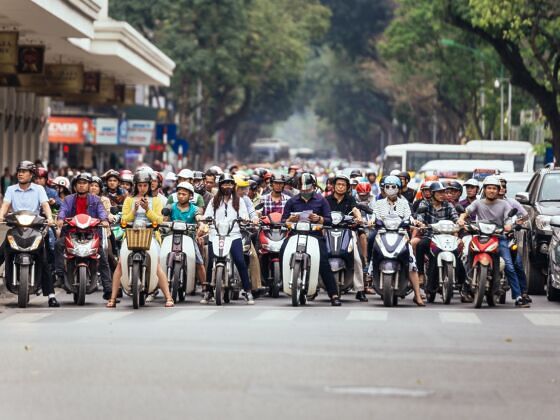
More people, more vehicles, more of everything means new ways of navigating our cities.

In the six years I’ve lived in Los Angeles, four of them have been without a car. This wasn’t an accident. Rather, this was a conscious choice that I gladly made after weighing all of the options.

For many, this decision would be tantamount to social suicide, especially in a town where everything is known to be “20 minutes away” regardless of actual distance or amount of traffic congestion.

But it’s nowhere near as bad as people make it out to be. It was a simple matter of shifting my priorities and aligning my lifestyle habits to match them.

So how does a metropolitan person in the 21st century go about ditching a car?

The first thing I did was move closer to my job and along the path of a major bus line. This diminished my commute from 35 minutes of stressful driving to twelve minutes of blissful “me time” – I was free to read or write or listen to music or just enjoy the scenery.

My gasoline expenses, car payments, insurance bills, maintenance fees, parking costs and possible traffic tickets evaporated like the fumes from the natural gas-powered bus I now rode. And the best part, beyond my ability to invest these savings, came in knowing I’d lightened my ecological footprint.

I can’t recommend enough how much better your life can be if you give up your car. In fact, this course of action may become necessity in the near future, as all evidence indicates petroleum will start to run out (for a primer, check out my interview about Peak Oil).

Stalled In The Driveway

However, there are roadblocks in the future of mass transit, especially here in Los Angeles. One simple truth is that in addition to running out of petroleum, we’re also running out of land.

We’re bulldozing houses and businesses to make room for our gas-guzzling cars (”eminent domain (pdf)“) and a 2001 report by the California Energy Commission for the State Legislature indicates that by the year 2020, California is expected to be home to 45 million people and more than 31.5 million motor vehicles (up substantially from the 35 million people driving 22.8 million vehicles in the State in 2000).

Where are we going to get the room for all these highways, vehicles and parking lots? Right now, we’re sandwiched between the two greatest enemies of any proposal: budget and safety.

Right now, we’re sandwiched between the two greatest enemies of any proposal: budget and safety.

That means we either take out massive Federal subsidy loans to pay for more light rails and subways or we wait for the next earthquake to destroy all our hard work when we double deck the 101 freeway — a terrifying yet serious proposal that’s been brought up time and time again – can you imagine the carnage of 50,000 motorists crushed to death?

I have to believe that there’s a better system. And what many people don’t realize is that an almost-infinitely expandable public transportation infrastructure is already 75% completed. One that’s much less expensive to implement and maintain, that’s much more environmentally-friendly and boasts a safety rate that other systems only aspire to.

And this infrastructure has the potential to move a comparable amount of people as the subway lines. But nobody has taken steps to utilize it…yet.

The World Of Tomorrow

I have a picture in my mind of the future of Los Angeles, plucked straight from the past and modified to help alleviate some of our current transportation woes. To see the future, all we have to do is look to the skyline…

3d Blimp renderingHere in Los Angeles, we have the Metro Red Line, Blue Line, Green Line and Orange Line. What if we also had the Metro Skyline?

A fleet of airships that carried as many people as subway cars, that docked on the roofs of buildings that were converted to landing bays (parking garages, for example) and ran on green energy such as solar power? What if we had a system of buses and subways in the sky?

I know what you’re thinking already, and I don’t blame you because it’s hardwired into our collective consciousness…

hindenberg explosionThe Hindenburg disaster was over exaggerated and wouldn’t have happened if we weren’t letting Nazi ships land on American soil.

See, that’s the part they leave out – that it only caught on fire because it was filled with hydrogen at a time when all other airships were filled with helium. Hydrogen is one of the most explosive elements in the universe (it’s found in the heart of most stars!), yet helium needs very rare circumstances to ignite.

And the only reason the Hindenburg was even filled with hydrogen in the first place was because the Nazis had acquired it and plastered it with swastikas, so we embargoed them on helium (the U.S. produces 84% of the world’s supply as a by-product of mining) and they were forced to use incredibly explosive hydrogen instead.

Of course, I’m not suggesting we should have given the Nazis helium. I’m suggesting that if we hadn’t let them into U.S. airspace, this tragedy might never have happened.

Some more quick facts about the “tragedy.” Contrary to popular belief, most of the crew and passengers survived. Of a total of 36 passengers and 61 crew, 13 passengers, 22 crew members and one ground crewmember died. Most deaths did not arise from the fire, but were suffered by those who leapt from the burning ship. Those passengers who rode the ship on its gentle descent to the ground escaped unharmed.

But who could ever forget Herbert Morrison’s recorded radio eyewitness report from the landing field of, “Oh, the humanity!”? Which, by the way, wasn’t even broadcast until the next day and had parts later dubbed onto the newsreel footage to give an incorrect impression that the words and film had always been together.

And I won’t even get into how the airline industry bigwigs, including Howard Hughes and Juan Trippe, helped to spread some paranoia about zeppelins in order to give their own fledgling airline industry a leg-up.

A Viable Alternative

The bottom line is that these things aren’t “widow-makers” waiting to explode. And they aren’t slow-moving turtles — they can go about 150 mph, actually. They can carry over 100 people in their gondolas. The hardest part is landing them, which could be solved easily if we gave them the same amount of research that we give to, oh, Viagra.

They could be made out of lightweight plastics and run off of solar power/hydrogen cell batteries. The infrastructure for landing pads is incredibly expandable, as all you need to do is convert existing rooftops.

Basically, airships just got some bad press and have sat stagnant for no good reason. It’s a technology that has rotted on the vine and been relegated to studying weather patterns or tracking animals in the wild or making an appearance at the Superbowl.

Home Depot adPretty humbling for an entire field of aviation that once ruled the skies, if you ask me. The only real downside to improving them with modern technology is that you’d see an increase in lame rooftop advertisements.

I think the best way to turn this idea into a reality would be to start it as a tourist venture first. But there are a few factors that would keep the Skyline grounded.

  • 1. The Federal Aviation Administration’s rules on lighter-than-air vehicles.
  • 2. Investor hesitancy.
  • 3. Public fear and misconception.
  • 4. Rising petroleum prices.

In Part II of this article, I’ll address these issues, possible solutions, what life would be like for tourists who could see a city from above as well as from ground-level, the effects on people who live in cities with airships and other unconventional methods of mass transit.

Derek C Wallace is a conscious consumer and an advocate for organic reform. In fact, he’s embarking on a world-wide trip to learn about sustainability and share it with the rest of the US. Visit his website to learn more.

  • Stumble It

About the Author

Derek C Wallace

Derek C Wallace is a conscious consumer and an advocate for organic reform. In fact, he’s embarking on a world-wide trip to learn about sustainability and share it with the rest of the US. Visit his website to learn more.

4 Comments... join the discussion!

  • Stephen Rees replied on May 2, 2007

    I had never before seriously contemplated the idea of air ships as part of the transit system.

    But they could already be deployed here to replace seaplanes (noisy, uncomfortable but happily nostalgic) and helicopters (even noisier, cramped and hideously expensive) for trips between Vancouver and Victoria. That’s thirty minutes flying time or several hours by ferry by the time you add the congested highways and long waits at the terminal. And BC folk like to think they are green since Greenpeace was born here.

    (Report comment)

    ↵ Reply
  • Andreas G. replied on May 2, 2007

    What a great article, I blogged about it on http://airshipworld.blogspot.com to you this might just be a distant hope or a vision, to us at airshipworld this is our business. We want to help the world becoming aware of the potential of airships and we want investors to understand the importance of alternative ways of transportation. Thanks for your article it’s one more step for airships into the collective consciousness.

    Regards Andreas

    (Report comment)

    ↵ Reply
  • Alvaro [viajarasia.com] replied on May 14, 2007

    I don’t know if it would be a reliable urban transport system (what about winds, storms, such things?) but the sole idea is simpli beautiful.

    (Report comment)

    ↵ Reply
  • Derek C. Wallace replied on May 15, 2007

    Good question, Alvaro. This would be Factor 3, which I mention near the end of the article and will address in Part II (which will be published soon).

    (Report comment)

    ↵ Reply

Leave a Comment

Get Matador in your inbox and around the web.

Sign up for our FREE weekly newsletter.


View full list of RSS feeds

Jump To Category:


Popular Stories on Matador

10 Tattoo Clichés To Avoid At All Cost

If you have tattoos (like me) then you know people are ... 

Behind the Scenes of Big UP's New Indoor Climbing Film

On the set of Big UP Productions' new project, an indoo... 

The World's Most Spectacular Skylines

Here are staggeringly beautiful images where city meets... 

Notes on Morning Darkness in Calcutta

"The rickshaw drivers wait like well-mannered ghosts. .... 

Doc (Not) in a Box

... 

World Cup Preview: North Korea vs. South Korea

2010 will be the first time that North and South Korea ... 

5 Choice Spots to Enjoy Spring Blooms

Spring has come to the northern hemisphere. Here are so... 

How Much Does it Cost to Live in China?

Your dollar by dollar guide to living in China. ... 

Notes on Missing the World Cup

David Beckham has probably missed his last chance to pl... 

Graffiti Mundo: Street Art for the People in Buenos Aires

While the art scene worldwide is getting more elitist a... 


Focus


Editor Blogs

Friends