4 Lessons Learned From The Camino del Santiago Pilgrimage

02/29/08  Print This Post Print This Post    8 Comments   Popular   Written by Laurie Pickard
  • Stumble It

Over the past millennium, thousands of people, from all over Europe and all over the world, have made the pilgrimage to Santiago. Laurie Pickard is one of them.

One hundred miles into my two-hundred mile journey, I was seriously considering calling it quits.

I was tired and sore, and I had blisters on every single one of my toes. Even the thought of putting my pack on again in the morning filled me with dread.

Although I am not religious, I have always loved the idea of a pilgrimage.

What would be so bad, I thought, about hopping on a bus at the next town? Putting myself out of this misery?

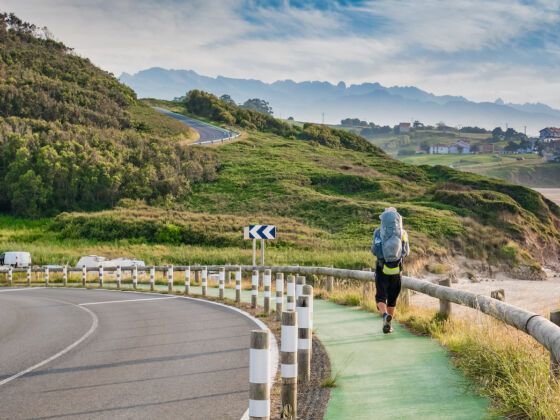
I was hiking a portion of the Camino de Santiago, a path across the north of Spain from the French border to Santiago de Compostela, where St. James the Apostle is supposedly buried.

Although I am not religious, I have always loved the idea of a pilgrimage: the singularity of purpose, the inevitable hardship and triumph over adversity, the camaraderie with other pilgrims.

And the fact that you get to call yourself a pilgrim.

Over the past millennium, thousands of people, from all over Europe and all over the world, have made the pilgrimage to Santiago. Halfway through my journey, I wasn’t sure I would be able to count myself among them.

What follows are a few lessons I learned about travel and life during my journey to Santiago.

1. Be Kind To Your Feet

Feet in the greenThe number one piece of advice I can give about taking any kind of backpacking trip is to buy good shoes.

I walked in a pair of too-small boots that I hadn’t used since high school, and although I lived to tell about it, there were times when I thought I might come back missing a toe or two.

I spent an entire day of my trip thinking only about how to describe the terrible pain – and finally came up with this: With each step, I felt like my little toes were being passed through a meat grinder.

I’m no gear head, but I will never again mess around with inadequate footwear.

It also doesn’t hurt to be prepared with a basic first aid kit just in case. On any backpacking trip, I carry medical tape to cover any spots that are rubbing (some people prefer duct tape, believe it or not), mole skin for padding, and baby powder to keep my feet dry, which also helps to stop rubbing.

As for other types of gear, there isn’t a lot that is necessary. Which brings me to my second point.

2. Travel Light

The longer I hiked, the more I realized what I didn’t need.

I started out with what I thought was a pretty light load, but the longer I hiked, the more I realized what I didn’t need, and how every ounce makes a difference when you’re schlepping it on your back.

Halfway through my walk, I ended up sending myself a 5 pound package general delivery to Santiago for pick-up at the end of the trip. I ended up with the following in my backpack:

  • One outfit for the daytime
  • one outfit for the night
  • one extra pair of underwear
  • basic toiletries and first aid supplies
  • sunscreen, soap for washing my self and my clothes, foot care items
  • water bottles
  • a sleeping bag
  • and a journal

That’s it.

While I was hiking, I met a man who was carrying absolutely nothing. He had one outfit that he wore day and night, and it included a large piece of fabric that he used as both a garment and a sheet. One of the most amazing things about backpacking is realizing how little it takes be happy and content.

3. Be Open To The Journey And To Other Travelers

On the roadWhether or not you set out with a religious or spiritual intention, traveling by foot can be a deeply spiritual act.

Unfortunately, it is all too common for travelers to get caught up in competition for spaces in the nicest guest houses, to obsess over how far they are able to travel in a day, to put too much emphasis on the destination without taking the time to appreciate the journey, one of the best parts of which is meeting other people.

Especially during difficult times, I found how nice it was to have other people to rely on for comfort. I also found that if I were open to it and willing to listen, people said exactly what I needed to hear when I needed to hear it.

4. Go Easy On Yourself

Part of what makes travel meaningful is dealing with difficulty. Of course, it’s easy to get discouraged, to get frustrated, and to blame ourselves for everything we have failed to do right.

Ultimately, though, what would a pilgrimage be without trials?

What’s really important is to deal with what comes up as it arises. Even the most prepared pilgrim can’t plan for everything.

One Foot In Front Of The Other

Part of what makes travel meaningful is dealing with difficulty.

Of course, I didn’t have the benefit of this advice before I started my pilgrimage, and nursing my blisters halfway through, I really did think about quitting.

After a hot meal and half a bottle of wine (that’s how they do it in Spain, you know), I was feeling a bit more optimistic. At least, I thought, I can make it through one more day.

I continued until one morning, miraculously, my feet didn’t hurt any more. My blisters had hardened into thick calluses. By the time I made it to Santiago, I was even a little disappointed not to be able to look forward to walking again the next day.

Although I wouldn’t trade my experience on the Camino for anything, I am certain that the next time I take a pilgrimage (or even go on a weekend trip), I will be better prepared.

Inspired by the Camino de Santiago? Thinking about doing the pilgrimage yourself? Check out Walking the Camino de Santiago, a feature article in Matador’s Traverse magazine.

Laurie Pickard is a lifelong lover of travel and learning. She grew up in suburban St. Louis and currently lives in Philadelphia, where she is working on a master’s degree in geography. Laurie is passionate about languages, cultures, people, and places. She is currently planning her next trip, which will be to South America in fall 2008.

  • Stumble It

About the Author

Laurie Pickard

Laurie Pickard is a lifelong lover of travel and learning. She grew up in suburban St. Louis and currently lives in Philadelphia, where she is working on a master’s degree in geography. Laurie is passionate about languages, cultures, people, and places. She is currently planning her next trip, which will be to South America in fall 2008.

8 Comments... join the discussion!

  • Stu replied on February 29, 2008

    Of course, I didn’t have the benefit of this advice before I started my pilgrimage, and nursing my blisters halfway through, I really did think about quitting.

    WHAT? ok I have no sympathy. You did zero research. _ANY_ long distance hiking website would have told you this and way more. shesh… Lets walk 200 miles in too small boots I havnt worn in years? umm ok. sounds like a marvellous idea!

    (Report comment)

    ↵ Reply
  • Ian MacKenzie replied on February 29, 2008

    I think Laurie is implying that she learned more than “get a better pair of shoes” once the trek was over. Hence the 4 Lessons, and not just 1. ;-D

    (Report comment)

    ↵ Reply
  • Daniel Harbecke replied on February 29, 2008

    I rolled up a few feet of duct tape at the end of a pen. There’s a hostel in Florence with a fountain in the back, and after a long day of rambling a few of us liked to soak our feet with the goldfish (it was against the rules, but if the goldfish were fine with it I figured we would be, too).

    I got so much crap for duct tape on my toes. By day three they were asking for some. Who’s laughing now? WHO’S LAUGHING NOW?!?

    No matter how much info’s out there, you never learn a lesson so well as when you run into it face-first. Like my pappy used to say, “We can all learn something from someone who’s walked 200 miles face-first.”

    (Report comment)

    ↵ Reply
  • Haley January Eckels replied on March 3, 2008

    I used the duct tape trick to great effect when walking the Camino in the spring of 2005. I have to say, though, the shoes didn’t seem to matter much. All the pilgrims I met had foot problems, regardless of their shoes. One trick some Danish ladies taught me was applying tea tree oil to blisters. It stings like crazy, but it helps keep them clean and uninfected.

    Buen camino Laurie!

    (Report comment)

    ↵ Reply
  • Rebecca replied on April 1, 2008

    Good for you, Laurie! Last summer I spent the month of June with a friend, walking from Le Puy en Velay to Lauzerte — about 250 miles. We had expected to get all the way to the Spanish border at least (and really thought we might do the whole 900 miles to Santiago).

    My friend had no trouble with her feet. Mine hurt all the time. And we were both fitted for special shoes before the trip. Go figure.

    I, too, ditched a LOT of stuff on the way, starting the very first day — just gave it to people. You really do find out how much you do NOT need when you have to carry it up and down those mountains and hills.

    The day we decided to leave I thought I’d never want to go back and finish the camino. But now I’m feeling excited about covering more of it. Who knows? Maybe this spring and summer. The people we met along the way — other “pilgrims” and people in the towns and villages — were wonderful to us (we were the only Americans and we actually got APPLAUSE from French people twice). This time I’m thinking about going on my own and wonder how different that might be …

    To anyone considering the trek: Go! Buen camino! Bon route!

    (Report comment)

    ↵ Reply
  • Layla replied on April 17, 2008

    Nothing can be as important as knowing first aid in a time of need. It truly can be a lifesaver.

    (Report comment)

    ↵ Reply
  • Emma Cayless replied on March 25, 2009

    That sounds like very sound advice, I’m planning to walk the camino way in Oct.. is this a good time to walk it do you think? I enjoyed reading your advice and i will certainly take it. thanks.

    (Report comment)

    ↵ Reply
  • Ralph Alcorn replied on July 15, 2009

    Your feet will expand, probably to a size larger, so keep this in mind when buying footwear. I by the way wear running shoes. Carry a roll of 3.4 in stretchy breathable tape that you can get in any drug store. It tears off in about 2 inch lengths. If you get ANY uncomfortable or sore spot on your feet stop immediately and tape it. Prevention is much better than blister care. Also keep your pack weight to under 20 lbs. The weight on your feet from the pack contributes to the problems. We walked in Sept Oct a couple of years. For the most part, weather was wonderful. Some cold nights, and the shorter days make walking longer distances more difficult. Have rain gear, and pay attention to the weather before crossing the mountains.

    (Report comment)

    ↵ Reply

Leave a Comment

Jump To Category:


Latest Community Blogs

  •  New York City.  Beauty in diversity.  Subway musicians, ethnic food, dancing dragons.Little India, in Ja...
    » posted on 5 November 2009
  • Here is a sample of our main blog at www.knkexplore.wordpress.com. My wife and partner is Jessie Kwak. She is the writer...
    » posted on 6 November 2009
  • My Hometown:  Alexandria, VirginiaOn just about any Saturday or Sunday, Old Town Alexandria's historic, picturesque...
    » posted on 6 November 2009

Popular Stories on Matador

10 Volunteer Opportunities For Free Travel

From assisting with disaster relief to helping on the A... 

How to Get Off Grid in a Vintage Travel Trailer

Misty Tosh pimps out a vintage travel trailer and goes ... 

18 Essential Items for a Trip Around The World

What you decide to take on a round-the-world trip ultim... 

10 Things to do in Amsterdam BESIDES Smoking Pot

There's more to Amsterdam than legal bud.... 

Best Nude Beaches In The World

It’s a big world out there, with plenty of nooks and ... 

10 Traveler's Tips For Rocking A Nudist Beach

Travelers tend to enjoy ultimate freedom on the road, t... 


Focus


Editor Blogs

Friends