Does The World Discriminate Against Disabled Travelers?

03/5/08  Print This Post Print This Post    11 Comments   Popular   Written by Julie Schwietert Collazo
  • Stumble It

Disabled Travelers

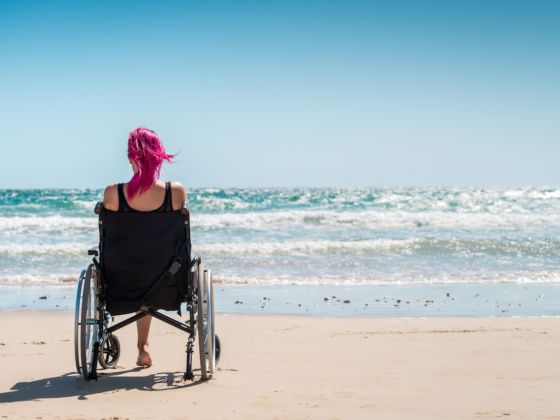
Being a disabled traveler involves challenges many others don’t have to face. But is movement getting easier or harder for disabled travelers to move around?

I once worked with a man named Victor. We forged a friendship that was contingent upon a shared penchant for searing social criticism, ironic humor, and good food, (though not necessarily in that order).

I thought about how much effort Victor had to exert every day just to move his paraplegic body from point A to point B

The evening we decided to go out for dinner to indulge all three interests was a watershed moment for me.

As we waited outside for the handicap ramp to be slid over the restaurant’s steps, and as Victor rejected my offer for help, using his calloused, dusty hands to heave his wheelchair over the lip of the ramp, I thought about how much effort Victor had to exert every day just to move his paraplegic body from point A to point B.

Years later, I thought about Victor as I watched tourists with walkers and wheelchairs try to navigate the uneven cobbled streets and narrow sidewalks of my adopted hometown of Old San Juan, Puerto Rico, and I began to think about the accessibility of travel for people with disabilities.

How are the challenges of travel exacerbated by disability? How are the joys possibly tempered? I could only imagine how difficult travel must be for disabled people. But I was wrong.

Walt Balenovich and Dave Wilkins set me straight. These intrepid travelers and travel writers recently spoke with me about their experiences in the air and on the road. Both men are seasoned backpackers whose passports are well-inked with the evidence of their intercontinental journeys.

Here are the highlights of our exchange about traveling with disabilities.

Serial and ParallelJulie: What type of disability do you have?

Walt: I had polio when I was 12 weeks old and spent the first 5 years of my life in the hospital. I used to walk on crutches, but when I was 27 I moved into a…wheelchair full time. Far from confining, the increased mobility freed me up to travel.

Dave: I had a brain hemorrhage in ‘97 which has left me with no feeling on the left side….I have balance problems and can’t see anything coming from the left. I also suffer anxiety….My scrambled brain cannot cope with noise, large crowds, and rapidly changing situations.

Julie: How do you go about choosing your destinations? Do you look for places that are disability friendly in terms of transport, accommodations, and the like?

Walt: I just decide what continent to go to. Usually access doesn’t enter into it. I am backpacking the world alone, so I have to rely on help sometimes.

I hate the idea of having to fit in with someone’s wishes…I need to concentrate on looking after myself.

Dave: Where I go is certainly NOT disabled friendly! I chose Ecuador as my first destination as I knew the country and lacked the confidence to try somewhere totally new at that time. Then to SE Asia because it had always attracted me. In recent years I have concentrated on West Africa because I have been bitten by the Africa bug and can’t ignore the continent!

Julie: Do you tend to travel independently or as part of a tour or package?

Walt: I travel independently. I love doing my own thing. I like going when and where I want in my own time, so I usually avoid long tours, though I do go on boat tours often. Those are good because you can watch the sights float by!

Dave: I have never traveled with a group and would never consider it. I hate the idea of having to fit in with someone’s wishes…I need to concentrate on looking after myself.

Julie: What kinds of challenges have you encountered as a disabled traveler?

Walt: Mostly just stairs and washrooms… sometimes a place to sleep, but not often.

Dave: Have you got all day? My life is a never-ending challenge from getting up and having to get washed and dressed, to eating/drinking/moving about, to getting to bed at night.

Magnify these by adding the novelties of a foreign country, customs, language, and food, to finding a means of traveling to the next destination, fighting off crowds, suffering bouncing journeys, and hunting out a bed that isn’t too bug-ridden and with water for washing…. (Dave’s personal best for a long-haul vehicular journey is 52 hours in a 7 seat taxi with 13 passengers plus luggage).

Julie: Among the places you’ve visited, which ranks best for the disabled traveler?

Walt: Iguazu Falls in Argentina, on the Brazil border. The upper track of the National Park is fully wheelchair friendly and you are suspended over the gorge and surrounded by over 100 waterfalls in the beautiful tropical Amazon basin.

Dave: Laos is my favorite destination… however I fell in love with a dusty little village in Cameroon that doesn’t appear on any map. I return there are least once a year….By no means is this place disabled-friendly, but I love it.

(He loves it so much, in fact, that he’s started a charitable organization to promote women’s rights and children’s health in the extreme north of Cameroon).

The Verdict on Disabled Travel

Wheelchair signWalt and Dave agreed that while it might be nice for more places to be accessible-especially with respect to transportation systems, they also insisted that people with disabilities need, in Walt’s words, to “get out there and be visible.”

Dave acknowledges that meeting the needs for diverse disabilities isn’t feasible in many cases-”the cost would be astronomical,” he says, “and it would adversely affect the beauty of such places.” Both men hope that by traveling without limits, they can inspire other people with disabilities to travel anywhere in the world.

Increasingly, it is becoming easier for people with disabilities to travel.

John Weaver, of the company Special Needs at Sea, explains that advocacy groups such as the Society for Accessible Travel and Hospitality have been instrumental in uniting disabled travelers and encouraging them to travel, as well as representing their interests and needs by working with local governments and private businesses to understand accessibility needs and improve practices.

SATH authored a Code of Conduct towards travelers with disabilities that was adopted by the World Tourism Organization in 1991.

But for those travelers with disabilities who aren’t willing to wait for the tourism industry to adapt to their needs, the world is waiting for them.

Weaver also reports that certain segments of the tourism industry are improving accessibility significantly, noting that cruise ship companies are becoming increasingly accommodating of disabilities.

Many ships now have signs posted in Braille and in December, 2007 Royal Caribbean realized just how much of a boon disabled travelers can be for business when more than 3,800 deaf and hard of hearing passengers set sail together on a cruise that was specifically designed to meet their needs.

But for those adventure travelers with disabilities who aren’t willing to wait for the tourism industry to adapt to their needs, Walt and Dave say that the world is waiting for them.

Most people on their journeys around the world have been friendly and helpful, and both have learned that few places are totally inaccessible to them.

Visit their blogs to read more about their experiences, and check out Walt’s recently published book, Travels in a Blue Chair.

Julie Schwietert Collazo is a writer, editor, researcher, and translator who lives in New York, Mexico City, and San Juan. She has a BA in English and Women’s Studies, a Masters of Social Work, and is working on a PhD in Literature at the Centro de Estudios Avanzados de Puerto Rico y el Caribe.

Inspired by Walt and Dave’s courage? Got a story of your own to tell? Please join the conversation by leaving a comment below!


  • Stumble It

About the Author

Julie Schwietert Collazo

Julie Schwietert Collazo is a writer, editor, researcher, and translator who lives in New York, Mexico City, and San Juan. She has a BA in English and Women's Studies, a Masters of Social Work, and is working on a PhD in Literature at the Centro de Estudios Avanzados de Puerto Rico y el Caribe.

11 Comments... join the discussion!

  • Cedric Pieterse replied on March 5, 2008

    Good article Julie! I have met travellers with disabillities on my travels through Africa, hardly a place that caters for the disabled. In one case, I met a guy that was driving from London to Cape Town, and he is paralysed from the hips down. He drove a modified vehicle, and he asked people around the campsites for help when needed. It was amazing to see him pitch a tent and set up camp. He even changed a gearbox in the Sahara Desert, all by himself! Another guy that I met, also in a wheelchair, set off on a Round-the-World trip on his sailboat. He also had the boat modified to suit his needs. He got hit by the tsunamies in Thailand and was lucky to have survived it. His boat was a mess, but he took it to Australia on an oil-tanker and fixed it up. I always admire disabled people who, regardless of their dispositions, manage to do stuff that we as perfectly able people find difficult to do. When I had problems on my travels, I always thaught about these guys, and realised that my problems were not really that big.
    Where there is a will, there is a way…

    (Report comment)

    ↵ Reply
  • Julie replied on March 5, 2008

    Cedric-

    Thanks for your feedback and the stories you shared. Dave and Walt both told me that their most gratifying travel-related moments are when they hear from other people who have read their writing who write to thank them for showing that travel with a disability is possible. By serving as a platform to share these stories–like the one about the guy changing the gearbox and the guy on his boat living through a tsunami–we’re helping people know they CAN travel.

    (Report comment)

    ↵ Reply
  • Jackie replied on March 5, 2008

    Very inspiring, very exciting! Long live fearless travelers!

    (Report comment)

    ↵ Reply
  • Turner replied on March 8, 2008

    I heard about a group advertising support for disabled travelers (in groups, though):

    http://www.accessibleescapes.com/

    (Report comment)

    ↵ Reply
  • David Williams replied on March 8, 2008

    Hi Julie,
    A very interesting website and Dave (your article above) is a very good friend and I know that he is quite remarkable and very brave.Last year he managed to obtain a donated 4wd vehicle, drive it across the Sahara Desert and deliver it to his favourite village in Cameroon.He wishes to find another generous person so that he can do the same this year in order to help those who will benefit from his charitable work.
    Is there someone out there who can help?

    Thank you for this opportunity.
    Best wishes,
    David.

    (Report comment)

    ↵ Reply
  • Maggie replied on March 26, 2008

    This article is great for those who are disabled but still can do many things for themselves, like, getting in and out of a wheelchair to get to a bed, toilet, etc.

    But does not address the variances of what disabled means and what the different disability levels require.

    What about those like my sister who is 227 lbs, lg electric wheelchair, who require a caregiver 24 hrs a day, a Hoyer lift to get to and from bed to wheelchair and need a bedpan to go to the bathroom, which means in and out of the bed again. More equipment to get into a room, whether it be a hotel room or a room on a cruise.Try to deal with all that , luggage, another person and moving her around in the lift in a 350 sq ft room…full of furniture!!! Impossible.

    I have been very frustrated at the minimum standards that deem a place “accessible” to the disabled. (wide doorways and a roll in shower).

    Planning a cruise for my sister has been a nightmare and I have spent many hours online, on the phone with travel agents who, despite what I state our needs are, only extoll the virtues of a room with a view…I have cried many tears of frustration. But I am still working on it…

    Where is the article to help my sister and I find something that will really work for her?

    (Report comment)

    ↵ Reply
  • Susan replied on March 26, 2008

    I liked the article, but Maggie, you raise a good point. What’s accessible to one person may not be to the next. I use a wheelchair, but these guys are more able-bodied than I am. I’d have a harder time roughing it. If you have the money and the will though, you can go pretty much anywhere.

    The minimum ADA standards really are minimum, so going to another country is going to be even worse. I’d recommend ditching the cruise, unless it’s going to Puerto Rico or a Hawaiian island. Agents always automatically hand people with wheelchairs the cruise brochures, because they have this idea that it’s an accessible wonderland. They’re wrong when it comes to people in wheelchairs, especially people with needs like your sister has. They’re often stopping at places without ramps and curb cuts or accessible transportation, there’s a lot of places you can’t go on the boat, the rooms are small, etc. Try a warmer state and do your own thing. I just had a great time in Hawaii. I rented a van with a wheelchair ramp, and stayed in accessible hotels. Of course, those rooms were full of problems for me, but when you’re traveling you work with what you’ve got. I don’t use a lift, but I could have rented one from a local medical supply place, they’ll set it up for you in your room. You can rent beach wheelchairs, find pools with lift chairs, accessible boat rides, helicopter rides, etc. You can even rent a private accessible condo or home if you look on the internet. That would work great for your sister. There were accessible bus tours everywhere to go on and I never had to leave my chair.

    Travel agents only drove me crazy and ended up costing more money, even the “accessible” agents. It’s easier to do it all yourself, if you ask me. Instead of telling someone your needs so they can repeat them to someone else, cut out the middle man. You don’t need to pay someone to type some key words into Google. Research where you’d like to go and call. Just call every place and ask detailed questions. Have them measure doorways, look for specific obstacles, whatever, because they won’t know off the top of their head. When you’re not disabled, you don’t notice things you take for granted. I don’t know how many times people have told me something was accessible and I show up and there’s a flight of stairs. The earlier you can make arrangements the easier it all will be.

    If you need any help you can contact me through my photo website, I’d be happy to help.

    (Report comment)

    ↵ Reply
  • Moha replied on April 1, 2008

    Hi all
    i am very grateful to the team (person) who have created this site to help disabled persons to be persons in terms of travelling. I find Morocco very interesting for persons in wheelchairs. Morocco has amazing scenery that you can enjoy only with eyes. it also offer access to disable persons in public places. it’s not expensive at all. try it and you will be satisfied
    fun of Morocco

    (Report comment)

    ↵ Reply
  • Julie replied on April 12, 2008

    Maggie and Susan-

    Thanks for your feedback on the article. You’re right– one of the challenges of writing an article on the topic of disabled travel is that the range of disabilities is so vast that it’s all but impossible to address all kinds. That’s why I really appreciate the insights of your own experiences.

    I’m by no means an expert in the area, but I’d recommend checking out some of the resources I mentioned in the article, particularly the Society for Accessible Travel and Hospitality. Among other functions, they serve as a clearinghouse for information about services for people with varying disabilities who want to travel. They have contacts with other organizations, such as Special Needs at Sea, that truly are dedicated to helping disabled travelers, and I’ve found that they are genuinely open to requests, ideas, and listening to the difficulties that travelers have encountered– they take that information and try to offer new products and services based upon your input.

    Like “green” travel, tourism industry reps. who bill themselves as “disabled friendly” or “accessible” don’t always conform to a specific set of standards, and it’s not at all unusual to encounter the kinds of frustrations you’ve detailed here. But SATH DOES have international standards, and it’s worth asking whether the hotel/transport provider/attraction you’re inquiring about follows SATH guidelines. If not, why not direct them to SATH? You may not benefit immediately, but hopefully you’re raising awareness and letting the tourism industry know that you expect more.

    Peace,
    Julie

    (Report comment)

    ↵ Reply
  • Scott Rains replied on March 24, 2009

    Julie - Great piece on a vast subject.

    Walt - I agree with you on Iguaçu. Did you see the rusted narrow walkways falling into the river (and over the waterfalls) next to the new boardwalk? That’s how we used to have to do it in the 1970’s. Precarious!

    For Brazil specifically we just started a site for travel agents - TurisNautas - (in Portuguese) with a section on Inclusive Tourism. South Africa is gearing up with accessible infrastructure for the 2010 World Cup; India for the Commonwealth Games; Vancouver for the Winter Olympics; Brazil for the 2014 World Cup. Tune up that Blue Wheelchair for some more trips!

    (Report comment)

    ↵ Reply
  • Rick1848 replied on June 30, 2009

    I often travel (except overseas) with my service dog. My experiences have run the gamut from the horrible to wonderful. Airlines are the most contradictory. On one occasion Northwest demanded to know exactly what my service dog did for me and when I told the agent that his questions were illegal and offensive he told me that he and he alone controlled who got on his aircraft. His supervisor though had a better understanding of the word lawsuit. On the other hand, Southwest, Sun Country and United have been wonderful and the crew of our Northwest flight were beyond nice.
    Overall. I find that most people are curious about my service dog but go away with a better understanding of the need to “stand” alongside the differently abled to fight for all our rights. Officialdom hasn’t quite caught up even given the ADA!

    (Report comment)

    ↵ Reply

Leave a Comment

Get BNT by Email


Jump To Category:


Explore the Community


Latest Community Blogs

  • Life has changed drastically.  perhaps not drastically, so much as I was walking down the road towards my life and ...
    » posted on 19 July 2009
  • Where to begin?  A solo roadtrip is interesting, exilerating, grounding, tiring, and freeing all at once.  It ...
    » posted on 18 July 2009
  • Notes on Ward, living at 9,200 ft. 1.    Up here you appreciate having dogs around. 2.    ...
    » posted on 17 July 2009

Popular Stories on Matador

How to Drop $400,000 at Disneyland

I knew Disney was expensive. But THIS expensive?... 

50 Inspiring Travel Quotes

Stuck in a travel rut? Jumpstart your lust with these i... 

"Daggering" in Jamaica: A Dance Craze Gone Too Far?

The spiraling popularity of "daggering" -- a "lewd" dan... 

Inside Japan's Freaky Themed Bath Houses and Bars (NSFW)

Prostitution is illegal in Japan, which may be one of t... 

Best Nude Beaches In The World

It’s a big world out there, with plenty of nooks and ... 

12 Personal Travel Websites That Will Make You Quit Your Day Job

... 


Focus


Blogroll