Brave New Traveler - Online Travel Magazine

How I Made Peace With My American Identity

Print This Post Print This Post    23 Apr 2008 in Politics by Rachel Friedman
Turns out not everyone loves Americans. For Rachel Friedman, the shock of seeing her nation from abroad led to feelings of betrayal, denial and awakening.

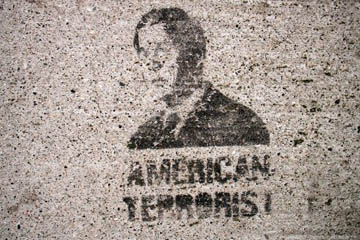
Photo by Scott Muscatello

My first solo trip abroad was less than a year after 9/11.

Life in the U.S. was still tense, especially on the East coast, where I was a junior in college.

Airports were enveloped in almost sanctuary-like silence. While I waited to board my flight to Dublin I watched people remove shoes and sweaters and belts.
Women hadn’t yet learned not to wear knee-high boots or anything with complicated laces. Security guards went through their motions with heavy, serious expressions.

Tomorrow I would be in Ireland for the start of a long summer away from home and I felt a distinct sense of relief when the U.S. gave way to the Atlantic Ocean.

I thought that, in addition to leaving behind all of my personal worries (like what to do now that graduation was approaching, or how to heal my failing relationship), I was also leaving behind some of the cultural worries you couldn’t help but absorb in the United States in 2002.

I was going to escape my American identity and cultural baggage. In Ireland I would reinvent myself completely.

No Escape?

It’s true that I was temporarily able to detach myself from the personal decisions and messes I left behind in the U.S

Now that I’m a little bit older and a little more travel-savvy, I realize that my idea of complete escape and self-renewal was naive.

It’s true that I was temporarily able to detach myself from the personal decisions and messes I left behind in the U.S. For four months, I managed to ignore the aspects of my life back home that no one in Ireland knew about.

However, I soon found that escaping my cultural life and American identity in Ireland proved impossible from the outset.

From the moment I landed in Ireland and opened my mouth to ask directions, I revealed my nationality and, given the current state of world affairs, there was no denying my American roots.

In fact, now that I was a foreigner, I felt more American than ever, since in my own country I took this part of myself for granted.

A New York State Of Mind

In Ireland, when I told people I was from New York, sincere expressions of sympathy and empathy greeted me.

I made half-hearted attempts to explain that I was from upstate New York (like way, way upstate with farms and cows and no Bloomingdales) and had only visited the city a handful of times. A few weeks later when I had made some Irish friends I realized a good half of them had spent more time in New York City than I had.

But it didn’t matter. People heard New York and that was all it took.

Before then I had never really thought how citizens from other countries were affected by the terrorist attacks in America. I was so wrapped up in my own shock and sadness that I hadn’t given a sustained thought to the rest of the world.

That others were sympathetic to what I previously considered a wholly American trauma was not the only thing I learned as an American abroad. I also found out (and please stifle your giggles) that Americans are often considered loud and ignorant.

The idea that I might embody either of these traits to even a small degree truly flabbergasted me. And then I found something even more disturbing.

Apparently, even though we are an affable and fun-loving people, there are those (some might say many) out there who don’t like us, who, it might even be said, downright loath Americans.

Coming To Terms

I grappled with these revelations in different ways.

First I was surprised by what other people thought of Americans, the stereotypes and then, especially as time ticked further away from the immediate post 9/11 sympathy, the overt frustration and cynicism many expressed over the actions of the U.S. government leading up to the war in Iraq.

At the same time, I was meeting people from other countries who offered me wholly new perspectives on things like universal health care, affordable education and the consumptive lifestyles we in the U.S. tend to lead.

After getting over my initial shock, I began to experience something like betrayal. A lot of childhood messages instilled in me about being American — essentially that we do everything better than everyone else — started to ring false.

After surprise and betrayal came embarrassment and even denial. (Yes, I once or twice pretended to be Canadian).

After that came self-deprecation, heartily lamenting the state of my government alongside people from other countries and listening to diatribe after diatribe while I tried to convince people that Americans themselves, especially those who travel, were clearly distinguishable from George W. Bush.

Home Sweet Home?

When I returned home after two years, I was still in this weird place where I both knew that I was definitively American, but didn’t really want to be.

When I got off the plane in New York, I saw my own people through the eyes of the travelers I had met.

When I got off the plane in New York, I saw my own people through the eyes of the travelers I had met. We were loud and nosy and unaware of other people’s personal space. I felt more like a foreigner than ever.

But eventually, after I settled back into my life and reconnected with family and friends, I started to remember the good things about Americans as well–our chatty warmth, our willingness to make fools of ourselves, our desire to be better and to have a better country than we do now.

I also realized that I was the only one responsible for the way that I lived. If I wanted to, say, start a recycling program in my neighborhood, I could. If I wanted to enter politics and become an advocate for universal health care, I could.

And if I wanted to change perceptions about Americans by writing about my travels and continue to make connections with others around the world who also believed in the revelatory power of travel, I could do that too.

Making Peace With Myself

Somewhere in the months after I returned home, I stopped apologizing for things outside of my direct control, for my government and my politicians.

Instead, I looked for similarities between people and places and, when I began doing that, I started to feel better about who I was and my place in the world. Although I still struggle with my identity, I realized that I had to make peace with the American in me in order to move forward.

So I did. Mostly.

Do you struggle with your nationality abroad? Share your thoughts in the comments!

Rachel Friedman

Rachel Friedman's travel writing has been published in Get Lost Magazine, The Arizona Republic, and Clever Magazine. She works in publishing and is currently writing a book about backpacking - a kind of Motorcycle Diaries meets Devil Wears Prada - minus all the expensive clothes.

| Share on Facebook | Stumble it!

24 Comments »

  1. Comment by Amanda — April 23, 2008

    Nice story, Rachel. As an Australian, my perspective is slightly different - in most places abroad, Aussies are usually welcomed, although what people expect of an Aussie is maybe not what they get with me (I’m not a great beer drinker, for starters!). But it’s true that when you’re traveling, your nationality is one of the most defining parts of you, which is weird when it’s so unimportant at home. I don’t really like that much, yet I definitely do it to other people too - as in “remember that French girl?” instead of bothering to use her name. I’m really interested to hear about what people from other nationalities say here.

  2. Comment by trevpage — April 23, 2008

    I found it interesting that you told others to ’stifle their giggles’ when mentioning that ‘Americans are often considered loud and ignorant’. Maybe some of that ‘childhood messages instilled in me about being American — essentially that we do everything better than everyone else’ still peeking through? Because who would ever say such falsehoods about Americans?.

    It’s good for everyone to travel and learn other points of view.

  3. Comment by Jacob — April 23, 2008

    Strike a chord–I took off for Europe in 2005, partially due to the previous reelection. “‘Love it or leave’ say those stupid hicks, so I’m leaving!” I angrily huffed.

    hindsight is painful.

    What I think is interesting is that Americans are always on the defense amongst the international travel community. While other nationalities are quick to call us (American-born travelers) the anomaly, we are then to believe that they (foreign-born traveler’s) are the majority in their country. Meanwhile, tourism number suggest that they are just as much of a minority (often more so) amongst their countrymen than Americans.

    I am ashamed of many of the images projected about the United States, but I’ve failed–on multiple occasions–to be ashamed about being, myself, an American.

  4. Comment by Nomadic Matt — April 23, 2008

    You know, I’m going to disagree here. I never once hid my american identity and, nothing personal, but I have little respect for those who do. I wouldn’t advertise my nationality in various parts of the world but I would never hid it if asked. If you (the general you) are embarrased or ashamed of your nationality, move. Why hid who you are? You’re american, for good or bad. I never once hid my naitonality and if people had problems with it, i simply told them that no country is perfect and that every country has done something bad or had a bad leader (the dutch started slavery, germans had hitler, the britsh tried to subjegate the world, Ozzies weren’t too kind to the Aborigines, etc etc) and that in 2008, Bush would be gone.

    BUT I rarely had those conversations because all of the people I ever met loved Americans, they just hated George Bush and I just had to explain our electoral system. Only once did I evern encounter blatant Anti-Americanism.

    I’m not one of those FOX news loving nationalists but at the same time, I am who I am. I’m american and nothing will change that. I may not like what is going on now but I’m not ashamed where I am from and I wouldn’t hid it.

  5. Comment by pam — April 23, 2008

    I’m with Nomadic Matt on this. I’ve never worn the maple leaf and never apologized for my nationality. Okay, I’m probably exaggerating, I’ve been traveling for a long time and I’m sure I tried to pass in the past. But now, no way.

    It’s our responsibility as travelers to represent our nation. When, while traveling, we hide our nationality, we also hide the opportunity to present Americans to the world as curious explorers who don’t believe the world ends at our borders.

    I didn’t choose my nationality any more than I chose the color of my eyes. By hiding our nationality, we give credence to Nationalism as a philosophy - Germans are X, the Japanese are Y, Americans are Z, therefore I don’t want you to know that I’m Z. Americans might have plenty of negative characteristics, but there are one or two reasonable Yankees out there, why not be one of them in the open?

  6. Comment by Tim Patterson — April 23, 2008

    Agree with pam that it’s our responsibility to represent our country - and if that means fiercely criticizing the current state of our politics, so much the better. The broader point, though, is that seeing your home country from abroad can be a revelatory experience. In my case, traveling hammered home the point that standard of living and quality of life are two very different things.

  7. Comment by Tim Patterson — April 23, 2008

    Also let’s keep in mind that America is one of the most diverse countries in the world - loud and ignorant actually doesn’t describe many Americans I’ve encountered.

  8. Comment by Nomadic Matt — April 23, 2008

    Here! Here! Pam,

    When I told people I was American, they were shocked. Americans so rarely travel that people simply don’t know us expect what they hear about us on the news. When they met me had two reactions:

    1. “WOW! Your the first (2nd, or 3rd…rarely more than that!!) American I’ve meet! I didn’t know you travel!!!” (hahaha)

    2. “You know, american’s aren’t that bad. You’re pretty cool!”

    Like Pam said, hiding your nationality takes away an opportunity to show the world that there was a reason why we used to have a lot of respect and that we never changed, it was just our current administration, and that will change again.

  9. Comment by Tim Patterson — April 23, 2008

    Rachel’s overall point, though, isn’t that she was embarrassed and hid her identity, but that traveling was the impetus for an emotional and intellectual process of coming to terms with and accepting her American identity. Is that fair to say Rachel?

  10. Comment by Turner Wright — April 24, 2008

    …and feeling the pressure of her being a designated representative of her nation.

    However, I doubt too many people on BNT can boast being a Texan traveler. Residents of Japan are so confrontational about George W. you feel like you have to justify yourself.

  11. Comment by Rachel Friedman — April 24, 2008

    Yes, Tim, definitely on your last point. I don’t think I could articulate the overall point of this article any better than you have–and I wrote it! This article is about a complex, and complicated, journey of self-discovery, an ongoing process for me at least, so it’s really interesting to see the specific sentences/ideas readers are focusing on.

    Also, this article is edited quite a bit from my original version, in ways that I understand it needs to be for brevity and clarity. However, my initial version was a bit more, well, maybe not light-hearted, but tongue-in-cheek. The sentence about pretending to be Canadian, for instance, was more of a joke in the initial version. I didn’t pretend to be Canadian for long stretches of time or put a maple leaf on my backpack. But I did have moments where I felt conflicted about my country, which was the overall theme of those few paragraphs.

    I still question my place in the world, and that includes negotiating my identity in many different ways, including being American, but I have ultimately found a balanced perspective. This article is my honest portrayal of the journey to that balanced place.

    Thanks for all your comments!

  12. Comment by Eva — April 24, 2008

    Nomadic Matt:

    I totally agree with your point about representing as travelers, etc, etc. However (and admittedly speaking as an outsider here) I think that this thought is one of the most dangerous (and pervasive) in the States today:

    “If you (the general you) are embarrased or ashamed of your nationality, move.”

    The idea that anyone who wants change or sees American society as flawed should just leave, is guaranteed to kill positive innovation and leave America in the dust. It’s kind of like a sentiment I heard expressed on CNN yesterday: “It’s never okay to criticize the President,” one woman said. That thought belongs in North Korea.

  13. Comment by Daniel Harbecke — April 24, 2008

    Hi, Rachel -

    Solid article. I can relate. Please forgive the long reply, but it hits home.

    I met plenty of Americans who were truly wonderful people - that special kind of “friendly” you’d be lucky to work with or have as neighbors. They blend in so seamlessly that nationality isn’t really an issue, because they’re willing to conform politely without sacrificing their identities. When you take notice of that unique bit about them, you have to ask “where ya from?” because you wonder what part of the States produced someone so enjoyable.

    I also met the other kind - judgmental, impatient, disrespectful, demanding, practically impervious to the needs and attitudes of those around them. They waive the worst of their nationality in everyone’s faces as if to say “We’re Americans, and you’re just LESS.” You can’t help but see them through the eyes of your hosts, and it turns your stomach. No one asks what part of the country they’re from, they only see them as Americans.

    But here’s the thing: you’re not ashamed to be an American, you’re ashamed that Americans are acting this way and you don’t want to be associated with such displays of ignorance. Nationality becomes the sticking point mainly because Ugly Americans make other Americans look just as awful.

    I never hid my nationality, but also never saw a need to make a big deal about it. I am who I am, and as long as I treat people with respect and equality, I believe I represent the best my country has to offer. When I saw a head-on motorcycle crash in Taiwan, the natives literally ran away from the crash because it’s “bad luck.” My fiancee, a Russian, held back because Good Samaritans put themselves at considerable risk in her country. I went in to help. Later, I felt proud that this is an almost instinctive reaction in my home country.

    In a Swiss restaurant, I saw an American family act like complete slobs, almost getting into a fistfight with the waiter because they couldn’t (or wouldn’t) read the menu since English was presented in a list with three other languages. Afterward, I told my waitress in broken German that “my face was red (Mein Gesicht ist rott).” She asked me where I was from, and she couldn’t believe it when I replied “America.” She’d never heard an American attempt to speak German - she didn’t recognize my accent. It was an appalling experience.

    Months later, on September 11, I was in Stockholm trying to find an Internet cafe to write home to tell my family I was okay. I found one, but every seat was taken. On my way out, the young man at the desk saw I had a backpack and asked, in English, “Excuse me, are you American?” I replied yes. He left the desk to address the entire room, something to the effect of “there’s an American here who needs to contact home, could someone offer their seat?”

    EVERY PERSON in the room stood up.

    Even today, I still get choked up when I think back on that moment. That one instance taught me what it is to be an American: it’s not about nation or wealth or superiority, it’s about seeing each other as one people. It’s about moving beyond cultural difference to honor the spark at our human core. In that single act of giving, and my gratitude for it, I felt so proud to come from a land that’s all about spreading this message.

    We at once have much to be proud of, and much to regret when we fail our ideals. But the hope is always there, because even if we stumble a bit, the ideals are still a part of us, and we can learn how to do better. Being born in America is more or less fate; BEING American is about upholding our duty to what it stands for.

    I meet Americans everywhere I go, and I’m proud to be among them.

  14. Comment by Jacob — April 24, 2008

    Turner: That’s because Texans are citizens of Texas, not the U.S. ;)

  15. Comment by Eva — April 24, 2008

    Daniel, you just made me cry in a sweaty internet cafe in Saint Vincent and the Grenadines. The boys playing PS2 are appalled. ;)

  16. Comment by Tim Patterson — April 24, 2008

    Beautiful Daniel, just beautifully said.

  17. Comment by Ian MacKenzie — April 24, 2008

    Wow, Dan, great story. Thanks for sharing it with the rest of us.

    Having spent much of the last 6 months in the US (longer than I’ve ever spent there) I came to respect the “mythology” upon which America was born. The belief that you can come from nothing and earn your place in society - the belief that you can ‘roll up your sleeves’ and get hard things - and the clear distinction between right and wrong.

    Of course, as the past 8 years has shown, that mythology can be abused by those in power to sway a population that wants so badly to believe their leaders can’t be wrong. But once the truth is revealed, and it will eventually, hell hath no fury like an American scorned.

  18. Comment by Rachel Friedman — April 24, 2008

    Dan, I have to join the chorus of impressed “wows” here–really compelling comments. They make me want to think more deeply about the differences between nationality, ideology, and plain old personality. The conversations that get going on this site after each article is posted are so insightful. I’m just totally entranced by them.

  19. Comment by Lola Akinmade — April 24, 2008

    Just to chime in….

    Daniel, your story struck a compelling chord even amongst us non-Americans.

    One of my favorite quotes goes:

    “A wise traveler never despises his own country.” - Carlo Goldoni

    Rachel - Nice Article!

  20. Comment by Turner Wright — April 25, 2008

    Going back to Eva’s comments as well…

    A wise traveler never despises his own country, but I think he’s perfectly justified in hating the press.

  21. Comment by Daniel Harbecke — April 25, 2008

    Hi, all -

    Thank you for the kind words. Eva, no woman no cry. =) You know the lyrics: “Eva, ting’s gonna be all right…” (Maybe Bob’s really saying “everything,” but that’s not quite as funny.)

    Rachel, thanks for writing this. The comments come when someone writes a piece that catches them just right - you did a nice job relating the awkwardness of seeing your country through other’s eyes. Americans love to feel bad about themselves, but it gets depressing if you don’t remedy it without feeling like you’re BSing yourself. Your article points to a good-sized Elephant in the Room - that’s a first step. Thank you.

    Turner - what an awesome name you’ve got! - I’ve got a quote for you to compliment your lines of thought: “‘My country, right or wrong,’ is a thing that no patriot would think of saying. It is like saying, ‘My mother, drunk or sober.’” - G. K. Chesterton, from “The Defendant.” (You’re not from Austin, are you? Great place, I hear….)

    Lola - just after 9/11, all flights to the States were cancelled for a few days. American travelers were stuck in a strange limbo with no way to go home. When French papers declared that “Today We Are All Americans,” those of us abroad felt much more at ease for being with people who grieved with us. At home, with all that was going on, folks didn’t all feel that as keenly as we did. Regrettably. I hope you and other non-Americans understand that all your goodwill was never forgotten nor brushed aside - not by all of us. For all those who didn’t hear it, there were many more who did. THANK YOU. If that hasn’t been said before, it truly should have.

  22. Comment by Russ Rogers — April 25, 2008

    I agree with your sentiments. And to a large degree, I have to agree with the perceptions of your Irish friends. If you take an example from Muslims and the perception of them in the US after the WTC tragedy, you can understand how points of view can be skewed. For instance, from my experience, I have never met a mad, angry, disgruntled, or violent Muslim. Ever. Period. But the point of view of most “non-traveled” Americans after 9/11 was a sheer fear of them. It was a generalized understanding based on the actions of a VERY small minority of a group of people. Americans are perceived in much the same way. We have the same issues any other group has. There are loud, obnoxious, uneducated, and ignorant citizens in the US that put forward a bad face for our country. We’re not all like that. But the only way ANY person, in ANY country, will ever truly understand this is by traveling around the world, meeting people, and learning.

    First person experience and knowledge about other races, cultures, and nations is the only cure for suspicion, fear, and ignorance.

    Just my .02 cents.

  23. Comment by Rosanne — April 25, 2008

    I cannot speak to what makes an American an American since I am Canadian, but your reference to my nationality made me think of how I expect to be perceived when I travel. I assume that we are considered nice and polite and everyone likes us. We have reputation of being peacemakers.

    I do not consciously behave in ways that live up to that reputation, but I am aware of it and so far have not disgraced it. Your article made me realize that it’s fairly easy to do since the image is positive and how it might a sight more difficult to live down a negative one.

    This should be the end of my comment, but I have a twist to this.

    I am also First Nations and have faced all the conflicts of identity as well as the negativity that comes with it within my own country. The only way I have found to deal with it is show two faces. Within my own country I do not flaunt my heritage (this is easy since I do not physically resemble the stereotypical “Indian”) but I freely ‘admit’ to who I am outside of it. If that isn’t a sad commentary on my own country I don’t know what is.

    To the point….or not

    I have met many, many Americans and some of my very good friends are from places like Alaska and Texas. I have to admit (with some chagrin) to thinking the “loud” reputation might be deserved a time or two. I should know better as one who can only find acceptance by showing two faces. My sincere apologies about that and I’m not just being nice!

  24. Comment by Rebecca — April 29, 2008

    Great article! In August 2007, I went to Edinburgh, Scotland (third time to UK) for the International Fringe Festival. It was a blast! I stayed in a hostel and met people from Spain, Germany, Japan, Australia, England, and Los Angeles. The people from L.A. were not personable at all. The were the epitome of the “ignorant and rude” American stereotype. Great! When they left, everyone in the room was happy; this includes myself. I found myself apologizing for their behavior. I immediately stopped this once I realized that I can only control my behavior. I am not responsible for other peoples behaviors. Unfortunately, the actions of other Americans tends to make people “lump” all Americans into one category.

    I’ve learned to be who I am when I travel. Yes, I am an American. However, I know that I am neither ignorant nor rude. I actually read up on my travel destination and look forward to meeting and conversing with people. I love art and culture, and I cannot wait until my next adventure!

Leave a comment

Please note: If this is your first comment, it will be moderated.

Get BNT by Email


Jump To Category:

Latest In Politics

Latest Comments