
Brave New Traveler - Online Travel Magazine

Can Tribal Tourism Actually Help Preserve Indigenous Culture?

Print This Post Print This Post    30 Apr 2008 in In Depth, Politics by Lucy Corne
When the principal attraction of a trip is looking at other people’s lives, there’s a fine line between human interest and human zoo.

Photo by Monia Sassi

While much of Africa is best known for its stunning wildlife and superlative National Parks, Ethiopia’s main travel draws are scenic natural beauty and fascinating people.

Therefore, it seemed only natural that when our overland trip passed through Ethiopia, we took a detour to the Omo Valley, an area rich in colorful tribes.
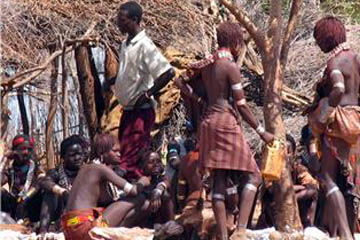
But seeing the excursion on our itinerary alongside temple visits, camel treks and countless game drives made me feel a little uncomfortable. When the principal attraction of a trip is looking at how other people live, there’s a fine line between human interest and human zoo.

In our short visit to this tribal region could we really learn much about a people’s traditions or were we just wandering through to gawk and collect a few snaps for Facebook?

On the jarring 12-hour truck ride to Turmi, a dusty town deep in the valley, we quizzed our guide Wesigne about the Hamer people, their customs and whether or not they would welcome interlopers.

When the principal attraction of a trip is looking at how other people live, there’s a fine line between human interest and human zoo.

He assured us that as well as being the most populous, the Hamer were the friendliest tribe in the region.

Sure enough, as our truck neared its destination the faces gazing at us from the roadside were smiling, though it is a little tough to appreciate a friendly wave when the outstretched hand is clutching a Kalashnikov.

Automatic weapons aside, the Hamer are a striking people, their chiseled, androgynous beauty marred only by the occasional decorative scars scored with inch-long thorns.

The Appeal of Tribal Tourism

For some reason, tribal living holds an undeniable worldwide appeal for tourists.

Admiring unique styles of dress and witnessing time-honored practices that have long-since become obsolete in western culture, offer a peek into a world that we only know from books and documentaries.

Photo by Monia Sassi

In fact, many people travel just to seek traditional cultures, shunning Western countries as boring, safe destinations. They want to visit those remaining corners where ancient lifestyles prevail before outside influences dilute and destroy them forever.

Yet by insisting on visiting these societies, perhaps we travelers are the very ones who contribute most to their decline.

Tourist visits inevitably bring items with them that are alien to certain cultures, items which many people believe pollute traditional societies by inflicting ‘westernisation’.

During our brief visit to the Hamer, Wesigne was quick to scold a travel companion for giving his old sunglasses to a teenage member of the tribe. He claimed that, while seemingly insignificant, a gesture like this could gradually change the tribe - starting with their traditional dress.

But are these minor changes such a terrible thing? Why should we as outsiders be so intent on keeping tribal cultures so traditional?

Is cultural preservation a selfish desire, so we can take striking photos and have a riveting tale for our next email home?

Agents of Cultural Decay

We presume that anything western would be a pollutant, but perhaps even the most traditional of tribes would enjoy a few modern conveniences to make life a little easier.

It seems that Westerners are intent on preserving other people’s cultures, even if that means making those people work a little harder for their daily bread.

The Hamer have already swapped their traditional spears for rather alarming machine guns. No, they’re not part of the typical costume, but when you’re dealing with AK47-wielding cattle rustlers, maybe you need something more than a spear to defend your livelihood.

At times it seems that Westerners are intent on preserving other people’s cultures, even if that means making those people work a little harder for their daily bread.

While wandering through the hassle-free market (aimed at locals, not the trickle of tourists that venture to this remote corner of southern Ethiopia) our guide bumped into his good friend Kale, a Hamer warrior.

Curious to learn a local perspective, we asked what he thought of tourists visiting his tribe and were surprised by his response. Translated through Wesigne, he told us that tourism might actually benefit the Hamer.

“If we know that people are visiting to see our customs, we become more proud of them and maybe that means there’s more chance of us keeping our traditions alive,” he said.

It was a point of view that I had never considered.

Pride and Tradition

If outside interest maintains pride in tribal traditions and travelers provide a small cash injection that enables rural dwellers to avoid the worldwide trend of moving to urban slums, is it possible ‘tribal tourism’ could actually help to conserve traditional life?

As we left Turmi a day later, I tasted much food for thought. We’d worried that our visit might be met with hostility, but what we found was an overwhelming indifference towards tourists.

Perhaps it was shyness, perhaps a way of masking distrust, but I think that we were seen by the villagers as an inevitable occurrence that, for the moment at least, has little bearing on daily life.

On our return truck ride along the bumpy dirt roads I noticed two Ethiopians from out of town heading back to their homes after a day of trading with the Hamer. Their Nike shirts and shorts were coupled with the headbands and gold bangles sported by tribal warriors in a style I like to think of as ‘Hamer Chic’.

It appeared that while outside influences are bound to change the tribe, cultural exchange is not always a one-way street.

Community Connection!

Check out Matador founder Ross Borden’s 10 Essential Tips For Visiting Indigenous Peoples

Do travelers damage traditional cultures, or does tribal tourism keep traditions vibrant and alive? Make your voice heard by leaving a comment below.

Lucy Corne

Lucy Corne is a freelance travel writer and English teacher. She has published three guidebooks and numerous articles for different publications. She is currently teaching English to Tibetan citizens in exile in India and loving it!

| Share on Facebook | Stumble it!

7 Comments »

  1. Comment by Haley January Eckels — April 30, 2008

    Very interesting piece, and it gives perspective to an increasing trend towards cultural/tribal tourism. In a way, all tourism aims at interacting with people unlike ourselves, but when it means interacting with a “traditional” group, we become nervous about the impact of our trips. While it’s good to be conscious of the affect that Western contact can have on isolated tribes (i.e. disease), it’s also a big presumptuous to assume that we should prevent them from becoming “modern” and worldly.

    Great food for thought, Lucy!

  2. Comment by Lola Akinmade — April 30, 2008

    “People travel to faraway places to watch, in fascination, the kind of people they ignore at home.” - Dagobert D. Runes

    Lucy - Definitely an insightful article and thanks for bringing it to the forefront.

    Once people stop struggling internally with the decision, thats when the real problem arises!

  3. Comment by Julie — April 30, 2008

    Lucy, Thanks for raising these questions and concerns, which apply not only to tribes but to “developing” countries in general.

  4. Comment by N. son — May 1, 2008

    I think travelers don’t damage traditional cultures if they are there for the right reasons. I don’t mean bringing medical supplies, aid or food. I’m talking about speaking and seeing different people and to learn from each other. We as humans are in a musical. Tickets are sold out everynight but casting is hard.
    laughter is key and smacking a 30 yr old kid is A Ok. Do you know who we be?

  5. Comment by Andrea Kirkby — May 2, 2008

    A very interesting piece. We don’t have very joined-up attitudes to other cultures, sometimes. I know someone who wants to bring anti-malarial drugs to Africa and wants to ban FGM - but also wants to prevent tribal peoples from being ‘corrupted’.

    (I wonder if the way Australian aborigines and Native Americans have started to develop and protect their cultures, while dealing with a modern world too, is relevant in Africa? That might be an interesting idea to follow up.)

    I thought it was very interesting that you allowed the local people to speak for themselves through your article. That brought a very fresh perspective. It’s certainly an issue we should all be thinking about - whatever, in the end, we decide to do on our travels.

  6. Comment by Denise — May 6, 2008

    This is my first comment…I just wanted to say that I believe what you stand for and what you do is remarkable, and that more people should take from your example and take the time to learn and appreciate other cultures. It takes all kinds of people to make up a world so why not be imformed about those who inhabit it?

  7. Comment by Turner Wright — May 8, 2008

    In Japan, I believe it does more good than harm. There’s an island south of the main group called Akusekijima, which celebrates the solar eclipse in the middle of July by resurrecting the native island tradition of dressing in grass skirts, donning huge wooden masks, and dancing to appease the gods. As there was little-to-no culture to begin with on these islands (fewer than 800 people on ten islands today), it’s a little bit of a refresher to see descendents carrying this particular tradition on.

    July 22, 2009 - total solar eclipse festivities on the southern islands of Japan.

Leave a comment

Please note: If this is your first comment, it will be moderated.

Get BNT by Email


Jump To Category:

Latest In Politics

Latest Comments