Could You Be A War Photographer?

05/7/08  Print This Post Print This Post    10 Comments   Popular   Written by Ellen Wilson
  • Stumble It
War photographers are accused of being adrenaline junkies. But they bear a terrible burden for witnessing the worst.

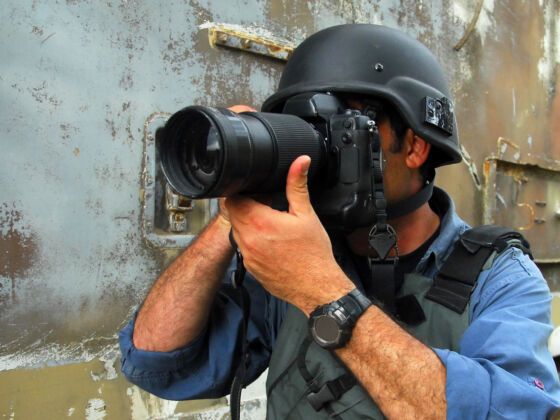
Photo by Mark Brecke

A photographer is a witness. Witnessing war is one of the ultimate human tragedies.

But what if you held a camera and not a gun? What would you see? What would you choose to shoot?

But perhaps, more importantly, what would happen to you after you took the shot? How would the experience change your view of humanity? How would it change your view of yourself?

War photographers are accused of being adrenaline junkies. Continually on the hunt for the next war, the next picture, they shove their lenses into the faces of their traumatized victims.

They are portrayed as voyeurs of suffering, and scavengers of the worst that humanity has to offer – mere human robots snapping pictures in the theater of war.

But there is a price to be paid for viewing all of this suffering.

Haunting Memories

The photographers all spoke of filming scenes of such grotesqueness that they knew the photos would never be published.

According to a study published in the Columbia Journalism Review, war journalists had significantly more post-traumatic stress disorder (PTSD), depression, and psychological distress than their domestic counterparts.

The war group also experienced a rate of PTSD over the course of their lives that far exceeded that of firefighters and police officers. In fact, war journalists approximated the PTSD rate recorded in combat veterans.

The photographers in the study all spoke of filming scenes of such grotesqueness that they knew the photos would never be published. Yet, even in the light of public squeamishness or editorial sensitivities, they felt compelled to record a visual testament.

Although the images never went further then the vaults of their mind, the collective weight of their memory would often intrude on their waking consciousness and nightly dreams.

With all the invasion of privacy, with all the peril, there is still this sense of mission.

Bearing Witness

World famous war photographer James Nachtwey has traveled everywhere wars and atrocities have been committed in the last decades: Iraq, Israel, Lebanon, Afghanistan, Indonesia, Kosovo, Chechnya, Rwanda, Bosnia, Sudan, Somalia, and many other countries.

Nachtwey believes his photography serves a purpose beyond visual remembrance.

He knows the gripping effect his photographs will have on people, and he has never stopped hoping that this effect will serve to stop the war, the hunger, and the poverty that is portrayed in his work:

“It’s more difficult to get publications to focus on issues that are more critical, that do not provide people with an escape from reality but attempt to get them deeper into reality. To be concerned about something much greater than themselves. And I think people are concerned. I think quite often, publishers don’t give their audience enough credit for that.

In fact, at the end of the day, I believe people do want to know when there’s some major tragedy going on; when there’s some unacceptable situation happening in this world. And they want something done about it. That’s what I believe. We must look at it. We’re required to look at it. We’re requited to do what we can about it. If we don’t, who will?”

There must be a reconciliation of the opposites of viewing the ugliest of humanity versus the beautiful good that humanity can create.

Shifting Morality

After 20 years of being a war photographer, Don McCullin wondered, “…these moral questions, later on, they came to haunt me.”

He speaks of a time when he was in the Congo, where the government soldiers had rounded up some young rebels fighting for Patrice Lumumba, and they were stripped, and the soldiers were goading them with rifles.

The young rebels looked at Mr. McCullin, pleading with him, with their eyes – to save them. There was nothing he could do. The government soldiers would have shot him.

As a witness, he took the picture, recognizing that he could be castigated for doing so. The photo, and the moment, will not be forgotten.

“I don’t approach these people as places as current events,” says Mark Brecke, a war photographer who travels light, and alone. “That’s not why I do this.”

Finding The Spirit

Brecke speaks of the people he has encountered, of stripping it all to the bare bones. He says, “It’s as if, in the face of it, stripped of everything else, they find the center, something spiritual – that thing that is most human.”

Even so, there is only so much humanity a human can take. “The day after a Congo grenade attack, I paid a guide to take me into the mountains to photograph the silverback gorillas,” says Brecke. “I’d had enough of people for a while.”

Perhaps this is why Don McCullin retired to Somerset, land of Arthurian legend, where he now gardens and advocates for the preservation of the English countryside.

Mixed within the fruits and berries of his garden pictures are Indian Gods and Goddesses. “I think I’m allowed to use this as a kind of herbal medicine for my mind,” McCullin says. “To love the environment where I live.”

Community Connection

Check out The Face Of War in A Child, a profile of Mark Brecke published last year in Traverse magazine.

What do you think of war photographers? Crucial service or crass opportunism? Share your thoughts in the comments!


  • Stumble It

About the Author

Ellen Wilson

Ellen Wilson is a freelance writer/photographer based in Michigan. She has taught English and biology in the US and the UK, and is constantly on the lookout for opportunities to educate and inspire others through her writing and photography.

10 Comments... join the discussion!

  • Jacob replied on May 7, 2008

    Great article! I think from an archive perspective that these photographers are downright vital. From a “telling the story perspective”, I’m not so sure.

    I remember watching “Gunner’s Palace”–the heart wrenching documentary of 2/3 Field Artillery Division–whose tagline was “Some stories will never make the nightly news”. The documentary was great, with soldiers breaking into rhymes seemingly “spontaneously” and young soldiers speaking candidly about accidentally firing their weapons. One scene even shows a soldier playing “Medal of Honor: Allied Assault” at his guard post. It all showed the blundering of the American forces in Iraq, in a deluge of images that were at times as funny as they were tragic. I loved “Gunner’s Palace” and thought 2/3 FA must’ve appreciated having the “real” story told.

    My brother was attached to the 1st Armored Division in Baumholder, Germany–the same place as 2/3 FA. “Gunner’s Palace” is a running joke there. Once, my brother brought up the movie to a colleague of his in 2/3 FA (who was “there” during the filming), at which point the officer rubbed his temples and said, “It’s like they took the few people in our unit with criminal records, and shone a spotlight on ‘em”

    My point–or rather, what I feel is important in this–is that “Documenting” is not a “story”. Stories have a slant, an angle, a purpose–protagonist, antagonist, etc. Filmmaker Michael Tucker seems to suggest that this film was a documentary and people such as myself were quick to take it for gospel. But for the people who “were there”, the remaining 90% of 2/3 FA, it’s nothing more than a highlight, a cute story about a few silly soldiers in a short period of time.

    This does nothing but entertain.

    When you say “Yet, even in the light of public squeamishness or editorial sensitivities, they felt compelled to record a visual testament,” THAT is what I feel is the vital service of combat photographers–to merely document, in spite of the economic gains.

    (Report comment)

    ↵ Reply
  • Eva replied on May 7, 2008

    Great article.

    It’s never even crossed my mind to think of war photography as “crass opportunism”. Again and again in recent history they’ve been the ones bringing home news and evidence that governments might not want ordinary people to see. Robert Capa’s Spanish Civil War photos, for example, or most famously the many photos that came out of Vietnam. (Vietnam’s tribute to American war photographers in the War Remnants Museum in HCMC is one of the more moving museum exhibits I’ve ever seen…) Even when they’re not unveiling “reality” in a political sense, they can teach those of us who stay back home so much. Capa (again – I’m a big Capa fan) is pretty much the reason why ordinary people know as much as we do about the experience of the D-Day landings.

    (Capa’s book, by the way, is called Slightly Out of Focus. He wrote it about his career in Spain and Normandy before being killed by a land mine in Vietnam.)

    (Report comment)

    ↵ Reply
  • Ian MacKenzie replied on May 7, 2008

    I found a recent talk from James Nachtwey where he talks about being a war photographer. Check it out!
    http://www.ted.com/index.php/talks/view/id/84

    (Report comment)

    ↵ Reply
  • Kimberly replied on May 7, 2008

    Really great post. I hadn’t thought of what photographers go through – and the decisions they’re forced to make – during war and natural disasters until I visited the recently re-opened Newseum here in DC 2 weeks ago. The Pulitzer Prize winning photo exhibit was harrowing.

    The photo that sticks out most in my mind was of a starving African child on the ground with a vulture right behind her, waiting for her to die. The quote from the photographer said that image haunts him and if he could go back and pick her up, he would. I can’t imagine trying to stay objective when witnessing something like that.

    (Report comment)

    ↵ Reply
  • Grace replied on May 7, 2008

    I know that photo well, it raises a lot of discussion amongst the viewers of the image as well as photojournalists-it’s from the early 1990’s taken by Kevin Carter, who committed suicide shortly after. It isn’t just the image that remains with me but the heart of the man behind the lens.

    (Report comment)

    ↵ Reply
  • Jack from eyeflare.com replied on May 8, 2008

    This is a great article. A book that really hit home when I read it, was Jon Steele’s “War Junkie” (review at http://www.eyeflare.com/article/war-junkie-by-jon-steele/).

    While Mr Steele was an ITN (Independent Television News) video photographer, he visited a number of the worst flashpoints of the time, including Rwanda. It’s a gut wrenching read, but I couldn’t put it down even while feeling quite ill imagining the brutalities he’d witnessed.

    The photogs who cover these situations aren’t opportunists, they’re very brave people who risk their life to bring us the reality of what our (and “the other side’s” politicians are throwing our soldiers into.

    (Report comment)

    ↵ Reply
  • Shawn replied on May 8, 2008

    Great article Ellen!

    Being a photographer who aspires to this field, this is something I’ve thought about long and hard… I wouldn’t say I wanted to be a “war” photographer but, being a very political and socially aware person, I want my photography to be the voice of those that cannot speak for themselves and the eyes for those who can’t see for themselves. I want to take photos that make someone, anyone, stop what they’re doing and say “It doesn’t have to be this way”. Does that include war? Sure. It has to. But when, and if, the time comes, will I be able to put my lens in the face of someone suffering and take their picture? I don’t know. I really don’t. My soul will surely be screaming for me put down the camera and help them. I’m just hoping that I have the wherewithal to realize that taking their picture just might be the best way that I can.

    (Report comment)

    ↵ Reply
  • Craig A Sheffield replied on March 13, 2009

    I am looking, at this time, into becoming a war photographer. My dad and grandfathers were soldiers, but I was unable to make the cut in the military due to my health. So, I would like to understand war through the lens of my camera. I would like to help portray the story of the dying soldier, and those who have passed on. I have a love for photography, and a high regard for the men and women who are fighting these wars. Trust me; I don't like war, but those soldiers who are fighting for our freedom deserve to have their story told through an unbiased source, because I can only shoot my camera by the freedoms they fight to uphold.

    (Report comment)

    ↵ Reply

Leave a Comment

Jump To Category:


Explore the Community


Latest Community Blogs

  • Electricity has not come to Nzulezu. Maybe it never will. The main source of light seems to be kerosene lanterns.  ...
    » posted on 7 November 2009
  • South African born Kate Berrisford, a law and environmental management masters graduate, who has several years of experi...
    » posted on 6 November 2009
  • Seattle weather is lovely in its violent, messy unpredictability.  Everything happens all at once and then can be s...
    » posted on 5 November 2009

Popular Stories on Matador

10 Volunteer Opportunities For Free Travel

From assisting with disaster relief to helping on the A... 

How to Get Off Grid in a Vintage Travel Trailer

Misty Tosh pimps out a vintage travel trailer and goes ... 

18 Essential Items for a Trip Around The World

What you decide to take on a round-the-world trip ultim... 

10 Things to do in Amsterdam BESIDES Smoking Pot

There's more to Amsterdam than legal bud.... 

Best Nude Beaches In The World

It’s a big world out there, with plenty of nooks and ... 

10 Traveler's Tips For Rocking A Nudist Beach

Travelers tend to enjoy ultimate freedom on the road, t... 


Focus


Editor Blogs

Friends