10 Ways To Avoid Getting Lost In A New City

05/12/08  Print This Post Print This Post    12 Comments   Popular   Written by Lisa Lubin
    Share
Getting lost in a foreign city happens to the best of us, the rest of us, and the most seasoned of travelers.
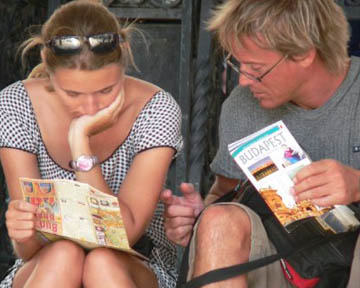
Photo by mcaretaker

You just landed in a foreign country after a 57 1/2 hour flight from Des Moines.

You’re tired. You’re hungry. You’re jet-lagged.

You manage to get through immigration and schlep your bags onto the metro. You emerge from the bowels of the subway into the blinding sunlight…and realize you have no idea where you are.

Sound familiar? Getting lost in a foreign city happens to the best of us, the rest of us, and the most seasoned of travelers.

We all get disoriented sometimes.What do you do when you don’t know where you are?

1. Don’t panic

First of all, you are in a city, not an Amazonian jungle. There is food and shelter (and probably a McDonalds) on every corner. Relax. Everything is going to turn out just fine.

2. Ask the locals

Not only are people almost always willing to help, asking for directions gives you a great excuse to talk to folks if you are feeling lonely.

If you’re female and feeling a bit scared, perhaps ask a local woman. This is a good way to practice your foreign language skills anyway (always learn the most important words: ‘thank you,’ ‘hello’, ‘excuse me’).

Don’t worry about a language barrier. If you are reading this article, you are fortunate enough to know a language that is spoken all over the world, and a smile is universal.

3. Look for big landmarks

In cities like Chicago, New York, and Paris there are some pretty tall, famous buildings usually visible no matter where you stand that can help you get your bearings.

Even the roughest New Yorkers sometimes emerge from the subway and need to find the Empire State Building so that they can orientate themselves and continue to the Carnegie Deli.

4. Pack a compass

Break out your trusty old compass, or go old school and seek out the sun. No matter where you are in the world, the sun will always set in the west (I’m making the assumption you aren’t lost at the North or South Pole).

If you know the general layout of the city, you can walk until you reach a river, park or major avenue.

5. Check out the tourist information office

Even if you’re not lost (yet) drop by this helpful place, if for no other reason than to get a good map. These goldmines of free maps and advice are typically located in airports and in train and bus stations.

6. Prepare in advance

If you are staying at a hotel that was recommended by your guidebook, there is often a city map in the book with the hotels marked on it.

While you are biding your time on the 10 hour train, bus, or airplane ride to your next destination, see where your lodging is on the map in relation to where you are coming into town and make a plan on how you will get from point A to point B.

7. Grab a business card

When you first check into your hostel or hotel, always take a business card (so you have the address and phone number with you at all times-to show taxi drivers, etc.) and also find the hotel on your map and mark it.

8. Retrace your steps

Always make a mental note of landmarks as you pass them, so that you can retrace your steps later if necessary.

9. Find a local pub or bar

Sit down. Take a load off. Have a drink. Repeat. You will start to feel better, I promise. And of course, you can then ask the bartender or friendly local next to you for some help.

10. Stay lost

You’re traveling! You’re in a city! How lost can you really be? Open yourself to serendipity and just wander around, taking in the sights and soaking up the vibe of the new place.

One of the best things about travel is embracing the unexpected, and being ‘lost’ is not necessarily a bad thing. In fact, in most cases losing your bearings leads to a fun adventure.

Imagine you’re a contestant on the Amazing Race, even though there’s no prize money at the end.

Some final thoughts…

Figuring out a new city, its infrastructure, its transportation options, and its layout can sometimes be frustrating, but also quite rewarding once you master the system.

I always feel like entering a new country presents a fun, new challenge and if you can find your way in a place like Hanoi…well, you will feel like you can do just about anything.


    Share

About the Author

Lisa Lubin

Lisa Lubin is a triple-time Emmy-award winning writer/producer who most recently worked for ABC in Chicago. After fifteen years in Television, she took a 'sabbatical' of sorts and just completed of a 17-month solo journey around the world. Check out her site LLWorldTour.

More By This Author

12 Comments... join the discussion!

  • Ian MacKenzie replied on May 12, 2008

    I totally got lost with a friend in Rome back in ‘99. We arrived at the train station, somehow made it to our hostel, then proceeded to get extremely drunk at a pub crawl. Hours and hours later, it only then dawned on us that we’d somehow need to find our way back to the hostel. From there, all I remember is a park bench, a guy named Carlo trying to sell drugs and feel up my friend. Oh yeah, and Christian missionaries.

    (Report comment)

    ↵ Reply
  • Eva replied on May 12, 2008

    Ha. Sounds like a good night, Ian.

    I know a diplomat who always takes a pack of matches or a card or something with him from his hotel when he goes out, to make sure he has the name and address on him. A few years back, he had to deal with the case of a Canadian in Athens who dropped off his stuff, put his passport and money in the safe, and went for a walk – got completely lost, forgot the name of his hotel, and wound up living on the streets for a matter of weeks before the Canadian embassy tracked him down. (The hotel had found the guy’s passport and notified them…) Crazy!

    (Report comment)

    ↵ Reply
  • Bill Chapman replied on May 12, 2008

    What an interesting contribution! I am not sure that English is as widespread or useful as people claim.

    I would like to argue the case for Esperanto, the international language to make travel easier. It is a planned language which belongs to no one country or group of states. Take a look at http://www.esperanto.net

    Indeed, the language has some remarkable practical benefits. Personally, I’ve made friends around the world through Esperanto that I would never have been able to communicate with otherwise. And then there’s the Pasporta Servo , which provides free lodging and local information to Esperanto-speaking travellers in over 90 countries. In the past year I have had guided tours of Berlin and Milan in the planned language. I have discussed philosophy with a Slovene poet, humour on television with a Bulgarian TV producer. I’ve discussed what life was like in East Berlin before the wall came down, how to cook perfect spaghetti, the advantages and disadvantages of monarchy, and so on. I recommend it, not just as an ideal but as a very practical way to overcome language barriers when away from English speaking countries.

    (Report comment)

    ↵ Reply
  • Turner Wright replied on May 12, 2008

    Number 10 rings true.

    (Report comment)

    ↵ Reply
  • Daniel Harbecke replied on May 13, 2008

    Nothing makes you look like an out-of-towner more than carrying around a big sloppy map. If you can, get a smaller one to compliment whatever larger map you’ve got. With the smaller map:
    1) fold it to show only your general area (it’s all you need), and
    2) fold it small enough to fit into a back pocket (otherwise empty, since you were smart enough to wear a money belt).

    If it fits in your hand so you can glance at it while you’re walking, you’re styling. If you really need to study it, duck into a doorway, sit on a bench, whatever – just get off the street. Travelers standing in the middle of the sidewalk with their swollen backpacks, blocking people from walking while they figure out where they are, suck. Plus, you look like a spectacular dork. Don’t be that.

    (Report comment)

    ↵ Reply
  • Alouise replied on September 6, 2009

    I got ‘lost’ several times in London. Of course usually after a few minutes of wandering I’d find a tube station and be able to get back to my hotel. It never bothered me. To me you’re only lost when you can’t find where you need to go to. I never had a set plan of where I should be so I never felt lost.

    (Report comment)

    ↵ Reply
  • Kevin Post replied on September 23, 2009

    Sure, being lost is exciting from time to time (in developed European countries where every other person speaks English). But try getting lost in the “comunas” of Medellín or taking a wrong turn in Diyarbak?r (where your Turkish is minimal and your Kurdish in non-existent). I can assure you that by the time you say “Stay lost” there are three guys whom have you at knife point. The majority of the people in the world are fantastic people but some of them have to eat and a white blond hair foreigner with a 55 liter pack is guaranteed to bring home some food.

    (Report comment)

    ↵ Reply
  • Vera Marie Badertscher replied on September 24, 2009

    On foot, staying lost in the daytime is a great idea. Not so sure about night time, when you can wander into a dicey area (all cities have them–not just Eastern). My favorite is #3. When in Athens–you can always see the Parthenon. Of course, if you did not follow the advice in #6 and look at the map in advance, you won’t know where you are in relation to the Parthenon, so it won’t help. I think Americans have the worst problems in old European cities that don’t have street names on every corner (or any corner) and no grid system. Even with a map it can be confusing, so a compass, advance preparation, and memorizing route as you walk are all essential.

    (Report comment)

    ↵ Reply
  • Joseph replied on April 23, 2010

    Number Seven is incredibly important, and although it seems like common sense, i just didnt think of it on my first trip to Japan. it would have saved a lot of trouble and many hours of fruitless searching for a friend who ran out of a bar drunk and disoriented and who ended wandering the streets of Kyoto for hours trying to find our hostel. But luckily i learned that Japanese police are very helpful and its good to have recent photos of your missing travel companion in your camera.

    (Report comment)

    ↵ Reply

Leave a Comment

Get Matador in your inbox and around the web.

Sign up for our FREE weekly newsletter.


View full list of RSS feeds

Jump To Category:


Explore the Community


The Radar  

Quick hits from the Matador Editors


Popular Stories on Matador

Photo Essay: Daily Life Around Monasteries in Burma

What do monks and nuns do when they aren't meditating? ... 

How to Back Up Google Docs

Taking for granted that Google will always be there mig... 

How Climbers Can Help Pakistan Rebuild

A senior official at the Red Cross has said that rebuil... 

How To Know When You're NOT Ready To Pack Up & Go?

Just ask yourself two very simple questions.... 

Introducing the Matador Store

Pick up a t-shirt and send us shots of you exploring th... 

Building Skis and Skating Rinks: 5 Hands-On Projects You Can Do

Gear is expensive, but if you’re handy with a hammer,... 

Why Would Anyone Ever Want To Leave America?!?

I’d love this country if it weren’t populated with ... 

Notes on a Pilgrimage to the Bodhi Tree

Robert Hirschfield visits the Bodhi tree where "a man g... 

Balloons, Cars, & Nose Blowing: 10 Incomprehensible Fetishes

What bores some stiff gets others that way. You may ne... 

9 Facts About Micro Four Thirds Cameras

Documentary photographer


Focus


Editor Blogs

Friends