Photo by Chrissy Olson
One of the first pieces of advice I received before leaving on this reporting project was from an Ethiopian diplomat in the States who requested that I “not be a typical journalist” in my coverage of Africa.
What he meant was that he didn’t want to see any more stories about African poverty in the news.
“Why don’t you write about positive things, like investment opportunities,” he suggested cheerfully as we toasted with Ethiopian honey wine in his spacious suburban home.
This is an increasingly common attitude in the media world as well, one I’ve even heard myself espousing at times. The concern is that coverage of Africa has been reduced to abstract misery; conflict, disaster, and of course, shocking poverty.
This numbing loop has left many Westerners dulled to images of violence and need.
A few days ago I had drinks with an American correspondent in Nairobi who said she felt that Americans were tired of images and descriptions of African poverty, that they no longer made an impact. Her answer was to focus her reporting on the Kenyan middle class as a way of humanizing African citizens.
This is another conversation I’m familiar with, one that pokes fun at reporters that go looking for the news clichés of “babies with flies in their eyes,” or “mothers that can’t find enough food to feed their families.”
Making An Impact
Before judging reporters for their insensitivity, keep in mind that our job is to get stories into the media and our hope, most often, is to ensure that those stories will make a lasting impression when you read them over your morning coffee.
This is a job that often requires unsettling ethical calculations as we strategize ways to convince editors to take another story about infant mortality, and whether that story will emotionally resonate with our relatively comfortable audience thousands of miles away.
Recently a piece I wrote comparing my water-wasteful lifestyle in the United States with the stories I’d reported of water shortages in rural Ethiopia–specifically how one father had lost four children to waterborne diseases–was classified by one reader as just another “guilt trip.”
Yet most of the reporting our team has done on this trip has centered on the larger environmental and political explanations for water shortages and water-related problems in eastern Africa.
African poverty has certainly made appearances, but it hasn’t seemed like a crucial focus of our work. That is, it hadn’t until I visited Kibera township.
The Face Of Poverty
Photo by Chrissy Olson
I traveled on a series of crowded matatus (minibuses) blaring African rap and boasting stickers declaring “Kibera ni Moja–Kibera United” and ended up in one of the world’s largest slums.
It was about 7am on a Saturday when I arrived at one of Kibera’s many entrances. Despite it being the weekend I watched as an endless line of people passed on foot in the still faint dawn.
I stood quietly as Nairobi’s factory workers, maids, cooks, nannies, security guards and drivers entered Kibera at the end of a long nightshift or trudged out for another day of work.
There was no hard news reason for me to be here. The post-election violence that put Kibera on the media radar this winter was long over. The displaced people were still displaced and the burned homes stood in charred ruins.
All that was left for an American reporter to see was the cold reality of life in one of the world’s most impoverished communities.
A Desperate Affair
Life inside Kibera, whether journalists and editors deem it worth repeating or not, is a desperate affair for those that call it home.
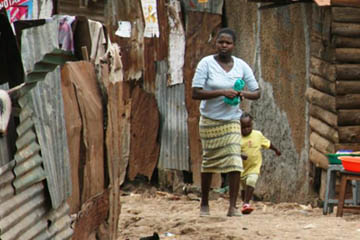
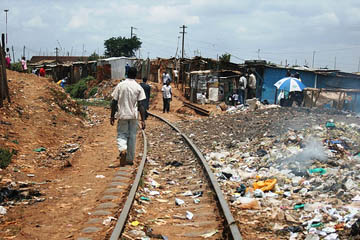
The Kenyan rainy season has begun and the tiny paths that connect homes and businesses have turned into a slippery clay-like sludge. Open sewers flood with human waste, corroded pipes unload brown water into backyards, tiny kids dressed in almost humorously ill-fitted and tattered outfits chase each other over mountains of shredded plastic bags and scraps of rotting food.
Kibera has been growing steadily since it was first settled by Nubians brought here to build the country’s railroad, and a century later it is home to an estimated million people who still live without basic services.
The Kenyan government is hesitant to legitimize illegally squatted land. That means there is no sewer system, no garbage pick-up, no piped water, no regular electricity and no government schools.
It means that residents, most living on less than one U.S. dollar a day, must fend for themselves without any illusions that their government or the rest of the world cares.
And before I lose my readers’ attention with generic descriptions of urban squalor, before you decide–as I have on occasion–that this story has been told and doesn’t properly represent life in Africa, or think privately to yourself that there isn’t much you can do and anyway, “the poor are always with us,” let me place these scenes in the terrifying context they deserve.
By The Numbers
The United Nations Population Fund estimates that 1 billion people live in slums like Kibera. That’s one in every six people in the world. In Nairobi it’s 60% of the city’s population.
The UN predicts these numbers will double over the next few decades.
Given this perspective, investment opportunities and Africa’s “middle class” suddenly don’t seem like the most relevant stories to tell here.
The other day, as I stood in a cloudburst on a muddy hill above the train tracks that cut through Kibera and looked out on a landscape of rusted tin roofs, I couldn’t shake the rising fear that I was looking into the future.
I felt beyond a shadow that I was looking at the makings of the permanent underclass required to support the polarized global economy we are shaping today.
And I wondered if we, citizens in the rich world, hadn’t already steeled ourselves to this cruel reality. If this callous resignation isn’t the reason why we’ve tired of reading about twenty-first century poverty before the magnitude of it is even realized.
Because Kibera isn’t a story that’s already been told-it’s a story that’s being written.
What are your thoughts on writing about “real issues” such as global poverty? Share your thoughts in the comments!
About the Author
Related Posts
15 Comments... join the discussion!
-
-
Sarah – Great article and I understand the need to continue telling these stories to make sure the world doesn’t become insensitive to these issues.
I also remember New Years Eve 2000. Watching the news as major world cities around the world welcomed 2000. “We take you live to Sydney and London and Beijing…”, the reporter says. “The world is celebrating…all except Africa”. Then they pan to faces of poverty we see daily. And he goes on to say something like “Africa is not celebrating because its still devastated by famine, disease,…..”.
There were fireworks and massive celebrations all over the continent even in the smallest communities.
As an African, what I want is absolute balance in the media’s coverage of Africa but that may just be a dream. Africa is a very complex continent – over 3000 unique languages, 50/50 Christian/Muslim, 50% of the world’s natural resources, etc. All of which incite conflicts on various levels. Not until Hurricane Katrina did the US truly expose its own problems with poverty and the world got to see it.
I understand your point and I also understand the diplomat’s point. Its easy to discount the words of someone living a more privileged life when in fact those words may ring true as well. Take Nigeria for example. My country is known worldwide for its volatile oil industry and “419″ corruption, yet its also one of the booming hubs of telecommunication and innovation on the entire continent.
My mother runs a grassroots NGO in Nigeria which focuses on empowering local communities and villages in terms of health education and social responsibility so I’m speaking as someone who understands and volunteers as well.
CLP is doing a fantastic job in its East Africa reporting, and please continue to do so.
Sometimes, its frustrating because the media always reports Africa in a constant state of despair. There are pockets of hope and grassroots successes that need to be highlighted as well.
↵ -
I agree with you, but it’s definitely a challenge to find a personal African poverty story without falling into the pitfalls of writing about the continent, as described so wonderfully (and humorously) by Binyavanga Wainaina in his Granta piece a few years ago:
http://www.granta.com/Magazine/92/How-to-Write-About-Africa?view=articleAllPages
“Never have a picture of a well-adjusted African on the cover of your book, or in it, unless that African has won the Nobel Prize. An AK-47, prominent ribs, naked breasts: use these. If you must include an African, make sure you get one in Masai or Zulu or Dogon dress.”
↵ -
I was just staring at a world map the other day. It’s funny how, in international media, it’s all just “Africa”. But like Lola pointed out, its a plethora of cultures, conditions, religions and circumstances. I couldn’t believe how many little lines there were all over that land mass.
It seems when people talk about the good, it’s very specific like “Forest Preserves of Kenya!” but when it’s bad, its nice and vague, as in “AIDS in ‘Africa’” or “Conflict on the Horn of Africa”.
It would be nice if we the media let Africans have their own identity more often. Lord knows, I’d be pissed if I was referred to as a “North American”.
Great article, Sarah.
Josh: Loved the Granta piece. Thanks for the link!
↵ -
Sarah– Thanks for this piece.
Lola– Totally agreed with you. And your remarks don’t just ring true about Africa; they’re applicable to Latin America, to Asia, to any place the West tends to view as a monolith. What we need to do, always, is to look for the micro-narratives: not just the macro picture, but also the tiny stories, which, like all lives, are full of hope and passion and dreams… and difficulties. And it’s all real. And it’s all important.↵ -
Regarding the continent question, here’s another quote from that Granta piece:
“In your text, treat Africa as if it were one country. It is hot and dusty with rolling grasslands and huge herds of animals and tall, thin people who are starving. Or it is hot and steamy with very short people who eat primates. Don’t get bogged down with precise descriptions. Africa is big: fifty-four countries, 900 million people who are too busy starving and dying and warring and emigrating to read your book. The continent is full of deserts, jungles, highlands, savannahs and many other things, but your reader doesn’t care about all that, so keep your descriptions romantic and evocative and unparticular.”
↵ -
Thank you for your article… I, of course, being an African living in Africa, have strong feelings about the way Africa is portrayed in the media, but I am also impressed by the comments here… Making me realise that not everyone buys into that “poor Africa” thing. One other thing- and this may be controversial, but: what model is used to determine what “poverty” is? Yes, yes, clean drinking water, basic shelter, etc- but what about the rest? Do you think that maybe part of the entrenched ideas about African poverty have to do with Western ideals? I confess to liking a Western lifestyle very much- which is part of the reason I am online- but is that what we ALL want?
Just a thought.
↵ -
It is the problem witrh mainstream journalism here Sateside that, no kidding, allowed over half an hour on the Today show be dedicated to the ugly divorce/child custody battle between Charlie Sheen and Denise Richards. An in depth story on how to provide the basics of Maslow’s pyramid to people all over the world? forget it. I’m still wondering what Bill and Melnda Gates mean in their NPR plug for their foundation. “everyone deserves a healthy, productive life.” Gotta throw in with Ian on this one on reporting successes, no matter how seemingly insignificant. I smell a story here. :Best Projects Improving the Day to Day Lives of the World’s Citizens.”
↵ -
I watched an indy film recently called Control Room, about Al Jazeera’s coverage of the second Iraq War. It confronted how we see other cultures, how they see us. There was a short clip in the extras about how one of the senior producers came to America (specifically New York) for the first time. He said he was surprised there were so few police sirens – in the movies, that’s all you hear.
I think we become numb to the same image of Africa, the two-dimensional depiction which Wainaina was getting at in the Granta piece. The problems are undoubtedly more complex than what we’re shown, but all we see are the results: the slums, the starving. And how can you not? How can a reporter look at this and not be moved to say something to people who have no idea what’s out there?
We seem to be paralyzed at a certain level, and we need to progress beyond it – not ignore it, nor gloss over it with TIA – “This Is Africa.” We need to keep it in the foreground, and not just throw money at it like a bribe to shut up. We need the different angles to understand the problem and what can be done. We see the house is on fire, but not how to put it out – and you can’t do that unless you keep getting more insight on it.
I believe the future you see will be unchallenged without the constant wakeup call. But I can’t believe people have accepted that future yet. God, though – it’s so difficult to see the present as it is, let alone the future…
↵ -
Great piece, Sarah. I visited Kibera several years ago with two other travelers as well as a Kenyan friend of mine and her brother. We had walked through the richest part of Nairobi earlier that day. What was surprising to me was how many people in Kibera were smiling. Yes, the quality of life was horrific–but people find a way. I certainly felt more welcome as an outsider in Kibera than I did walking outside Mbeki’s wife’s house, where the soldiers waved guns in a not-so-subtle message for us to keep moving.
I also think that no amount of reporting about Africa will enact a shift in mindset about the continent and its complexities unless people also begin to travel there in greater numbers (and I mean really travel, not just hit up the Serengeti, Zanzibar, and the Pyramids). Ninety-five percent of the foreigners I met in Africa were aid workers, whereas in India, Asia and Central America, 95% were travelers. While aid workers and journalists offer valuable insight, I think it’s travelers who can shine light on aspects of Africa that don’t need to secure funding or sell newspapers.
↵ -
“…people find a way.”
Insightful, Jenny. I’m only beginning my worldly travels, but this observation does ring true – people adapt; some of us grew up in urban middle-class nuclear families and did not spend our lives lamenting the fact that we weren’t born millionaires (well, hopefully not). People around the around the world are born into their reality, their standard on what constitutes “normal”; how long does it take children to discover that there are creatures thousands of miles away with fresh water spewing from a magical fountain, so much food that some “must” be discarded, in a different world entirely…?
Even up to that point, they’re ruled by the same emotions that govern us all: feeling happy when something unexpectedly good happens (yes, which must eventually happen around the world), laughing at the ridiculous, accepting where they are from, and knowing what they are capable of – anything.
This is one reason I get so frustrated when I hear media stories along the lines of “we must save these few kids from this kind of life”… no, we must slowly improve the conditions of the world, to make these areas habitable and comfortable, not suddenly infuse with money that can’t be used over the long term, or have celebrities remove them to “more civilized” areas of the world.
↵ -
In a toney suburb of Johannesburg, lost trying to find my way back to my friend’s house from the grocery store, affluent people of my own skin tone rolled up their windows and accelerated past me when I tried to get directions. I had y friend’s business card with his address. When I did talk to someone face to face he feigned no comprehension of English, being Afrikaans. Turns out they thought I might be a car jacker.
I had no such reaction in the poor sections of Durban as I hiked through town or in any other less affluent places. One of my favorite memories involves those “rag tag” children on a beach in western Madagascar, who’d dance with me as I walked on the dusty road to my room every afternoon. We cut some mean moves in the dirt and I’ve never seen such bright smiles. They were rewarded with dried apricots… these were some very happy kids; their folks seemed pretty content too.
↵