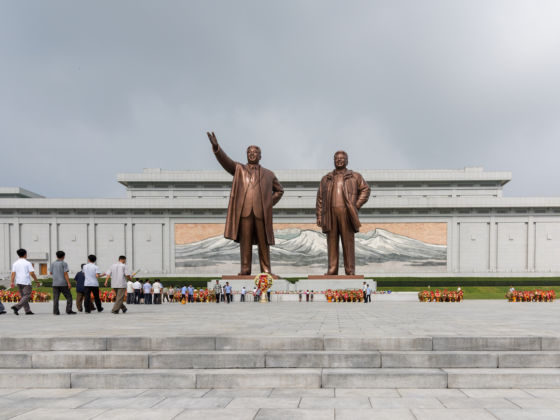
Photo by wajakemek
Cuba. Syria. North Korea. Myanmar. China.
You’ve heard the names and the stories. Their governments are abhorred by the international community for being repressive, authoritative, and sometimes bloody.
They limit access to information, movement, and education. They limit the freedoms of their people and hoard the country’s wealth while their people suffer in poverty.
Since Cyclone Nargis and the chaos in Tibet, world attention on these countries has become more sharply focused.
As I recently wrote about Tibet, boycotting China only encourages a hard line. The same is also true for these repressive countries. Boycotting only hurts the locals and keeps these regimes in power by limiting the people’s access to the information that may foster change.
Should we travel to these places? Will our travel, however tightly controlled, help the people or the government in power?
This is a complex and personal issue but, in my opinion, the benefits of traveling to these countries outweigh the negatives.
Travelers expose the people who suffer under repressive governments to ideas they can’t otherwise access. Depriving them of that information keeps them uninformed and helps the government to continue its stranglehold. A vibrant travel industry can also bring money they desperately need to survive.
People are understandably worried that their travel might be viewed as support for the government but by avoiding these countries.
Can we travel without supporting the government? Yes, here’s how:
Avoid government run organizations.
Governments have their hands in all the cookie jars. They run bus services, tourist offices, tours, hotels, and most everything else. It can be difficult to avoid them but it can be done. Find an operation not owned by the government, no matter how bad, and go there. Look for independent people offering rooms, rides, or guides. Support them.
Donate.
Give money to aid organizations in the country, temples, schools, or other charities that help the people directly.
Love thy neighbor.
Be kind, be gentle, be polite. Doing so will show the locals you aren’t the “boogie man” government propaganda makes you out to be. It will help counter the government propaganda machine. It will show them that the outside world isn’t so scary.
Volunteer.
This is the best way to offer direct assistance. Build a house, teach children, or help the sick. Whatever you do, it will be appreciated and directly improve the lives of the local inhabitants. Helping through Volunteer tourism will last longer than money and give the people something they can use years to come.
Follow the rules.
Following the rules is extremely important. Not only does this keep you out of trouble, but it also helps counter the propaganda that all foreigners are trouble makers. Governments would love to parade you around as a rabble rouser. Don’t give them that chance! It gives them an excuse to tighten their grip and further limit freedoms, movement, and information.
Tip generously.
They need that dollar more than you do. As a backpacker, I know how a tight budget feels, but the victims of years of repressive policies need the cash more than you. By donating to them, you help improve their lives directly as well as show them a kindness they normally don’t see.
Travel shouldn’t only be about expanding your own mind, but also the minds of the locals you meet – and everyone is entitled to that opportunity.
Don’t punish the people of these countries because their governments are repressive – go and show them that there’s a bright world out there…and we want them to be a part of it!
Do you think traveling to repressed countries is better than boycotting them? Share your thoughts in the comments!
About the Author
Related Posts
22 Comments... join the discussion!
-
-
Matt-
Thanks for this article.
I’d propose that the very best step any traveler can take is to step outside the mainstream media chatter and start learning about the history and current events in these countries. As Eva mentioned, each of the countries that North Americans tend to lump together as oppressive each have very different historical, cultural, social, political, and economic characteristics.↵ -
Eva. You are right. Sudan and Zimbabwe are awful. I was using the examples of countries you most often here in the media, at least the US media. Cuba is always in the news here. Syria and Iran too.
I guess this highlights the good topic of cultural perception of “what’s bad.” I don’t think Cuba is one of the worst but, if you listened to the media in America, you’d think they were shooting people in the streets. Zimbabwe gets no mention in the media except on NPR.
I was just highlighting the names people would most often hear about.
ps- I don’t think Zimbabwe even allows foreigners in anymore. I could be wrong but since the election I thought I heard Mugabe had pretty much shut people out except for diplomats and very few journalists. Or if they allow foreigners, its very very very very restricted.
↵ -
Julie-
I totally agree. In our “War on terror”, just like in our war on communism, we lump all groups into one pile when really they all have different goals. The North Vietnamese had different goals than the Russians or the Chinese but by viewing them all has one unit, we ended up in some bad situations.
Same is true today.
↵ -
Matt wrote:
“I guess this highlights the good topic of cultural perception of “what’s bad.†I don’t think Cuba is one of the worst but, if you listened to the media in America, you’d think they were shooting people in the streets.”
My point exactly! One of the reasons (beyond the great ones you listed) why I do think it’s important to travel to these places is to overturn those media images on the one hand, and to bring the ignored stories into the spotlight on the other.
↵ -
Ian – I’m a little surprised by that quote! I know the backlash against the embargo can tend to paint Fidel et al as far more angelic than they actually are (what politician is?) but even when Cubans do crazy things like wedging themselves into airplane engine tunnels (don’t know the correct technical term – remember that guy who made it from Havana to Montreal?) to escape, they never seem to mention a fear of torture or death as the reason for their actions. Amnesty International’s 2007 report on Cuba mentions “intimidation” and “harassment” but nothing more.
http://www.amnesty.org/en/region/americas/caribbean/cuba#report
Julie, any thoughts on this from your own experience? I’d always been under the impression that one of Cuba’s savings graces was that there isn’t a great deal of bloodshed involved in the repression.
↵ -
Matt, I’d like to offer another item to your list: don’t treat the citizens like criminals or victims.
The government or history of a country in question certainly influence a people, but it doesn’t set their identity. I still makes me angry that we in the West are fighting a passive-aggressive Cold War with Russia (and even former republics thereof) in movies and pop culture, and my wife and many like her have to sit there and endure the constant barrage of negativity.
In another case, regarding Germany’s past: most people are in the middle – they regret much of their country’s role in 20th century history, and are willing to contribute to reparations (even if their own relatives didn’t come back from the camps, and they’re too young to have been a part of that era). On the Left, some groups demand more be done for reparation. On the Right, some people refuse to feel guilty about it, so much so that they end up agreeing with nazism. I can’t help but think that the thinly veiled “Germany = Nazis”, “Russia = Commies” junk pushes more people toward the hardliners, as well as reinforce our own ignorance.
If you don’t like a country’s regime, at least make the people feel like they have friends on the outside. Doing otherwise just forces them to cling to blind nationalism because they feel everyone’s against them.
Eva: Sorry, not to be a know-it-all – the correct term is “wheel well.” Extremely dangerous place to be: greasy from hydraulics (which tend to crush things caught in the wrong place), not pressurized so you can breathe, extremely cold when you go up even a few hundred feet, especially compared to Havana, and it’s good to have an idea when the plane will land, so you don’t drop out after you’ve settled in for the flight. That’s assuming you time the plane correctly and don’t get blown away by the engines or run over… and, no peanuts!!! It’s quite a statement to risk all that, but not a very wise one.
↵ -
(Erm, which you kinda said under “love thy neighbor.”)
Beloved Leader would want me to admit that.
↵ -
Hey Daniel, Thanks for the lingo update! A few years ago a man made it from Havana to Montreal that way – roughly a six-hour flight? – by sucking moisture from his shirt. Pretty nuts. Everyone expected a totally horrifying story from him about why he was so desperate to leave – his answer when he was asked why he did it was, he wanted to earn more money. Sadly, that was the wrong answer for the refugee board, and he got put back on a plane (in a real seat this time) to Cuba.
↵ -
But did he get peanuts this time?!?
↵ -
Maybe pretzels… Air Canada banned peanuts years and years ago.
↵ -
And STILL you wear your flag with pride… (Shudder)
↵ -
hmmm… I don’t know, personally I thought this post sounded a little narrow-minded…. It sort of sounds like that “treat the natives well” kind of approach. (which is why I like Julie’s comment). While I applaud parts of the post- like volunteer tourism- I think the rest is not the approach one should take if one really wants to learn about a country and its people. Come here with an attitude like that, and people will treat you like That Idiot Foreigner. You WILL be taken for a ride.
Love thy neighbour? Lol.. that reminds me of the obnoxious American tourists I met in Australia. They went out of their way to tell the Aussies that they had stuff just like in the States- no, BETTER actually. So I guess that’s a good point.
Am curious: the points you make, can you apply them to a trip to, say, Italy? Because etiquette must be the same wherever you go, right?
And when you say Zimbabwe is not letting in tourists- do you mean WHITE tourists? cos I know Bob is not keen on white people in general. I see a few tourists around though, white and otherwise
By the way, I know an American operator who has settled here- he’s an independent guy, and likes the country enough to tell you, it’s not all about what’s in the news. Yeah, bad government- but the people are not so bad. Don’t generalise.
↵ -
Shona-
Thanks for the comment. You said: “it’s not all about what’s in the news. Yeah, bad government- but the people are not so bad. Don’t generalise.”
This was my point. The governments are bad but the people are not and that we should go to these countries because the people are good and not punish them because their government is bad. At the end, I emphasize that point
I don’t see what is bad about treating the natives well. Your comment about the obnoxious American tourists highlights what happens when you don’t want the negative perceptions that can come out of that. Most of these governments paint a bad picture of foreigners. Any listen to what Bob says and you can see he that. So why not counter that propaganda and kill it with kindness? Show the natives we aren’t bad and we respect your local customs?
You could apply some of what I said to say italy. Respect the local customs. Treating the locals with respect does wonders towards promoting a global human community.
↵ -
Good points, Matt. I agree with what you’re saying in response to my comments; I just don’t think it came out quite so clearly in the post.
Forgive me if it sounded like I was trashing your post- it’s just important to me that people keep an open mind when they go to another country and culture, and the best way is to approach it with the attitude of learning, NOT teaching…. Because it’s oh-so-easy to be patronising.
↵ -
“Treat the natives well”?
Sure, no colonialist attitude here! Yes, by all means, we should treat people with courtesy and respect wherever we travel, but can we drop the “us” versus “them” labels?
↵ -
I think Shona hit the proverbial nail on the head with her comment about learning, not teaching. As someone who has worked in the tourism industry, I can safely say that nothing turns you off faster than someone who thinks your country and way of life is inferior to their own — it puts you in a defensive position where you feel you have to justify your actions or stick up for your country (or sometimes just agree — because the “customer is always right”).
On the other hand, it’s easy to warm up to guests who want to know more about your city/country and who are excited to experience new things. Attitude is everything. It’s not just about “traveller” versus “local” distinctions… It’s just good interpersonal skills.
↵ -
Matt,
Thanks for this article. I experienced Myanmar first hand. We were a fairly large group of documentary photographers and when we got to Yangon’s airport, a “policeman” spotted our Motorola radios (those small cheap ones, we use them to communicate when working) and had us “detained” at the airport for two hours, until they finally agreed to keep the radios at the airport and give them back when we returned to Cambodia. When they found out we were photographers, they wanted to keep our cameras, too. If that happened, we were ready to take a plane back. There was no point for a photo group to stay w/o our work tools. They finally understood this and let us in.
The interesting thing is that, once in Yangon and Bagan, things were way more relaxed, and we didn’t have any other problems, not even while openly photographing on the streets.
For some people this was a shocking experience. That is why articles like these are so useful when it comes to researching the country you’re traveling to. Someone said that in Cuba, tourists are treated like kings and that Cuban government goes to the point of being very permissive with foreigners. I don’t know about this because I’ve never been there and I’m not planning to go for now.
Thanks again!
↵ -
Beth,
I had no colonial attitude in mind when I said that. I just meant that we should treat the locals with respect, like you said.
↵ -
Very interesting forum with alot of interesting angles. The steps listed in the article are definitely useful and do open lighter doors in some of these hotspots.
In the end leaving a people and a country in isolation does work agains a move forward in the right direction, however slow and grueling it may be.Cheers
↵


