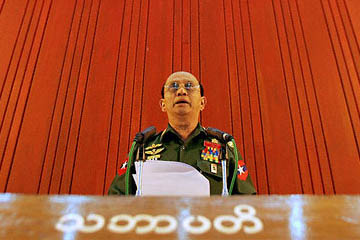
Lieutenant-General Thein Sein.
Last week BBC Worldwide, the commercial arm of the BBC, entered Burma Campaign UK’s “Dirty List” of 154 companies they claim directly or indirectly finance Burma’s brutal military dictatorship.
The reason for the inclusion?
Thanks to their majority stake in Lonely Planet, BBC Worldwide are now responsible for the Lonely Planet guide to Burma, undermining the democracy movement’s calls for a tourist boycott.
But do the BBC, and the 30 other tourism groups listed, deserve to be thrown in alongside nefarious oil and gas companies?
London-based pressure group Burma Campaign UK, believes so, “Our reviews represent the views of the Burmese democracy movement,” says, Campaign Officer Johnny Chatterton. “By going to Burma on holiday tourists are paying for the military machine that keeps the regime in power.”
Brutal Regime’s Tourism Links
Since 1962 Burma has been controlled by a military dominated government. Current leader Senior General Than Shwe identified tourism as a vital income source and, having used forced labour to build tourist facilities, now profits from many hotels and airports.
Half this money is spent maintaining military strength, not educating or caring for Burma’s people.
In response, the leader of the democratically elected National League for Democracy Aung San Suu Kyi, now under house arrest without trial for over 12 years, requested tourists avoid visiting the country.
“Burma will be here for many years,” Suu Kyi said. “So tell your friends to visit us later. Visiting now is tantamount to condoning the regime.”
Currently, thanks to this unsettled political landscape, only 750,000 tourists visit Burma annually, compared to the millions who flock to neighbouring Thailand.
Rough Guide respects Suu Kyi’s request and refuses to publish a Burma guide. But BBC Worldwide, Burma Campaign UK argues, undermines Suu Kyi, effectively defending tourism to Burma.
A Brutal Regime
BBC Worldwide have stressed that their decision to publish a guide to Burma does not represent support for the current regime. It, they say, provides information and lets readers decide for themselves.
Lonely Planet guides pride themselves in being independently written, offering impartial advice without any political affiliations. In the Burma guide they choose not to specifically state which hotels are regime owned, (no comprehensive list is currently available), but they do advise that such establishments are easily identified
“The first chapter of the guide presents all the issues and includes the views of Aung San Suu Kyi and the Burma Campaign UK,” says BBC Worldwide Director of Corporate Affairs Jennie Allen.
“For travelers who decide to visit Burma, it provides information which, if followed, will help maximise support for the local population and minimise the prospect of money going to the military regime.”
There is no arguing the regime is indeed brutal and shouldn’t be supported.
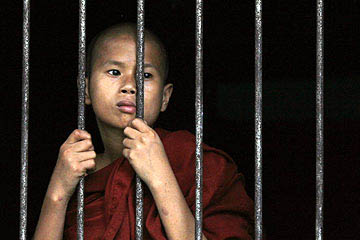
In September 2007 Buddhist monks protesting against government were fired upon by security forces resulting in many deaths. More recently, obstruction of aid relief following Cyclone Nargis undoubtedly resulted in additional suffering to the country’s people.
But is discouraging independent travel the correct course of action?
The Moral Question
Voices for Burma, an independent international NGO believe that responsible, small scale tourism benefiting local communities and raising awareness has a place in Burma.
Isolation, they claim, will only make the military government stronger and the people poorer.
Hannah James, editor of Real Travel magazine, agrees, “Independent travelers return with tales of locals desperate for visitors to come and an understanding of a country that the dictatorship just won’t allow to escape otherwise.
“If we stop going, are we turning our back on the military dictatorship or on the Burmese people themselves?”
Johnny Chatterton disagrees, “I would say that the people of Burma – represented by their politicians and trade unions – are the best qualified to judge whether tourists can play a positive role in their country.”
Some argue that the Burmese regime is no more brutal than those of other tourist destinations. But the reality is that Burma is different. Human right breaches can be directly connected to the tourism industry and the resulting revenue is helping the regime continue.
Letting The Reader Decide
BBC Worldwide’s guide, which they say will continue to be published, simply presents the information, leaving the decision its readers.
Even Rough Guide, in supporting the request for a tourist boycott, stresses it is a personal choice for individual travelers to make.
“We’re here to inspire and encourage travel, but we try to do so in as responsible a way as possible,” says Hannah James.
“The independent traveler will go to Burma if they want to, and it’s our job to best equip them to deal with the experience in a suitable manner rather than ignore them, and therefore the Burmese people, entirely.”
Readers of Lonely Planet are generally knowledgeable of political situations and fully aware of ethical travel. Their journeys tends to benefit local communities and small businesses first and foremost.
Ultimately, in publishing the Lonely Planet guide to Burma it is difficult to argue that the BBC Worldwide is supporting the Than Shwe’s regime.
Travelers will decide on their own merit the ethical issues of traveling to this controversial but no doubt beautiful country. And hopefully they will help by either spreading knowledge or financial support.
What is your stance on the controversy? Share your thoughts in the comments!
About the Author
Related Posts
8 Comments... join the discussion!
-
-
Having lived in Burma for three years and traveled throughout the country, including to many very out of the way places, I agree that there is no point in discouraging tourism there. This isolates the people of Burma from contact with outsiders, which they fervently desire, and has little or no impact on the military regime, which has many more lucrative sources of income, including gas and gems. Opposing tourism is a head in the sand approach which is out of step with the realities in Burma, whatever Aung San Suu Kyi may think. The greatest hope for positive change in Burma rests on opening it up to outside influence, which sooner or later will have an impact on the direction of events there. Attempting to further isolate the country just plays into the hands of a reclusive leadership and harms the Burmese people who need all the outside contact they can get.
↵ -
Don-
Well-articulated and your perspective as someone who has lived in Burma is definitely insightful.
↵ -
It’s a tough issue that requires hard decisions – especially considering Aung San Suu Kyi specifically asked that tourists spend their dollars elsewhere. Thanks Julie and Don for your comments on the other side of the argument.
↵ -
Your claim that readers of Lonely Planet are generally knowledgeable of political situations and fully aware of ethical travel made me laugh out loud… I undertook extensive research on exactly this problem, and, guess what, backpackers know NOTHING about Burma, about politics, and are generally not aware at all of ethical issues when travelling. Unfortunately, most of them are interested in the Full Moon Party, and the rest of the ‘Asia-trail’. Come on, face reality, just look at Khaosan Rd etc, don’t be a fool
I know that there are a lot of well-meaning travellers, and some of them are well-aware of the political issues, but most of them have no idea, mate! unfortunately knowledge does not run very deep amongst the LP readers, as they often don’t read much wider than that
other than that good article
PS: i see you are traveling in China at the moment? So what about the ethics of that?
↵ -
Andrea,
Thanks for reading the article and taking time to comment.
I do feel you are being slightly harsh on backpackers. My experience of the situation is that they are generally clued-up and respectful about the places they visit. Although I will agree there are always exceptions. I would be interested in finding out more about your extensive research.
Regarding your China question, I advise you to read Matthew’s article http://www.bravenewtraveler.com/2008/05/28/why-its-useless-to-boycott-the-bejiing-olympics/. While this may not present a definitive answer it goes some way to explaining my logic in visiting China.
Cheers
Colin↵ -
I’d generally agree, although probably in less forthright terms, with Andrea – I chatted to several travellers I met in Thailand who’d been or were planning to go, to Burma, and in every case they had little or no real understanding of the issues, and in the majority of cases hadn’t even considered them, and were surprised to hear about the position of Aung San Suu Kyi or the Burma Coalition. For most, their desire to go was about ‘getting off the beaten track’ without really thinking why that is the case.
That’s not to say all travellers are like that – from what you say Don, you are clearly not that type, and I have read accounts from other enlightened backpackers – but sadly I think you’re a minority, and it’s partially for that reason I continue to support the boycott in general, while supporting more engaged travellers like yourself.
↵ -
Traveling throughout Myanmar (Burma) it was sadto see the reality on the ground for the Burmese. They are benefiting from Foreigners coming to their country. There were those who were ignorant of the fact of state owned enterprizes which was quite dissapointing but there were others who tried to give as much as they could to the people.
Isolation would make the situation in Myanmar (Burma) harder and conscious and informed travelers definitely make a difference in presence and communication.Cheers
↵