10 Extraordinary Burial Ceremonies From Around The World

06/25/08  Print This Post Print This Post    16 Comments   Popular   Written by James Michael Dorsey
  • Stumble It

Photo by Dale Harrison

Not all cultures believe in burying the dead in the ground. Here are 10 unique ceremonies from around the world.

The modern dictionary defines the word ‘burial’ as placing a body in the ground.

But burying the deceased was not always the case.

Just as primitive man has long worshiped the four elements of Earth, Sky, Water, and Fire, so too have these elements taken their place in burial practices as diverse as the different tribes of the earth. 

The way mankind deals with its dead says a great deal about those left to carry on.  Burial practices are windows to a culture that speak volumes about how it lives.

As we are told in Genesis, man comes from dust, and returns to it. We have found many different ways to return. Here are 10 that I found particularly fascinating:

Air Sacrifice – Mongolia

Lamas direct the entire ceremony, with their number determined by the social standing of the deceased. They decide the direction the entourage will travel with the body, to the specific day and time the ceremony can happen.

Mongolians believe in the return of the soul. Therefore the lamas pray and offer food to keep evil spirits away and to protect the remaining family. They also place blue stones in the dead persons bed to prevent evil spirits from entering it.

No one but a lama is allowed to touch the corpse, and a white silk veil is placed over the face.  The naked body is flanked by men on the right side of the yurt while women are placed on the left.  Both have their respective right or left hand placed under their heads, and are situated in the fetal position.

The family burns incense and leaves food out to feed all visiting spirits.  When time comes to remove the body, it must be passed through a window or a hole cut in the wall to prevent evil from slipping in while the door is open.

The body is taken away from the village and laid on the open ground. A stone outline is placed around it, and then the village dogs that have been penned up and not fed for days are released to consume the remains.  What is left goes to the local predators. 

The stone outline remains as a reminder of the person.  If any step of the ceremony is left out, no matter how trivial, bad karma is believed to ensue.

Sky Burial – Tibet

Pounding the bones. Photo by Rotem Eldar

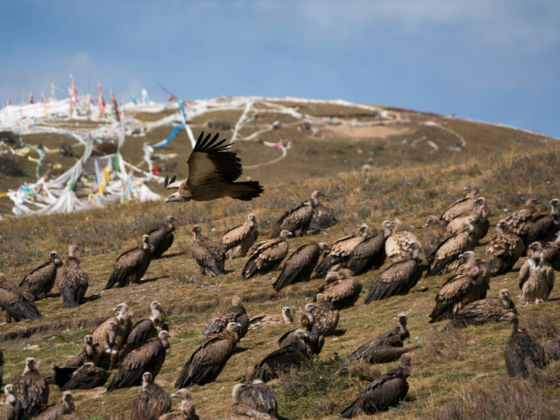
This is similar to the Mongolian ceremony. The deceased is dismembered by a rogyapa, or body breaker, and left outside away from any occupied dwellings to be consumed by nature.

To the western mind, this may seem barbaric, as it did to the Chinese who outlawed the practice after taking control of the country in the 1950’s. But in Buddhist Tibet, it makes perfect sense. The ceremony represents the perfect Buddhist act, known as Jhator. The worthless body provides sustenance to the birds of prey that are the primary consumers of its flesh.

To a Buddhist, the body is but an empty shell, worthless after the spirit has departed. Most of the country is surrounded by snowy peaks, and the ground is too solid for traditional earth internment. Likewise, being mostly above the tree line, there is not enough fuel for cremation. 

Pit Burial – Pacific Northwest Haida

Haida carvings. Photo by Turbulent Flow

Before white contact, the indigenous people of the American northwest coast, particularly the Haida, simply cast their dead into a large open pit behind the village.

Their flesh was left to the animals. But if one was a chief, shaman, or warrior, things were quite different.

The body was crushed with clubs until it fit into a small wooden box about the size of a piece of modern luggage.  It was then fitted atop a totem pole in front of the longhouse of the man’s tribe where the various icons of the totem acted as guardians for the spirits’ journey to the next world.  

Written history left to us by the first missionaries to the area all speak of an unbelievable stench at most of these villages.  Today, this practice is outlawed.

Viking Burial – Scandinavia

Viking’s ashore. Illustration Long Beach City College

We have all seen images of a Viking funeral with the body laid out on the deck of a dragon ship, floating into the sunset while warriors fire flaming arrows to ignite the pyre. 

While very dramatic, burning a ship is quite expensive, and not very practical. 

What we do know is most Vikings, being a sea faring people, were interred in large graves dug in the shape of a ship and lined with rocks.  The person’s belongings and food were placed beside them.  Men took their weapons to the next world, while women were laid to rest wearing their finest jewelry and accessories. 

If the deceased was a nobleman or great warrior, his woman was passed from man to man in his tribe, who all made love to her (some would say raped) before strangling her, and placing her next to the body of her man.  Thankfully this practice is now, for the most part, extinct.

Fire Burial – Bali

Fire consumes all. Photo by Barnacle Bikers

On the mostly Hindu Isle of Bali, fire is the vehicle to the next life. The body or Mayat is bathed and laid out on a table where food offerings are laid beside it for the journey. 

Lanterns line the path to the persons hut to let people know he or she has passed, and act as a reminder of their life so they are not forgotten.

It is then interred in a mass grave with others from the same village who have passed on until it is deemed there are a sufficient number of bodies to hold a cremation. 

The bodies are unearthed, cleaned, and stacked on an elaborate float, gloriously decorated by the entire village and adorned with flowers. The float is paraded through the village to the central square where it is consumed by flames, and marks the beginning of a massive feast to honor and remember the dead.

Spirit Offerings – Southeast Asia

Row of spirit houses. Photo by Marc Aurel

Throughout most of Southeast Asia, people have been buried in the fields where they lived and worked. It is common to see large stone monuments in the middle of a pasture of cows or water buffalo.

The Vietnamese leave thick wads of counterfeit money under rocks on these monuments so the deceased can buy whatever they need on their way to the next life

In Cambodia and Thailand, wooden “spirit houses” sit in front of almost every hut from the poorest to the most elaborate estate.  These are places where food and drink are left periodically for the souls of departed relatives to refuel when necessary.  The offerings of both countries also ask the spirits of the relatives to watch over the lands and the families left behind.

Predator Burial – Maasai Tribe

No after life. Photo by Demosh

The Maasai of East Africa are hereditary nomads who believe in a deity known as Enkai, but this is not a single being or entity.

It is a term that encompasses the earth, sky, and all that dwells below.  It is a difficult concept for western minds that are more used to traditional religious beliefs than those of so-called primitive cultures. 

Actual burial is reserved for chiefs as a sign of respect, while the common people are simply left outdoors for predators to dispose of, since Maasai believe dead bodies are harmful to the earth.  To them when you are dead, you are simply gone.  There is no after life.

Skull Burial – Kiribati

Chilling out. Photo by aargh

On the tiny island of Kiribati the deceased is laid out in their house for no less than three days and as long as twelve, depending on their status in the community.  Friends and relatives make a pudding from the root of a local plant as an offering. 

Several months after internment the body is exhumed and the skull removed, oiled, polished, and offered tobacco and food.  After the remainder of the body is re-interred, traditional islanders keep the skull on a shelf in their home and believe the native god Nakaa welcomes the dead person’s spirit in the northern end of the islands.

Cave Burial – Hawaii

Cave burials. Photo by Extra Medium

In the Hawaiian Islands, a traditional burial takes place in a cave where the body is bent into a fetal position with hands and feet tied to keep it that way, then covered with a tapa cloth made from the bark of a mulberry bush. 

Sometimes the internal organs are removed and the cavity filled with salt to preserve it.  The bones are considered sacred and believed to have diving power. 

Many caves in Hawaii still contain these skeletons, particularly along the coast of Maui.

Ocean Burial

The open sea. Photo by Spirit of Albion

Since most of our planet is covered with water, burial at sea has long been the accepted norm for mariners the world over.

By international law, the captain of any ship, regardless of size or nationality has the authority to conduct an official burial service at sea.

The traditional burial shroud is a burlap bag, being cheap and plentiful, and long in use to carry cargo.  The deceased is sewn inside and is weighted with rocks or other heavy debris to keep it from floating. 

If available, the flag of their nation covers the bag while a service is conducted on deck. The body is then slid from under the flag, and deposited in Davy Jones locker.

In olden days, the British navy mandated that the final stitch in the bag had to go through the deceased person’s lip, just to make sure they really were dead.  (If they were still alive, having a needle passed through their skin would revive them).

It is quite possible that sea burial has been the main form of burial across the earth since before recorded history.

The Final Frontier

Today, if one has enough money, you can be launched into space aboard a private commercial satellite and a capsule containing your ashes will be in permanent orbit around the earth.

Perhaps this is the ultimate burial ceremony, or maybe the beginning of a whole new era in which man continues to find new and innovative ways to invoke spirits and provide a safe passage to whatever awaits us at the end of this life.

Any other death ceremonies you’ve encountered? Share your thoughts in the comments!


  • Stumble It

About the Author

James Michael Dorsey

James Michael Dorsey is an explorer, author and photographer who has traveled off the beaten path in 35 countries. He lives among indigenous peoples and records their cultures. His work has appeared in Christian Science Monitor, BBC Wildlife, WEND, Sea Kayaker, and TravelersTales. Visit his website www.jamesdorsey.com

16 Comments... join the discussion!

  • Daniel Harbecke replied on June 25, 2008

    Fascinating material! Thank you, James – quite an insight into how people view the Afterworld, the nature of life, one another… but now you’ve got me thinking…

    If I were going to have a burial ritual, it’d be called the Ice Cream Offering. Much like an Irish wake, the departed’s remains are tied to a 2-wheel dolly, fixed in a genial pose (like a friendly wave of greeting) and carted to Dairy Queen. Funeral attendees order whatever they like, all the while gesturing over their shoulder to the Late Lamented and saying the ritual words: “He’s buying.” The last mourner in line should be expected to have fast legs and a cover on his or her Peanut Buster Parfait.

    Erm, now that I think of it, it’s less of a wake and more like “Weekend at Bernie’s.” Though not as cool as Hunter S. Thompson’s ceremony, I just have this to say about my ceremony: “Free ice cream.”

    (Report comment)

    ↵ Reply
  • Tanya replied on June 25, 2008

    When you say Pacific Northwest Indians, you mean Native Americans right? Because Indians means from the origin of India which these people clearly are not.

    (Report comment)

    ↵ Reply
  • heather replied on June 25, 2008

    Fantastic! So interesting. I’m lucky to have StumbledUpon it.
    Thank you so much.

    (Report comment)

    ↵ Reply
  • Ostichrecliner replied on June 25, 2008

    How about taking a lesson from the Rolling Stones’ Keith Richards, where Mom or Dad’s bones are cremated then ‘inhaled’ by all the family members over Thanksgiving dinner!

    (Report comment)

    ↵ Reply
  • Miss Cellania replied on June 25, 2008

    I know this is picky, but it’s the perfect opportunity to use the poem.

    The one-l lama,
    He’s a priest.
    The two-l llama,
    He’s a beast.
    And I will bet
    A silk pajama
    There isn’t any
    Three-l lllama.*

    – Ogden Nash

    (Report comment)

    ↵ Reply
  • Julie replied on June 25, 2008

    Really interesting; thanks, James. Though it’s not quite so dramatic or infused with tradition as any of the burial rituals you describe, I’ve been fascinated by the emergence of “pod burials,” in which the deceased is put in a biodegradable pod and buried, either in traditional Western fashion or–depending on local laws–in a patch of land that held special significance for that person. Certainly seems to be more environmentally sustainable than coffins, though I’ll admit that I don’t know very much about the practice.

    (Report comment)

    ↵ Reply
  • Michaela Lola replied on June 25, 2008

    Ooohhh! very interesting…The Philippines also has some unusual burial practices. The Hanging coffins of the Philippines is one of these..

    http://www.gooya.us/photos/2007/11/hanging-coffins-of-sagada-philippines.php

    Some are extremely high up and hidden at the top of a mountainside and to this day, how people got the coffins up there remains a mystery.

    Thanks for a cool read…

    http://michatheperegrine.googlepages.com/home
    http://lookingforlola.wordpress.com/

    (Report comment)

    ↵ Reply
  • Tom Swirly replied on June 26, 2008

    In Bali, a cremation is a huge party, these days with custom T-shirts for friends and family. It costs a bundle, so it’s very common to temporarily bury your relative while you save the money for the cremation, there are quite a few little graveyards with temporary markers.

    One of my big regrets in Bali was that I was invited to one of these and passed it up (I was under the weather but I could have made it…)

    (Report comment)

    ↵ Reply
  • K Young replied on November 12, 2008

    There are so many terrific options to consider. If you would like to better the earth and the sea at the same time, please consider permanent ocean monuments with Twin Rocks Undersea Memorial. http://www.twinrocksunderseamemorial.com. Monuments are permanently placed in the Pacific Ocean, GPS located and have niches for sea life. A really great option for those choosing cremation.

    (Report comment)

    ↵ Reply
  • Debra Joy replied on December 17, 2008

    This is a great article. Really interesting. I think it's interesting to learn about the different relationships we have with death and dying.

    (Report comment)

    ↵ Reply
  • Viveka replied on December 18, 2008

    Very interesting article, I liked it a lot. Just wanted to comment on this little bit (without being rude, I just felt this needed to be mentioned):

    "If the deceased was a nobleman or great warrior, his woman was passed from man to man in his tribe, who all made love to her (some would say raped) before strangling her, and placing her next to the body of her man. Thankfully this practice is now, for the most part, extinct."

    Scandinavians (because Viking "tribes" ceased to exist quite a while ago) do not strangle their women as part of a burial ritual, as we happen to be normal people like the rest of you. So no, the practice is not "for the most part" extinct. It is. Permanently. If the Vikings did it, it was a long, long time ago, and as Vikings technically don't exist anymore, their Scandinavian ancestors do not necessarily follow the same customs.

    (Report comment)

    ↵ Reply
  • Daniela replied on February 15, 2009

    Oh, that was interesting!
    If anyone has a particular interest in exotic burial ceremonies, please check a tradicional Bororo (Brazilian indians) funeral. They are incredible.

    (Report comment)

    ↵ Reply
  • Erin replied on June 23, 2009

    The whole Viking human sacrifice thing has very minimal evidence to support (there’s some, mind you, but it’s a very rare occurance). And only a snall portion of Viking burials included boats, ships, or boat-shaped stone settings. Viking burial practices are fascinating though, particularly because they were so varied.

    Burials could occur in chambers, boats, wagons, coffins or simple pits. They could involve cremation or simple inhumation. Grave goods ranged from simple things like knives and beads to very elaborate collections of items such as weapons, jewellery, everyday tools, imported objects etc. Animals were sometimes sacrificed, particularly horses and dogs. Very rarely, there may be evidence for human sacrifice (such as the grave at Balladoole on the Isle of Man). Individuals were usually buried alone, although in some instances more than one person might be included in the grave (as at Scar, Orkney), without evidence for sacrifice. Also, sometimes graves were opened and a second individual was added, perhaps a spouse who died later?

    The Ibn Fadlan account upon which your information is based is fascinating, but flawed for a number of reasons. Not saying it is completely false, but it does not seem to represent typical Viking burial, not even for a chieftain.

    (Report comment)

    ↵ Reply
  • David replied on October 5, 2009

    Being PC is so yesterdays fad. You know what Indian means.

    (Report comment)

    ↵ Reply
  • mamad replied on January 20, 2010

    wow…………..
    that was astonishing meanwhile very cruel anyway i think anybody should decide himself how would be his funeral,i myself would like to denote all parts of my body and then be buried underground respectfully.
    anyhow thanks for the information

    (Report comment)

    ↵ Reply
  • karen replied on March 3, 2010

    fantastic from a nursing student :)

    (Report comment)

    ↵ Reply

Leave a Comment

Get Matador in your inbox and around the web.

Sign up for our FREE weekly newsletter.


View full list of RSS feeds

Jump To Category:


Popular Stories on Matador

20 Quotes to Inspire Change

You wanted to save the world, but somewhere you lost yo... 

9 Ways To Customize Your Backpack

For slow travelers, it's very likely that you and your ... 

10 Gadgets to Unleash Your Inner James Bond

Introducing real-life gadgets that trounce some of 007'... 

Essential Gear for the Nomadic Travel Photographer

Are you a serious travel photographer constantly on the... 

8 Classic Mexican Expressions To Perk Up Your Spanish

Echar la hueva: the opposite of "echarle ganas." Inste... 

Material Transparency: manifesto on a writer's personal brand

Material Transparency is an underpinning or ethic of a ... 

The Dharma Shack Chronicles

Notes from Summer 2009 in the Dharma Shack, a lean-to a... 

Riding the Recession: Best Budget North American Ski Resorts

When lift tickets come in under $60, there may even be ... 

Travel Blogging Tips: Adding Social Media Buttons

Using social buttons to share your content is essential... 

Someday Syndrome & the System of I-Can’ts

Or why I left my five year old standing in a raging riv... 


Focus


Editor Blogs

Friends