Escape From Iraq: A Muslim Family Finds Solace In Ramadan

11/7/08  Print This Post Print This Post    15 Comments   Popular   Written by Sarah Shourd
  • Stumble It

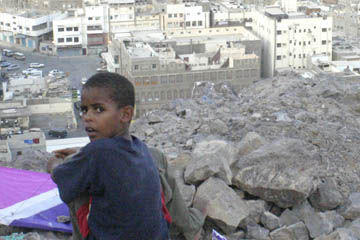
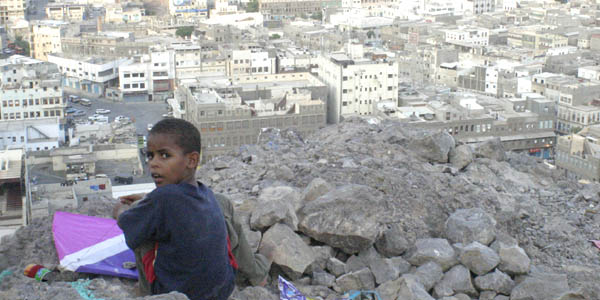
Young kite flyer in Aden / Photo author

On a visit to Yemen, Sarah Shourd is invited to an enlightening dinner with an Iraqi family.

It’s a few minutes before 6 and the light in the port-city of Aden in South Yemen is beginning to fade.

As the sun sinks behind jagged cliffs the city takes a deep, full-bodied breath. Its mouth opens wide, its lips stretch thin and like a great, harmless beast it sucks all the people into its warm, concrete belly.
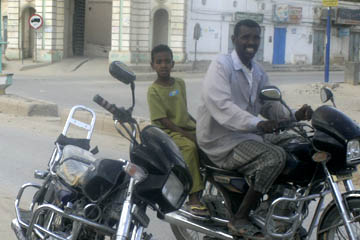
In seconds the streets are empty. Steel-doors are bolted shut, soccer games cut short and kites quickly pulled from the sky. Women disappear into their homes and men duck into small, crowded restaurants.

No dark clouds mar the gray sky; no sound of thunder threatens in the distance.

The population of Aden is driven indoors by the sound of dozens upon dozens of loudspeakers. Mosques scattered across the city’s face erupt into a kind of song that is not music or chant, not beautiful or ugly but awesome and commanding.

From my birds-eye perch 500 feet up on the backbone of an extinct volcano the locals call Crater, the sound is deafening. It ricochets off Crater’s walls and collides in my inner-ear like a great, booming storm, “God is great, God is great. I bear witness that there is no god but Allah.”

It is the evening call to prayer.

The Power Of Faith

It’s Ramadan, the 8th month of the Islamic Calendar, Muslims all over the world are demonstrating the power of their faith by exercising restraint.

Aden is like an Arab version of Coney Island: A city by the sea that never sleeps, awash with spectacle and surprise.

In Aden people are taking their first sip of cool water since dawn. They are enjoying special treats like breaded balls of soft potato, creamy pudding, crispy meat-filled samosas and soft, sugary dates.

Muslims not only consume nothing during daylight hours for one month, they also do their best to resist illicit thoughts and behavior, read the entire Koran and act generously toward those who have less.

When the voices start up again, “Hasten to prayer, hasten to prayer,” women clear the cups and plates and lay out their prayer rugs.

Men wipe the crumbs from their lips, rinse the grease from their hands and head for the mosques.

City By The Sea

Aden is like an Arab version of Coney Island: A city by the sea that never sleeps, awash with spectacle and surprise.

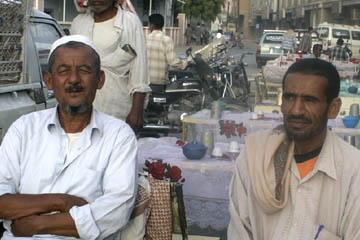
During Ramadan it is common to shorten the fast by staying up late; in Aden the typical bedtime is 4am. All night people squat around platters of food, boys play pool in the street and half-naked old men pose like cats on small squares of cardboard.

I meet Nada while traveling on a bus on the first day of Ramadan. As we traverse a rocky, green landscape the passengers begin to arrange food on the small, plastic tables attached to the chairs in front of them.

When the sun is no longer visible behind low cliffs, a dispute breaks out when two passengers start eating and others say it’s too early. Someone yells to the driver to turn on the radio and all doubt is assuaged when the call to prayer comes crackling over the airwaves.

Everyone hands around a little of what they’ve brought, a disproportionate amount being heaped on us. The bus is soon alive with chatter and shouts of, “Ramadan!” and “God is generous.”

A middle-aged woman in front of us turns to my friend and asks him about the book he is reading. It’s called, “The Shia Revival.” She wants to know why an American is reading this book.

“You have questions about Shia?” she asks, “I can tell you the real story of the Shia.”

Escape From Iraq

Nada is an Iraqi engineer who moved to Yemen 7 years ago with her husband and two sons to escape Saddam, who openly despised the Shia sect.

They left behind a house they were slowly building on the banks of the Euphrates in the center of Baghdad. Saddam feared that as the Shia majority might someday overthrow him and his Sunni-dominated government, so he robbed them of political power and killed them by the thousands.

Saddam feared that as the Shia majority might someday overthrow him, so he robbed them of political power and killed them by the thousands.

They had to leave Iraq, Nada explained, but little did they know it would soon become far more dangerous and that their family home would be blocks away from the Green Zone.

“Come to my house tomorrow,” she says, “8 o’clock.”

There are 12 identical unmarked apartment buildings lined up on Nada’s block. A kid helps figure out which one is number 10. When we knock on her door the urgency in her voice pulls us inside:

“How did you know the building?” she asks.

“You told us number 10, we asked a boy in the street.”

“Which boy?” she shoots back.

“Just a boy!”

She has reason to be uneasy around Americans. She later confides that her son yelled at her that afternoon, “The Americans occupy our country and now you invite them to our house!”

They guide us into their living room where we sit and watch while she and her sons bring out plate after plate of Ramadan treats.

Shortly after we begin eating the conversation turns to the war. They explain that since the Occupation, they and their Sunni neighbors have been pitted against each other. This bitterness didn’t exist under Saddam; now Iraqis are killing other Iraqis for the first time.

“It’s Not Your Fault”

They went back to Baghdad to visit family in 2005. Her youngest son, Riyad, was seized by American soldiers during a raid. They held a gun to his head and threatened to kill him.

Somehow they were able to get him out alive but his family is still very protective of him. He is the only one in the room who doesn’t speak English and is exceedingly jealous that his handsome older brother is getting more air-time.

Nada pleads with me to try and speak Arabic with him and I somehow get out a few, hard-earned sentences.

At that very moment, amidst all the commotion, it dawns on me that this is my first time sitting around a table with Iraqi people. I tell them that everyday I feel ashamed at what my country has done to their country.

“It’s not your fault,” they say graciously, “we know your government doesn’t listen,” but then a silence falls that none of us can resist, each steeped in our own thoughts.

But Riyad can’t bare the somber mood for long. He’s soon clowning around, quizzing us on American pop-culture. He teases us because we don’t know the name of the recent American Olympic multiple-Gold-Star Medalist, Michael Phelps.

“You probably haven’t even seen his picture,” he laughs at us, shaking a sports magazine in front of us. “Tell me the truth, have you seen his picture?”

I’ll Come Back to Yemen

The white, sandy beaches just outside of Aden are colonized by thousands of crabs. Transparent and swift, they weave and dance along the calm, blue coast.

From war-torn Iraq to the hot, languid streets of Aden, people are keeping the same traditions alive.

The next morning I wake up to the sound of the sunrise prayer blasting through my window. I step out onto the balcony and see dozens of men walking almost single-file towards the mosque.

Breathing in the quiet beauty of dusty streets and turquoise-domed mosques, I picture similar scenes replicated all over the world: sunrise over empty streets, loudspeakers blaring the call to prayer, men trickling into the mosque.

Ramadan knits countless communities into a tight fabric; communities that would otherwise have little else in common. From war-torn Iraq to the hot, languid streets of Aden, people are keeping the same traditions alive.

I watch the men emerge from the mosque and head home to sleep, then I turn my back to the sun. A new day of Ramadan has begun.


  • Stumble It

About the Author

Sarah Shourd

Sarah Shourd is an teacher-activist-writer from California currently based in the Middle East. She loves fresh broccoli, Zapatistas and anyone who can change her mind. EDITOR'S NOTE: Sarah has been identified as one of the 3 American hikers arrested in Iran. All of us at Matador hope for her safe and speedy release.

15 Comments... join the discussion!

  • keltic poet replied on August 3, 2009

    Wondering how Sarah, a woman that wrote above– “At that very moment, amidst all the commotion, it dawns on me that this is my first time sitting around a table with Iraqi people. I tell them that everyday I feel ashamed at what my country has done to their country.”–is feeling about being American today?

    (Report comment)

    ↵ Reply
    • Wayne Taylor replied to keltic poet on August 3, 2009

      Why don’t you move to the middle east then. Where is you writing so that I may read your poetry?

      (Report comment)

      ↵ Reply
    • Sarah replied to keltic poet on August 4, 2009

      Are you suggesting that she would somehow regret having said that, or she would no longer feel ashamed about what the U.S has done in Iraq, because she is in trouble in Iran? Or that she’s suddenly proud or eager to be an American now that she’s run into trouble?

      First of all, Iraq and Iran are different countries, so your point about her feeling guilty about her nation’s actions in Iraq is somewhat irrelevant. Secondly, I would imagine that Sarah has the capacity to distinguish between a country’s government and it’s people, and that she doesn’t think along such simplistic lines as to automatically assume that Iran is evil, Iranians are evil, Iraq is a terrible country, Iraqi’s are evil, and damn, it’s great to be an American. I don’t think her line of thought in this article was as simplistic as “America sucks, Iraq is great!”

      I’m continually amazed at how many people smugly consider this as some sort of illustration that the U.S is some wonderful bastion of human rights and these travelers are getting what they deserve. Why, even if something terrible happens to a person in a foreign country, would this all of a sudden prove the U.S was right to wage an awful, illegal, devastating war in Iraq?

      And why do people assume that travelers who may experience something terrible in a foreign country will automatically detest that country and “realize” that the U.S is right, and all of “these people” be they the terrorists or “the Arabs” or whatever, are wrong?

      I’m really fed up with such simplistic, dualistic thinking.

      (Report comment)

      ↵ Reply
      • Eva replied to Sarah on August 4, 2009

        Amen!

        (Report comment)

        ↵ Reply
      • tim replied to Sarah on August 6, 2009

        Having been stationed in Iraq and sharing with the people there, they are so grateful to the USA for the freedoms they are now experiencing. The common folks are not ashamed of the Americans but are beholden to them even though things are very far from perfect. No American should be ashamed either. War is aweful and lives are lost…precious lives…two friends of mine were killed there…American soldiers who I know personally would do it again even if it just gives some relief from the oppression. I am not for war but I am also not for people living without even the means to freely care for themselves and their families. The common folk in Iraq are happy to have someone standing up for them. Wake up people…it is not that simple to just say we should stay out of there. Sarah sould not be ashamed to be an American but should be happy that more people in Iraq now have more freedoms then they had just a few short years ago including those in Northern Iraq where she was visiting as evidenced by her even being able to be in Northern Iraq!

        (Report comment)

        ↵ Reply
        • Bethany replied to tim on August 6, 2009

          Tim,
          Thank you for your service.

          (Report comment)

          ↵ Reply
        • late_stranger replied to tim on August 6, 2009

          I wasn’t under the impression that she was ashamed of being American… I interpreted that to mean she is ashamed of the war, but not of being American in general.

          I am ashamed of many things the USA has done (actually, most of them fall under the category of ;has not done’), but I’m not ashamed to be an American.

          (Report comment)

          ↵ Reply
  • Ian MacKenzie replied on August 4, 2009

    A stunning read. It’s these stories that are so important, to humanize a region of the world that is grossly misrepresented by politicians and the media. It’s much harder to invade a country when it’s populated by human beings, rather than cardboard stereotypes.

    (Report comment)

    ↵ Reply
  • Dan Simms replied on August 4, 2009

    This kidnap victim apparently has a very anti-American disposition. Perhaps her leftist, pro Islamic writings will help get her released soon. My heart goes out to her family and I hope for her safe repatriation (maybe she will eventually appreciate her own country)..

    (Report comment)

    ↵ Reply
    • Eva replied to Dan Simms on August 4, 2009

      Kidnap victim? Good to know you armed yourself with the basic facts of the situation before sharing your informed opinion. As Sarah said above, being against the Iraq War (or not even going that far, simply having empathy for the Iraqi civilians whose lives were violently disrupted by it) is NOT anti-American. Do you really feel nothing for the civilians killed in war? Or are you too busy being smug about the safe, peaceful country you live in?

      (Report comment)

      ↵ Reply
  • Bethany replied on August 4, 2009

    Criticism is important to the growth of this country, but bashing, especially while overseas, just makes me cringe. It’s not a perfect analogy, but it’s similar to parents disagreeing in front of their children…too much of it will just end up weakening the unit. I try my best to understand people and their motivations, but I hope she will eventually acknowledge how lucky she is to live in a country where people still risk their lives to be, and where what she says won’t land her in jail. I don’t think Dan is being smug, just thankful, and rightly so.

    (Report comment)

    ↵ Reply
    • Ian MacKenzie replied to Bethany on August 4, 2009

      Bethany – thanks for weighing in, but I would hardly consider Sarah’s apology to the Iraqi family as “bashing” the US. I’m sure Sarah realizes every day she’s lucky to come from a “free” country, which is why she exercies that freedom by learning more about the world and sharing her perspectives with her fellow citizens back home.

      (Report comment)

      ↵ Reply
  • Rami Saffarini replied on August 6, 2009

    Sarah’s writing shows both humanity and humility. She is also a curious and daring person; which is probably why she is in trouble now. I hope that she is released soon and that she writes about her experiences from an even more informed point of view. As a Middle Eastern, I believe that people like Sarah are the best ambassador’s for the US in foreign land and the best positioned to inform Americans about the real Middle East.

    (Report comment)

    ↵ Reply
  • Charles Reilly replied on August 11, 2009

    I don’t believe that Ms. Shourd was stating any political views in her story other than reporting that this particular Iraqi family wasn’t enamored with the US military’s occupation of their country. Since she is now basically a prisoner of the Iranian government, Ms. Shourd should be afforded every consideration from the US State Department to secure her release (along with her companions). As everyone knows, Iran is a very volatile place at the moment, and Ms. Shourd and her fellow travelers may be in for a much longer and tougher journey than they originally planned. We can only wish them well.

    (Report comment)

    ↵ Reply
  • inderjeet replied on February 3, 2010

    Today 1st time in my life i know her as President of Iran said he will exchange her for its other prisoners.
    I read her story about Iraq and her worlds that he feels sorry about Iraq that what his country done to Iraq.
    At that moment i thought even after invading Iraq and all other things which happenign in Iraq. She is fre to walk on the street on Iraq and have nice meal and take picture and talk to people.
    Does that feeling and hospitality is ther in Her country or any other country who has is in help to invade Iraq other countries.
    I am in Europe but i can’t feel that freedom or friendly enviornment even there is nothing wrong done?
    Don’t Know Why????

    (Report comment)

    ↵ Reply

Leave a Comment

Jump To Category:


Popular Stories on Matador

Matador Launches Its Flickr Photo Pool

Add your photography to the Matador community's portfol... 

Material Transparency: manifesto on a writer's personal brand

Material Transparency is an underpinning or ethic of a ... 

Review Series: Rosetta Stone TOTALe – Part 1

I must confess. My previous relationship with Rosetta S... 

Graffiti Mundo: Street Art for the People in Buenos Aires

While the art scene worldwide is getting more elitist a... 

Top 10 Free Things to Do in Europe

There is such a thing as a free lunch, if you don’t m... 

4 Questions to Ask Before WWOOFing

Don't wait until after you've signed up to WWOOF to ask... 

What's In Your Backpack, Tony Vincent, Recording Artist and Broadway Actor?

From performing with the award winning Broadway show, R... 

World Cup Preview: North Korea vs. South Korea

2010 will be the first time that North and South Korea ... 

How To Bake Your Own Amazingly Easy, Incredible Bread

Join the artisan bread revolution today!... 

The Best Condiments in the World Right Now

Tzakiki combines puréed cucumber and strained yoghurt ... 


Focus


Editor Blogs

Friends