Other than fellow foreign backpackers, my early photo albums rarely have shots of actual people.
It’s as if the local populations were non-existent, or at least hiding in their homes whenever I happened to wander into town. This had led to some odd conversations with family and friends after arriving back home. “So…where is everyone?” they’d ask.
The truth of course, was I lacked the confidence to actually snap a person’s photo.
There’s no denying it’s a common invasion of privacy, especially when a number of tourists treat them no different than capturing a photo of the scenery.
As Darren Rowse writes, “I realized that my approach was totally arrogant, disrespectful and very rude. People are not ‘Ëœtourist sites’ – they’re people and they deserve to be treated as such.”
“A much better approach is to take photos in a relational way. This doesn’t mean you need to have talked to them for hours, swapped numbers and told you deepest secrets before photographing them – but it does mean that taking their photograph can actually become a friendly interaction between people from different cultures.”
That’s not to say some people don’t love having their picture taken.
Encounter In Fiji
When hiking into the town of Lovoni on the island of Ovalau, Fiji, I happened upon a group of gardeners at the end of their day.
With little formality, they lined up, hoes slung over their shoulders, and invited me to preserve the memory on my $15 point-and-shoot camera.
I snapped two while they stood with proud smiles on their faces, then promised I would send them copies (which I did).
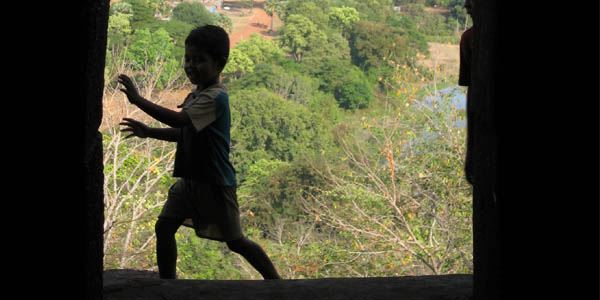
A few years later I was exploring the ruins of a hilltop temple in Cambodia. While wandering the doorways with my wife, we couldn’t help but notice the presence of two children flitting in our footsteps (though they tried playfully to remain hidden).
We waved hello. The giggled and waved back before disappearing around a rust-coloured corner of the temple wall. I continued to take photographs of the ruins.
Delight In Cambodia
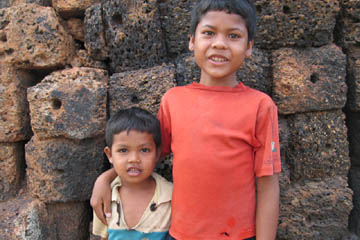
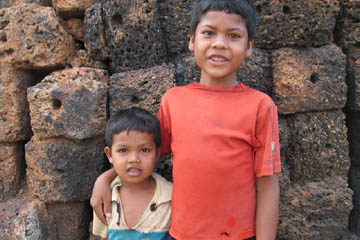
The Cambodian brothers posing.
Eventually they gathered the courage to tug on my shorts and point towards the digital viewer (this time I was armed with a Canon Powershot S80).
Much to their delight, I showed them some photographs. They were clearly enthralled.
While it’s generally understood to always ask permission before taking a child’s photograph, I could see no parents in the vicinity. I took the opportunity to mime my way into asking if they wanted to see themselves in the camera.
They nodded and stood against the temple wall, the older boy with his arm around the younger’s shoulder, a smile on both their lips.
I took a few shots then waved them over. They looked and nodded approvingly, before dashing away into the late afternoon sunshine.
I wanted to send them a few copies but I doubt these children had an email address. Instead we called out goodbye and made our way off the hilltop, down hundreds of steps with ancient serpent statues lining our descent.
Moment In Time
I felt a little guilty for taking their picture without parental permission, even if the parent’s were nowhere to be seen.
Yet if I had attracted negative karma I doubt my wife and I would have been stopped by the three earnest monks we encountered on the way down. Instead, one of them promptly demanding we have our photo taken with them.
Afterwards, one of the monks gave us some gum. Go figure.
For more info, check out Darren Rowse’s excellent advice on “Asking Permission to Photograph People.”
Anyone else have some useful tips or hilarious/embarrassing experiences asking for someone’s photo? Feel free to leave a comment below.
About the Author
Related Posts
7 Comments... join the discussion!
-
-
Our photos from our first trip to Thailand four years ago were pretty similar – lots of photos of pretty temples and landscapes, but not many images of people. Since then, we've become more brave and adventurous in engaging with locals and photographing them, but it still can be uncomfortable. I completely agree with Darren – try to find some connection with the person first, even if you don't speak a common language. If an opportunity comes to photograph the person, it will likely be a much better photo as the person is already familiar and comfortable with you.
We have seen photographers with multiple DSLR cameras around their neck shove a massive telephoto lens in the face of a woman at a market in Burma or kids at Angkor Wat. It was sickening to people treated this way, as objects. And the images reflected this – there was no expression in the people's faces.
I also find one of the most fun things about photographing people is to show them the images in the viewfinder afterward – the laughter and giggles from children when they see themselves can be infectious. I wish I could bottle it up and release it when I'm having a bad day.
↵ -
In Africa and the Middle East, I have found most people like being photographed. Women are a big exception in the Middle East. My impression of people in most SE Asian nations is that they adore the camera and will very willingly pose.
The biggest problem I encounter are police and military. I kept my camera out of sight in Malabo, Equatorial Guinea because of the paranoid and repressive regime. Here in Saudi Arabia, I just keep my photographic moments brief and unobtrusive – unnoticed for the most part. The strategy works well for me in most places.
↵ -
In Africa and the Middle East, I have found most people like being photographed. Women are a big exception in the Middle East. My impression of people in most SE Asian nations is that they adore the camera and will very willingly pose.
The biggest problem I encounter are police and military. I kept my camera out of sight in Malabo, Equatorial Guinea because of the paranoid and repressive regime. Here in Saudi Arabia, I just keep my photographic moments brief and unobtrusive – unnoticed for the most part. The strategy works well for me almost everywhere.
↵ -
Thanks for the insight on photos. I mostly take pictures of the structures around me. Next time I travel, I take photos of the locals; I'll ask for their permission.
↵ -
Good tips…I always think, how would I feel if a tourist were in my home city busily snapping pictures of me? I think I would feel like I was in a zoo. Something to keep in mind when you're phtographing people in foreign lands. Usually all it takes is a couple hand gestures, some smiling, and some nodding. Then show them the pic on the LCD.
↵ -
I am a newspaper reporter, and I am always amazed by our photographers' ability to make sources comfortable in front of cameras without begging permission outright. In fact, in more than five years on the job I have never seen a source wave away a photog and say, "No, no. No pictures, please."
Here are some things about their behavior that I think may help our sources feel better:
—They take a lot of pictures and seem concerned with getting a really good one. I think the most basic reason for camera-shyness is that people are afraid they will look unattractive in the picture. If I were a subject, it would help me to know that the photog is really putting forth an effort to not make me look awful.
—They stop taking pictures sometimes and listen to what the source has to say. That might make subjects trust the photog as someone who is on their side and who will show some mercy when selecting from potentially embarrassing shots.
—On the same note, photogs speak to the subjects, too. They don't intrude on my interviews, but they chat people up. The source seems to appreciate the photog as a human, too, and appreciate that he has a job to do.
—They don't slink around or act apologetic about shooting. They behave as focused professionals who want to be proud of their work. That seems to inspire confidence, and in a gentle way it might also give subjects the idea that, "Well, there's no use fighting this photographer's commitment to getting a quality picture of me. I may as well cooperate." Then they get comfortable cooperating.I think the fancy equipment also helps establish them as trustworthy professionals. I know I sometimes feel self-conscious that my meagre equipment tags me as an amateur who has no right to run around shooting strangers.
When I started shooting strangers, I felt awkward and voyeuristic. I don't do it very often now that I don't travel, but here are some things that help me:
-I don't ask permission beforehand (this is my own culture, where I can assume a photo is not a sacred violation – for travel I try to find out what is acceptable to the locals), but I DO approach a subject after one or two shots and explain what I'm doing: "Hi. I'm just taking a few pictures for my personal blog/album. I was interested in what you're doing here." They usually are cool and willing to tell me about themselves and whatever interested me in the first place (good for blog entries/captions). That makes me feel better about my little invasion.
-Once we've spoken, they usually are very chill about continuing whatever they were doing while I shoot more pictures.
-I always give them a note with the URL of my blog or flickr page so they can see the finished product.
During distant travel — especially in developing countries where not everyone has a camera — a lot of people really wanted their picture taken so long as I would mail a print to them later.
- I learned that I was uncomfortable shooting strangers not because I felt it was wrong or hurtful, but because I was self-conscious about how it made ME look. Once I gained confidence that I was trying (if not succeeding) to create something good, it was much better for me, for my subjects and for my pictures.
I am not a pro or artist of any sort! I just like to document what I see.
http://www.findingslc.com
http://www.poorpenmanship.com
http://flickr.com/photos/erinealberty/↵


