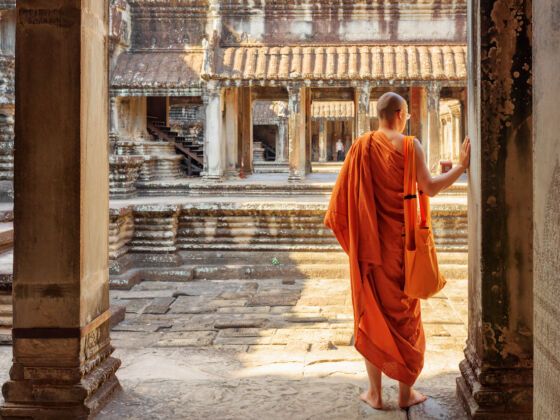
Feature photo by Swami Stream. Photo above by Liutao.
Western travelers have a propensity to romanticize the wisdom of the East. We often seek out places like India, China, and the Middle East precisely because their wisdom is older than ours. We visit their sacred places, their shrines and monasteries and wonder at the odd curves in their architecture.
By traveling East, we paradoxically yearn to connect outwardly with the most spiritual of inner truths. Perhaps it’s precisely that paradox which makes the East so compelling for Western travelers.
There is no overarching tradition that categorizes the extent of inner travel better than Eastern philosophy. Nowhere in the West has meditation and concentration been so ancient and connected with the spiritual and profound.
It’s in this tenor that I’ve compiled a shortlist of canonical Eastern thinkers to help inspire the inner wanderlust in all of us.
Lao Tzu. Photo by beautifulcataya.
Lao Tzu
Venerable author of the Tao Te Ching, Lao Tzu was an ancient Chinese philosopher and the founder of Taoism. There are few books more inspirational to take with you while traveling than the Tao Te Ching. The Chinese character for ‘Tao’ even means ‘path’, or ‘way.’
One of the more refreshing tenets of Taoism is that humans don’t hold a special status within the natural order, being only one of many manifestations of the Tao. It is thus the goal of the Taoist to find their own place in the Tao, to seek harmony with the order of things.
And isn’t that essentially the same for any displaced traveler? Finding oneself and one’s place in the grander scheme of the world, despite its multifarious unfamiliarities, is exactly what the traveler seeks, whether that journey is inward or outward.
Lao Tzu was also well known for travel metaphors. This oft-quoted gem is a personal favorite: “A good traveler has no fixed plans and is not intent on arriving.”
Prince Siddhartha Gautama.
Siddhartha Gautama
Siddhartha Gautama is the celebrated founder of Buddhism. Originally born a prince in a region of Ancient India, which we now refer to as Nepal, his early life was lived in relative luxury and obliviousness, far from the life of the great inner traveler he was to become.
As the story goes, his obliviousness was not his own doing, but rather his father’s, who wished to shelter his son from human suffering. But at the age of 29, Siddhartha defiantly left the shadow of his palace’s walls. In an event referred to as “The Great Departure,” he escaped in silence to seek the truth about life.
Thus, Siddhartha became the quintessential vagabond. Living frugally, he found wisdom while begging for alms in the streets. After eventually achieving enlightenment through solitary reflection and meditation, he traveled through India as a teacher.
At some crucial point, every traveler-at-heart makes their own great departure. We aren’t all founders of Buddhism, to be sure, but it’s that search that drives us– to see the world for what it really is, and to learn something about ourselves in the process.

Bodhidharma. Photo by Nemo’s great uncle.
Bodhidharma
Few brands of Eastern philosophy are as perplexing as Zen Buddhism, and we have Bodhidharma to thank for it. He began as a Buddhist monk in India, where it is said that he lived in a cave and meditated by staring at the cave’s wall for several decades.
Staring at walls undoubtedly inspired him to dream a lot about travel. Sure enough, he eventually left India and traveled throughout China, where he discovered that the Buddhist teachings there were filled with unjustified superstition and menial rituals. Thus, Bodhidharma developed a non-traditional path to enlightenment which was to become Zen Buddhism.
Although it is customarily very un-Zen to attempt to directly define what Zen is, I’d say that ultimately it’s about living life by the moment. It is about finding enlightenment through new perspectives, as each moment uniquely brings them, rather than relying on rules, habit or establishment as guides.
And I can’t think of better travel advice than that.
Zarathushtra. Photo by Christine K.
Zarathushtra
Zarathushtra, or Zoraster, was an ancient Iranian philosopher and poet who is credited with founding Zoroastrianism. Before Islamic conquests shook the region, Zoroastrianism was the dominant religious philosophy in ancient Iran.
It was also a key influence in the early development of Western philosophy, which goes to show that the line between the East and the West is not nearly as clear as some classifications imply.
At the heart of Zarathushtra’s philosophy is the belief that we must be open to all experiences life offers. Zoroastrians believe firmly in being an active participant in life. It’s our actions, particularly toward one another, which ultimately determine our own life’s meaning.
Travelers with a conscious respect for the cultures in which they’re traveling would do well to channel their inner Zoroastrian. That would be: to actively pursue every aspect of life, but always do it with good thoughts, good words, and good deeds.
Jiddu Krishnamurti.
Jiddu Krishnamurti
Unlike the other four Eastern philosophers mentioned above, Krishnamurti is not an ancient thinker. He was born in India in 1895 died in California in 1986. Thus, although his thought has origins in India, he has had a worldly influence.
As a young man, he was christened by those surrounding him as the next great World Teacher, and was groomed from youth to take that role. But after a process of awakening he later came to disavow this title, choosing to foster his own path.
Krishnamurti eventually traveled the world, giving lectures focused on the power of the mind in meditation. He taught that the problems of the world, such as hunger and war, are primarily a result of our thinking. If we want to enact change in the world, then he believed we must change the ways we think.
Rather than clinging to beliefs dogmatically, which isolates us from others and causes us to choose our beliefs over the well- being of others, Krishnamurti encouraged independent, positive thinking.
His philosophy is a reminder that the line between inner and outer travel is always a thin and delicate one.
COMMUNITY CONNECTION:
What other Eastern thinkers would you add to this list? If you haven’t already read it, Bryan’s list of Western thinkers can be found here.
About the Author
Related Posts
4 Comments... join the discussion!
-
-
I tell my wife the same thing, when she insists I get my lazy butt out of bed. =)
Please note the word "inner," as from the title: "Five Eastern Thinkers Who Understood Inner Travel."
↵ -
Markus, you're right, insofar as travel is a search or craving to fill an empty inner void. However, I don't think Buddhism is fundamentally anti-travel so long as the reason for that 'outward' travel isn't really just a distraction from what is really an inward struggle.
As Ian points out, travel can be very useful for the Buddhist, as the Buddha showed through his own extensive travels as a teacher. Furthermore, we can't forget the importance of Siddhartha's Great Departure in his intellectual and spiritual development. He had to see the way the world really was before he could truly overcome it.
↵ -
I have a stupid question about Zarathushtra. I'm currently reading Nietzsche's Thus Sapke Zarathustra (thanks to Librivox.org's free recordings) and wonder how closely the philosophy Nietzsche advocates in that book relates to Zarathushtra's Zoroastrianism.
↵ -
Craig, good question actually. First of all, it's not a coincidence. Nietzsche had every intention of referencing the historical Zarathushtra in using that name for his famous character. That said, as with most of Nietzsche's writing, the reference is mostly made as tongue-in-cheek. Although there are symbolic reasons for Nietzsche to use that name, the usage is mostly fictional, and is not meant to be a characterization of the real Zarathushtra.
Nietzsche is primarily using his book to establish the 'death of God' concept, as well as the concept of the Ubermensch. Here's my best go at the irony Nietzsche is shooting for by using Zarathushtra as his mouthpiece here:
Zarathushtra, and Zoroastrians, see the universe as a gigantic clash between truth and deceit. Truth is held as the highest virtue, and it is what Zoroastrians seek to obtain. So far, I think this coincides with Nietzsche's own aims vaguely enough. But here's the rub– Zarathushtra is also a moralist, unlike Nietzsche. Thus, Nietzsche is essentially tearing down moralism using a moralist as his mouthpeice, all while utilizing that moralist's own virtue of truthfulness.
Thus, I think most Zoroastrians would consider Nietzsche's characterization of their figurehead as a blasphemy and gross perversion.
That said, however, there are some real correlations to be made too. Within Zarathushtra's teachings are many of the precursors for existentialist philosophy (and, insofar as he is an existentialist, Nietzsche's own ideas as well). For one, Zarathushtra was one of the first to preach a doctrine of Free Will, such that it is the personal responsibility of individuals to make the world how they'd like it to be through their own actions. This notion of responsibility is more moralistic than it is an existential situation. Nevertheless, correlations can be drawn, I think, between the existentialist's notion of good faith, and the Zoroastrian notion of personal responsibility through Free Will.
Again, though, while there are connections to be drawn, those precursors also lead to very different places too. So don't get lead too far astray in drawing those connections. Zoroastrians are not Nietzscheans.
Does that help?
↵ -
That helps a lot – thanks for a concise and well-though out reply, Bryan.
↵ -
Siddhartha was also a traveler, inner and outer.
↵ -
It's true what they say, "you do learn something new every day." I never heard of Zarathushtra or Bodhidharma. I guess I'll do some research and check out Nietzsche's Thus Sapke Zarathustra which Craig mentioned in his comment.
I've always had a fascination with Eastern wisdom, religion, philosophy, mysticism, and anything that involves the Eastern part of the world. I do feel a connection to Eastern thinking. I do my best to meditate and quiet my mind. The best meditation for me is listening to music, writing, and art. I get lost and before I know it a couple of hours have passed. It's very soothing to my soul.
It does "boggle my mind" that the West likes telling people in the East what to do. Most of those countries have been around for about 5,000 years or so. Let's face it, the areas in the Middle East formerly known as the Persian and Mesopotamian empires have been around for quite some time. They are free to do what they want. What we judge as good or bad is nothing more than a label People in the West like to put "labels" on everything:)
↵


