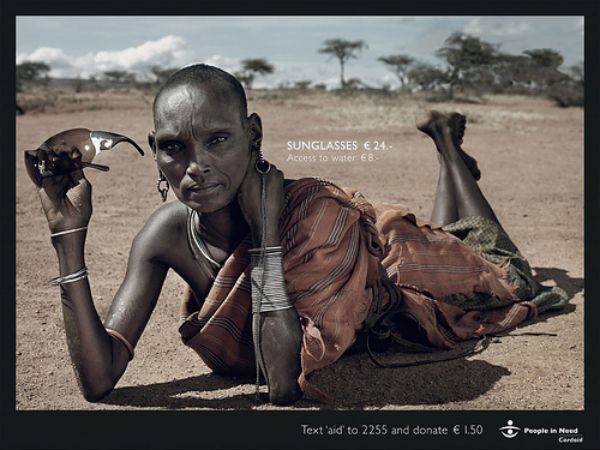
How do you feel when you see this ad?
Photo: Cordaid/People In Need
I’ll tell you the truth: I uttered “whoa” as I finished reading it. The ads were created by Cordaid for third world poverty.
Sometimes a nice smack-in-the-face reminder is just what we need when we’ve been complaining about not having the latest Google phone, or top-of-the-line Mac, or even a sweet pair of sunglasses (although considering I always sit on my sunglasses, I refuse to spend more than $10 on a pair. Still, that’s $10 a pair).
But some people do not appreciate this form of manipulation, or are downright offended by advertisements like these. Two recent campaigns that caused some negative backlash.
Depression Notes
The NYC Child Study Center used a ransom note as a means of portraying how depression can “take your child.”
This campaign also included a note about autism, saying, “We have your son. We will make sure he will no longer be able to care for himself or interact socially as long as he lives.” The campaign was pulled because critics complained these ads reinforced negative stereotypes.
The Booby Wall
Another offensive campaign was Schick’s Booby Wall (check out another one of their not-so-gender-correct ad campaign’s about “trimming the bushes“), which is supposed to bring awareness around breast cancer via an online picture exhibit of breasts.
This campaign is still in rotation, despite the fact that some viewers think it is trying to “sex-up” cancer, that it is thinly-veiled exhibitionism, and reinforces the objectification of women.
But, Do They Work?
Some social campaigns are obviously going to be smarter than others, and I’d be hard pressed to find people who don’t agree with the Dutch Cordaid/People In Need campaign.
I mean, who can argue with water being more important than sunglasses?
The real issue is whether these “shock ads” lead to much needed awareness, or merely outrage.
What is the more effective to promote behavioural changes: shame, or by positive experiences, such as directly connecting with other cultures? Share your thoughts below.
About the Author
Related Posts
7 Comments... join the discussion!
-
-
Very powerful ad. Outrage or no, it sends a message.
↵ -
In this age of Mindless Masses, I say shock ‘em all! If thats what it takes to get people talking about the issues, then theres no other way to impact people.
↵ -
I agree with Doug. The stronger the shock, the better. What’s wrong with an ice-cold shower of reality?
Thanks for this post, Christine.
↵ -
The shock ads, like any ad, will only effect or convince some people. Unfortunately, ads have a great power over defining our culture. It could be good, like convincing people to donate money to Africa, but most of the time it’s bad, like convincing women that they are only pretty and happy when they shave their public hair (where is there an ad geared towards men shaving pubic hair?)
↵ -
Isn’t the problem here that advertisers are forgetting to look through the eyes of the ‘ordinary’ person who is becoming immune to shock media.
For example, I looked at the above picture and thought ‘An African person with sunglasses, whoop woo.’ I didn’t care about imagery. If that had been in a magazine, I would have passed by with no second glance. Similarly, if the image had been more shocking showing a dead man in a crushed car with an arm sticking out holding a pair of sunglasses, I would have thought ‘Yuck’ and moved on.
Last night I watched a gorey horror movie. You can’t shock me any more. If you try, I pass by and look at something else. You are not catching my interest.
↵ -
I don’t think they’re over the top. They are provocative, but actually, modern ads are themselves so designed to cross the line or come close to it – I had to look twice to realize that this is a social and not a commercial ad.
Maybe they’ll be effective. Hard to say.
↵