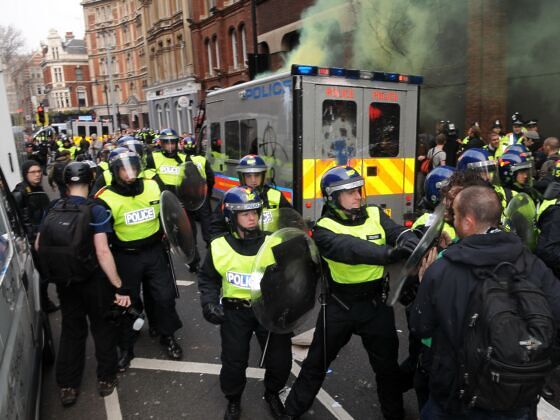
Guy Fawkes at the G20 Protest / Photo: quis
Imagine yourself in London on one of its rare sunny days.
From Westminster to Trafalgar Square, passing through Whitehall, you notice the streets are packed with police officers. Quite normal, you assume, considering that within a few kilometers are both the Parliament and 10 Downing Street, the official residence of the British Prime Minister.
Obviously, the two horses standing at the entrance do not provide Gordon Brown with enough protection.
Excitedly, you head to Westminster with your digital camera to capture the best shots for your travel blog. You reach the ideal spot, you set your equipment in the green park of Parliament Square, just opposite Westminster, and shoot a perfect postcard.
Then you get arrested for terrorism.
This scenario is not as far-fetched as it sounds. In the wake of the new counter-terrorism Act issued by the Home Office, travelers may find it hard to bring home pictures from the most famous London landmarks if they happen to catch police officers in their shots.
The section 76 is a recent update to the Counter-Terrorism Act issued in 2001. For years, humanitarian organizations have accused the government of restricting people’s civil liberties, but only recently a wider sector of the population are becoming aware of this late measure.
Strictly Forbidden
An Orwellian bus stop / Photo: Angela Corrias
Londoners are speechless in front of these progressive counter terrorism measures. Are they living in a growing police state?
The latest amendments of the Counter Terrorism Act 2001, added in 2008 and effective from February 2009, are aimed at increasing the power of the police against any behaviour that “elicits or attempts to elicit information about an individual who is or has been a member of Her Majesty’s forces, a member of any intelligence services, or a constable.”
The G20 summit, held in London on April, 2nd, is still on everyone’s minds, not for the summit itself, but rather for the police violence that left many injured.
An unprovoked beating may have caused the death of Ian Tomlinson, who was hit by the police and died from massive internal bleeding. An autopsy revealed Ian died of a heart attack, though speculation remains the heart attack was triggered by his push to the ground. Meanwhile, another policeman has been suspended after being filmed while hitting a young woman.
The tension felt by UK citizens has been increasing – and now tourists are being affected, especially when they are stopped from taking photos. Many tourists like photographing the red double-decker buses, the sign of the London tube, both considered landmarks of the city.
Klaus Matzka, a tourist from Austria, was on holiday with his son. He was recently forced to delete all photos of public transports he had taken during his stay in London, as it was “strictly forbidden” as a measure to prevent terrorism.
A police official later offered an apology, stressing the ban is on photographing officers. Even so, Klaus said he would not come back to London.
Report Your Neighbour
While similar incidents have also happened between officers and photojournalists, the latest altercations involving tourists make everybody think that the government is going too far.
The constant pressure of CCTV cameras, the police campaign encouraging to spot any “unusual” behavior, the overall sentiment of being under control or pushed to suspect that “anybody can be dangerous” are proving counter-productive.
In addition to restricting freedom of action, the Metropolitan Police have launched an anti-terror media campaign through radio ads and posters on the tube, trains and bus stops.
The slogans read “A bomb won’t go off here because weeks before a shopper reported someone studying the CCTV cameras” or “These chemicals won’t be used in a bomb because a neighbour reported the dumped containers,” followed by a threatening “Don’t rely on others. If you suspect it, report it.”
Such messages are disquieting rather than reassuring. Many people are trying to understand what the government wants to communicate. The result of this campaign stokes fear and distrust towards our neighbors instead of collaboration, a sense of increasing isolation instead of feeling part of a community.
Citizens have started to wonder if this is the right way to face the threat of terrorism.
What are your thoughts on these anti-terrorism measures – are they a necessary evil? Share your thoughts in the comments!
About the Author
Related Posts
14 Comments... join the discussion!
-
-
Yeah, from everything that I’ve read, England seems to be quite the downer. It’s because all of these extreme rules that I’ve taken it off of my list of places to visit.
↵ -
Cory Doctorow (on Boing Boing) regularly posts on these British counter-terrorism issues. A lot of people have done funny/scary remixes of the posters mentioned above.
http://boingboing.net/2009/03/26/remixes-of-the-paran.html
I visiting London in a couple weeks. I wonder how much of this is noticeable to the average tourist.
↵ -
For a counterpoint–I was in London last September, took around 1250 photos in two weeks without incident.
↵ -
A decent article, but I feel it hypes the problem in the same way as it accuses the government of hyping the terrorist threat.
What happened to Ian Tomlinson was terrible, but there is only evidence of a push; writing that the death may have been from an unprovoked beating is like saying it may have been from swine flu.
And while many people think the government has gone too far there is no evidence that ‘everybody’ thinks so.
I think Hal gives a true account of the situation: unless you are at a big public gathering or very unlucky you are unlikely to see much evidence of a ‘police state’ when you visit London, England or the UK.
↵ -
As another counterpoint, I live in London and work around 200m from where Ian Tomlinson died. The widely reported (and repeated) pictures on TV and the internet represented a tiny minority of the activities on the day.
Despite working in one of the banks that some of those present were protesting against, I went for a walk and didn’t feel at all threatened or worried by the crowd, most of whom were singing, dancing and drawing pictures. The shame was that the TV reporters concentrated on the small violent outbreak and completely ignored the mostly excellent speeches and lectures.
With regards to the Metropolitan police, I suppose there are more around, but given their complete absence over the past few years many would consider it a good thing. During the protests a lot of police were shipped in from the surrounding counties and given their inexperience with dealing with large crowds and terrorism issues I’d suggest that’s where most of the misunderstandings arose, such as the unfortunate Austrian tourist.
Those police who assaulted members of the public are rightly being prosecuted as criminals, as are those who hid their identities or wrote on Facebook that they “Can’t wait to bash some long haired hippys up”. The current poster campaign is a bit over the top, but it’s hardly a police state.
As one of our comedians Andy Parsons said: ‘The only real change with all this terrorism is that gone are the days when you see an abandoned bag on the tube and think “I’m having that!”‘
↵ -
Thanks for this detailed, first-hand account – much appreciated!
↵ -
Hi all,
you have made good points. I live in London too, and I reported from all G20 demonstrations. Violent episodes were very few, not as much as reported by mainstream media, and of course we can’t consider the UK a “police state”. Also, I don’t think the main occupations of police officers is stopping tourists to delete their holiday photos.
However, the only fact that this has happened, few times, but more than once, makes it “legal” and this is what I have noticed is worrying most people.
At the first march of the G20, the one at the City, tensions have started when the police formed cordons and stopped people from leaving the demo. Many, like myself, just wanted to leave, let alone the fact that except from a Costa, all shops and restaurants were closed and there were not services and facilities. This lasted for a couple of hours and increased the tension.
On top of that, the recent anti terror campaign has been considered by many exaggerated, as it pushes citizens to suspect anybody and report it to the police. A PR campaign, especially if it’s by the government or any institution, is launched after very careful considerations and not rushed off, so what we may think they are “exaggerations” or “mistakes”, maybe they were very well discussed.
The updates to the Counter Terrorism Act of 2001 were made in 2008 and effective from February 2009, so in September they were not put in practice yet, as wasn’t launched the ad campaign either.
I don’t think spreading fear among the population and increasing mutual suspicion are the way to face potential terrorist threats, as I don’t have any tools nor the training to understand if someone is doing something suspicious. I’m afraid that, if taken seriously, this anti terror campaign can have negative effects.
But these are just thoughts, and honestly I don’t think English civil society will allow to create a widespread atmosphere of panic.↵ -
Thanks for your additional input Angela. Yes, it is a fine balance between too little or too much policing, and our relative freedom is very important.
Today’s government decision to stop retaining the DNA profile of innocent people is another victory for civil rights.
Good luck with your studies and career.
↵ -
Thanks a lot Greenygrey.
↵ -
The monsters are due…
http://www.youtube.com/watch?v=vIBMWoVfnMY
↵ -
Try taking those photos wearing a turban next time, see how that goes.
↵ -
In response to Angela’s comment (”A PR campaign, especially if it’s by the government or any institution, is launched after very careful considerations and not rushed off, so what we may think they are “exaggerations” or “mistakes”, maybe they were very well discussed.”): People are entirely naive when they place that much faith in their public officials. I’m sure there are “careful considerations” put into these decisions, but under what motivation? Your well-being? Highly doubtful.
As a person who lives in the United States, “the land of the free”, I can say that in consideration of all of the CCTV cameras and other “big brother” measures in the UK, it is definitely a fledgling police state. The U.S. is rapidly becoming a police state, and the U.K. definitely has a lead on that unfortunate path.
↵ -
Ed, thanks for your comment. Generally speaking, I don’t like fomenting fear in the society, but yes, I’ve come across your kind of concerns quite often lately.
↵


