Bahá’í House of Worship in Delhi, India / Photo: macsurak / Feature photo: Christine K
Encountering different and unique religions worlds apart from your own is part of the travelling experience.
However, no matter how many countries you have under your belt or hostels you’ve slept in, you still might not encounter some of these extremely private, seldom heard-of religions.
1. Jainism
Praying at a Jain temple, India / Photo: mattlogelin
Jainism is one of the world’s oldest religions, dating itself prior to tenth century BCE India. There are approximately four million Jains today, almost entirely in India.
The religion revolves around five central beliefs of non-violence, truth, non-stealing, celibacy, and non-possession. The principle of non-violence is particularly important to Jains, as they believe that every living thing, even microscopic organisms, has a soul that can attain enlightenment.
Because of this, most Jains eat something resembling a very strict vegan diet and monks and nuns walk around barefoot sweeping the ground in front of them to avoid killing innocent insects.
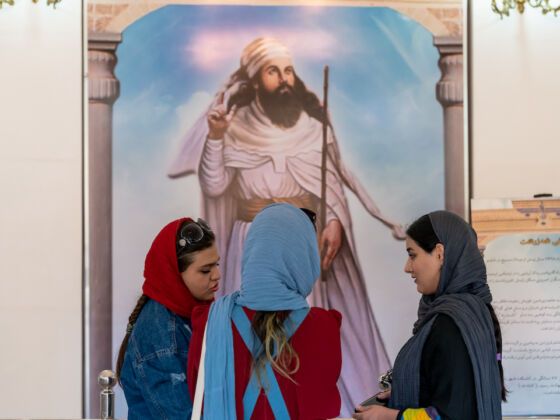
2. Zoroastrianism
Zoroastrian carvings / Photo: wallyg
Zoroastrianism is based on the teachings of the first millennium BCE Iranian prophet Zoroaster. There are estimated to be between 150,000 and 210,000 Zoroastrians in the world today, mostly in India and the United States.
These small numbers mask the historical importance of this religion. Both Eastern and Western religions can trace ties back to Zoroastrianism, meaning the religion has most likely had more impact on the world than any other belief system.
Zoroastrians believe in one universal God, Ahura Mazda, who is in conflict with the forces of chaos, led by Angra Mainyu. Humans need to take an active role in the conflict by performing good deeds and having good thoughts and words.
The conflict will ultimately be brought to an end when Soashyant, a savior, comes to Earth and reanimates the dead.
3. Baha’i faith
Baha’i Master looks on / Photo: blakeread
Baha’i was founded in the 1800s in Persia by the prophet Baha’u’llah. It emphasizes the spiritual unity of all humankind and sees religious history as unfolding through a series of divine messengers, each suited for what the people of the time could handle.
The prophets of the world’s major world religions are all accepted as valid, including Krishna, Abraham, Buddha, Jesus, and Muhammad. The social teachings of each religion, such as which direction to pray, may be revoked or changed, but some fundamental principles, including charity and neighborliness, are always unchanged.
The largest center of the Baha’i faith is India, where 2.2 million followers reside, followed by Iran and the United States. Baha’i was classified at the world’s second fastest growing religion by percentage in 2007, when it grew by 1.7 percent.
4. Yoruba
A girl in prayer / Photo: carf
The Yoruba religion is the beliefs and practices of the people located in the areas that are now Benin and Nigeria before they encountered other outside religions.
There are no specific numbers documenting the number of followers, but many believe that Yoruba is the largest African-born religion in the world. It has also heavily influenced several Afro-American religions such as Lucumi in Cuba.
The main belief of the Yoruba peoples is that all humans have a manifest destiny, referred to as ayanmo, to become one with the divine creator, known as Olodumare.
Our destinies are determined through our thoughts and actions in the physical world. The Yoruba see life and death as cycles in the physical and spiritual realms while the spirit moves towards union with Olodumare.
5. Mami Wata
Mami Wata, water spirit
Mami Wata is another African-born religion that venerates a water spirit known as Mami Wata. She is depicted as being incredibly beautiful with long hair and is frequently accompanied by an incredibly large snake.
The religion holds that Mami will sometimes assume human form in bars or busy markets and also will abduct people while they are swimming or boating on the water. These captives are then released in dry clothes and better health, but only after agreeing to an oath of sexual fidelity to the spirit.
From its beginnings in Africa, the worship of Mami Wata has spread to many Caribbean islands and parts of North and South America.
6. Mandaeism
Prep for Mandaeism baptism / Photo: credit
Mandaeism is an extremely secretive Gnostic Christian religion. Prior to the 2003 war, the religion’s sixty to seventy thousand followers were almost entirely located in Iraq.
There are now estimated to be only five to seven thousand left in Iraq, the rest having been either displaced or killed in the sectarian violence that followed the US occupation.
Mandaens believe that Jesus was a false messiah who corrupted the teachings given to him by John the Baptist. For this reason, John has a special place in their religion along with Adam, Abel, Seth, Enosh, Noah, Shem, and Aram. Abraham, Moses, and Muhammad, on the other hand, are all seen as false prophets alongside Jesus.
Any personal experience with these religions? Or how about a few we missed? Share your thoughts in the comments!
About the Author
Related Posts
17 Comments... join the discussion!
-
-
I had never heard of the Baha’i faith until my trip to Chicago to see family. One of our day trips was to their temple just outside Chicago, which coincidentally is the only temple located in the United States and I believe the North American continent. It was incredibly beautiful with ornate decorations. The key principles that they follow and beliefs that they follow are pretty refreshing as well. Great article with some very good information!
↵ -
Very cool–4, 5, and 6 are new to me. Thanks for the education.
↵ -
I worked with someone who was Baha’i back in the day. From what I remember, there is quite a bit of emphasis on educating yourself, though I think there are some hangups about sexual equality (again, this is just what I remember..it may just have been that one person who didn’t see women as equals).
↵ -
Colin,
I’m actually a Baha’i and we believe both males and females to be equal and have an equal station in the eyes of God. I’m not sure what exactly happened with your co-worker to make you believe this. Wonderful article though!!
↵ -
I’m actually a member of the Baha’i Faith and I really appreciate the accurate depiction of this religion in your article. Two comments relating to previous comments, however.
First, the Baha’i Faith was founded in Iran as opposed to Israel. Baha’u'llah, the Manifestation of God whom Baha’is follow, was eventually exiled to Israel after being banished from Iran, Iraq, and Turkey/the Ottoman Empire. Haifa, Israel is the current seat of international, nine-member, elected body of the Baha’i administration, referred to as the Universal House of Justice, but our Faith actually did begin in Iran.
Secondly, the equality of men and women is one of the fundamental principles of the Baha’i Faith, along with the independent investigation of truth, elimination of all forms of prejudice, and the onenesses of God, religion, and mankind. In fact, the Baha’i teachings state that man and woman can be likened to the two wings of the bird of humanity: if both wings are not equally strong, the bird of humankind will never be able to fully progress. In fact, I believe that the nine-member, locally-elected governing bodies of the Baha’i Faith in the United States have more women than men, on average. Our national body, which was elected a few weeks ago, has four women and five men unless I am mistaken.
↵ -
Most students of the African Diaspora in the Americas have come in contact with the various forms of Yoruba tradition:
Santería in the Spanish Caribbean (plus Miami and New York), Vodun/Voodoo in Haiti and Louisiana, Candomblé and Macumba in Brazil.
Because of its polytheistic nature, Yoruba gods melded much easier with the myriad Catholic saints venerated in Latin American societies (where Catholicism was forced onto slaves), versus the more stringent Protestant form of Christianity in the former British colonies, but some of the African elements are still seen in the West Indies as Obeah and in certain African-American cultural beliefs.
I once saw a teenager wearing a Changó t-shirt in the diety’s official colors of red and white at a shopping mall in Caracas; I regret not asking him where I could buy one.
↵ -
Thanks for this – I had heard of most of the faiths before, but didn’t know any details. Solid post.
↵ -
I was born into a typical southern U.S. Protestant family. I encountered Baha’is in Utah in 1961 and fell in love with it. I’ve been an active Baha’i ever since. Baha’i may sound exotic, but it deals with the needs of real people and the problems of the world. It has a unique form of community life and ways of solving problems using consultation. You can get find out more at http://www.bahai.us.org or bahai.org where you can learn the basic principles and actually read the Baha’i Sacred Scriptures.
↵ -
Also add Cao Dai to your list – centered in Viet Nam. An interesting one to research!
↵ -
Regarding gender equality in the Baha’i Faith – the highest Baha’i administrative body, the Universal House of Justice, consists of men, and only men. Women, by Bahaullah’s express decree (or so I was told), can’t be members. To me, that doesn’t sound like giving men and women equality, and it kept me from becoming a Baha’i. Yes, the Baha’i faith gave women much more equality than was normal in the early 20th century, but I don’t think it meets modern standards of gender equality. Bahaullah’s writings are beautiful, though, particularly the “Hidden Words”.
I like the Jains, too. On a trip to India (Delhi?) I found a hospital which a group of Jains was running for sick birds. We’d do well to learn some of their compassion for other forms of life.
Thanks for this article.
↵ -
Wow, I thought that I would know some of these when I saw the title. But I only know of Mami Wata. I guess I have a lot to learn about religions. Maybe I will make a point of studying religions a little more on my adventures, since it is such a large part of all cultures. Thanks
↵ -
Nice post, my dad’s from a Jain family thought he doesn’t follow a strictly vegan diet, etc. However, they have some really interesting ideas about non-violence and respecting animals/nature.
↵ -
Wow, it’s very informative. There are really many religious sects out there that needs to be known and recognized. Sometimes, followers of these religions often receive a different feedback from those belonging to a more established religions..
Nice article!
↵ -
Chris – very interesting article!
Have you got a personal website/blog telling of your time teaching English in S. Korea? Or perhaps another article in the works with tips and tricks for such a venture? I’m very interested to learn more about it!
↵ -
Hi there Rebekah,
Matador’s published a lot of great material on Korea lately, much of it dealing with teaching. Check out these links:
http://matadorabroad.com/10-korean-customs-to-know-before-you-visit-korea/
http://matadorabroad.com/chaos-culture-and-kim-chi-a-korean-cafeteria/
Or, just type “korea” into the search bar at the top of this page–tons of content and many, many community members who are currently teaching in South Korea.
↵ -
Thankyou very much for your article, it is about time recognition was given to some truly ancient religions that im sure the collective memory of which will sooner or later in our age of fast infomation evaporate. They give an indication of what life and ideologies behind them was like and interesting to see how they compare to current philosophies. I myself am half Parsi which is the nationality associated with Zoroastrianism. Few other races that i am aware of if any participate in the practice of Zoroaster and to put things into perspective of how easily this religion will go off the map is that currently in Britain there are around 5 thousand Parsis left and by 2020 there will be fewer than 25,000 in the world. This is why it is important in this world not to lose our awareness of history. Sorry to take up so much space, thanks again.
↵


