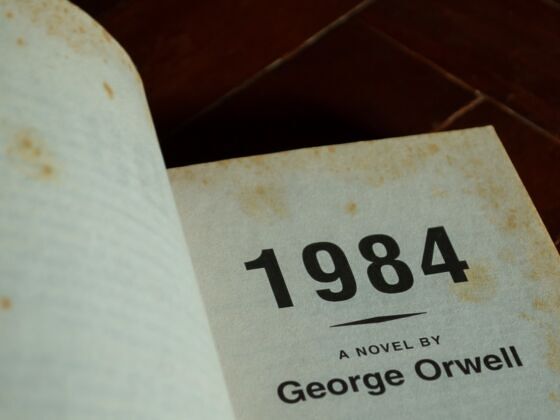
Feature Photo: adotjdotsmith
It’s been 60 years since George Orwell wrote 1984, his forward-looking satire of a sad and dysfunctional society.
The country of Oceania has a government who monitors every aspect of its people’s lives, participates in a never-ending world war, and rules over a society overrun by poverty due to sacrifices being made for the war effort.
The government officials, though, still live the good life.
Heh, heh, good thing Orwell was so off base about the future.
Love Your Leaders!
Nationalism was the central theme of this imagined society, with unquestioned love for a leader who may or may no longer be alive.
Orwell also looked at the idea of “transferred nationalism,” or the psychology used to transfer the love or hate for one government to another. Sexual repression was yet another overriding theme of the book–though this repression came from the government, not religious organizations.
Luckily, we see no-such-thing today.
To honor the anniversary of this book that gave the previous generation a look at what the future might hold (seriously scary how close he was), The Complete Works of Orwell has the entire book online.
Now remember, Big Brother is always watching, so don’t make any sudden moves on the internet.
Do you think Orwell was dead-on about what was to come for all societies, or is his vision a thing of the past? Share your thought below.
About the Author
Related Posts
11 Comments... join the discussion!
-
-
If you take his ideas at face value we seem to be coming more into it, take england, especially London almost everywhere is seen by cameras, which is what most people think when they hear 1984. Though the cameras aren’t meant to monitor everyone, but for security. When we look at what Orwell was going for, the loss of freedom and individuality, and absolute control by the government we are away and I don’t think we’ll ever get there, but we’ll see.
↵ -
Orwell wrote 1984 about the changes taking place in Burma. Take a loot at how that government is today. Orwell wasn’t far off.
There is a great book out called Finding George Orwell in Burma that should be read by anyone really considering how this book can come about in the modern world.↵ -
I think that Orwell’s vision was probably a lot closer to the reality of North Korea than the reality of the United States or London.
Some of the elements of his story are present in all societies, it doesn’t mean the government is going to spy on while I exercise in the morning or pull me of the street for an unauthorized romantic affair.
There is a danger in overreacting to the appearance of the violation of civil rights because people stop listening.
↵ -
You know what? I’ve never read this (shame!). I’ll be borrowing this from the library next.
↵ -
I’m not so sure whether he wrote it about an imagined future, or about the (then) present-day in Stalinist Russia? (Obviously, with some fancy made-up techno-stuff added in.) I always thought “1984″ was just an inversion of 1948, when he wrote the book. I think it’s certainly intended as a warning to the rest of us, but I think he also intended it as a reflection of an existing reality, not just a prediction.
At any rate, I know this goes against the English-lit orthodoxy, but as satires go I always thought Animal Farm was more biting in many ways. And beyond that, I think his non-fiction does a beautiful job of getting these points across, too – maybe in some ways, even better than the fiction/satire.
↵ -
Eva, I think you’re right…I believe Orwell was attempting to say that it was possible for totalitarianism to happen anywhere in the world, even Britain, and in essence, was a wake-up call to the realities of Fascism as they were happening in the late 1940s.
I think culturally, those-with-left-leanings in the US (and elsewhere) have enjoyed co-opting his work as a look into a future, especially during the Bush admin (I never heard the year ‘1984′ thrown around more than during those 8 years).
↵ -
I agree. People go sailing over the point when they claim 1984 as a less-than-accurate prediction. It’s pure warning. Orwell recognized that the only way to maintain fascism was to distort reality to its ends. In a real democracy, no topic should be so sacred as to be off-limits to criticism – Christine’s right to say the past 8 years were a lesson in Newspeak.
Orwell’s prognosis can be summed up in this quote: “If you want a picture of the future, imagine a boot stomping on a human face – forever.”
↵ -
You should take a look at this comparison of Orwell and Aldous Huxley: http://www.recombinantrecords.net/docs/2009-05-Amusing-Ourselves-to-Death.html
↵ -
Although Orwell was very prophetic in his book, One could argue Huxley was much more accurate in his prediction that the government would not need to spy on their citizens because they would just love the state so much that they would not disobey it. Brave New World and the closely related and newer book, Amusing Ourselves to Death by Neil Postman are just as applicable, if not more than 1984 in today’s world; especially when examining western governments (UK, US).
↵


