Indifference Abroad: An Expat’s Battle To Keep Her Compassion

08/27/09  Print This Post Print This Post    21 Comments   Popular   Written by Shannon Dunlap
  • Stumble It
  • Share

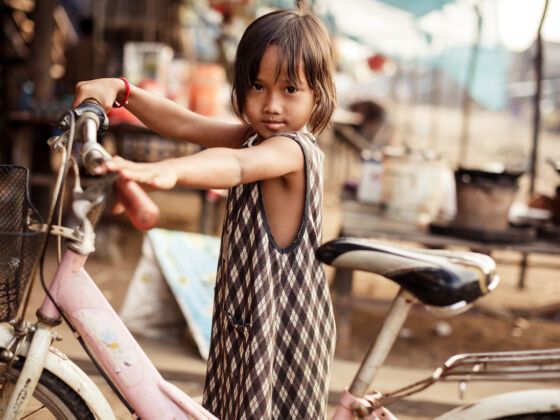
Cambodian child / Photo: subliminati

A Cambodian expat faces the daily reality of poverty and suffering – and wonders how it has affected her ability to cultivate sympathy.

This morning, I was making tea, and I read the name on the tea canister—the Thai company Phuc Long—and I didn’t even smirk, didn’t even think about making a joke about it.

And that’s one indication that perhaps I have been living here too long.

Here’s another:

Yesterday, I was walking down the street, and the guy with no arms who sells books out of a box hanging around his neck asked me for some money. I wasn’t carrying my moto helmet under my arm (as I usually do, marking me as an expat rather than a tourist), and he didn’t recognize me at first.

And then he remembered me from around town, and gave a sort of shrug and a not unfriendly smile, as if to say, “Sorry! You’re a regular here. Of course you’re not going to give me anything.”

And then we both sort of chuckled and walked past each other, and it wasn’t until I was about half a block away that I got a sickening chill at my own indifference.

Tea and Indifference

Has living in Cambodia made me less capable of sympathy? Even after close to a year here, it’s hard to know the “right” way to behave in the face of other people’s poverty and trauma. Feel it too much and you’ll be incapacitated; feel it too little and you’ll be some sort of Marie Antoinette (“Let them drink Angkor Beer if they have no potable drinking water!”)

Photo: Jason Leahey

To feel as if you belong here at all, you have to become a little inured to the realities of landmine victims and grubby children, and to act otherwise is to be viewed as a sap by both Khmer and expats.

Once, I went into the local Mexican restaurant and two expat women were sitting with a little Khmer boy for whom they had purchased dinner.

They seemed a little sheepish though, because after they had ordered, they noticed that, unlike most of the kids hanging around Pub Street at night, this guy had new tennis shoes, went to a government school reserved for the solidly middle class, and had a mother who was keeping an eye on him while chatting with her friends across the street.

Of course, there are far worse things than buying a child, any child, a Coke and a quesadilla, but they felt as if they’d been duped, giving help to someone who might not need it the most. It was such a tourist thing to do.

And we roll our eyes at tourists, the people who swoop in for a week or two and throw money at the first problem they see, regardless of whether it will do any lasting good. Then again, at least they’re doing something.

Judging The Other

What am I doing? Has anyone in Cambodia benefited from my writing so far?

And if I’m sometimes less sympathetic than I should be toward Khmer, you should hear my internal monologue about Westerners and their problems. Woe to the person whom I overhear complaining about heat, insects, potential bacteria in the water or uncomfortable bus seats; they will be silently excoriated by me.

Sometimes it is an asset to be able to witness the misfortunes of others and, instead of feeling crushing depression at the state of the world, feel sort of…well, lucky.

Firstly, haven’t they ever opened a guidebook about any Southeast Asian country?

And there’s another level to my reaction, the part of me that has always considered myself sort of a wimp. “If I can handle this,” this part of myself says disdainfully, “then you must be the lowliest of pansies.”

What’s worse, I actually like this tougher side of myself sometimes. It makes me feel hearty and resilient and less likely to feel sorry for myself. It’s not as if I’ve forgotten about the fact that, should I fall into penury tomorrow and die a slow death of starvation, that I still will have lived a more comfortable life than 99% of Cambodian citizens.

But sometimes it is an asset to be able to witness the misfortunes of others and, instead of feeling crushing depression at the state of the world, feel sort of…well, lucky. And yet…

Cultivating Non-attachment

I was talking to my monk friend Savuth about how, in the Buddhist view of things, human love is a kind of suffering, just like hate is. It is hard, having been raised amidst Western ideas, to wrap my head around this.

Photo: Ian MacKenzie

To a Westerner, the Buddhist ideal of “detachment” sounds suspiciously like indifference. But I think what Savuth was speaking about was achieving a philosophical equanimity—you should feel sympathy and pity for wealthy crooks and beggar children alike, because they are both suffering as part of the human condition.

My friend Elizabeth long ago told me something similar in a different way—”Just because root canals exist, doesn’t mean that getting a papercut isn’t painful.”

But isn’t that just like me, to look at a problem cerebrally instead of dealing with the sticky business of how to feel?

The last time I was in New York, I found myself telling a friend about the Big-Headed Baby, the monstrously deformed infant whose mother takes him to all large festivals, where she begs for money, a container for change placed on the corner of his dirty blanket.

Who wouldn’t feel sympathy for the child? But I have a hard time feeling pity for the mother, when she must be aware of the glut of nonprofit organizations in Cambodia who could possibly help her child—it is simply more immediately profitable to parade him around like a circus act.

Even so, my friend looked a little taken aback by my callousness. And maybe he should have been. I cannot conflate my own attitude with Savuth’s universal sympathy—nothing proves this more than my very disparate feelings toward the Big-Headed Baby and his mother.

So where does this leave me? Vainly hoping that I can force myself to feel for both the root canal patient and the papercut victim? Cambodia never provides any easy answers; it only makes it harder to ignore the questions.

Perhaps that means that I have not lived here long enough.

What are your thoughts on compassion versus detachment? Share your thoughts in the comments!


  • Stumble It
  • Share

About the Author

Shannon Dunlap

Shannon Dunlap is an American writer living in Cambodia. Check our her blog here.

21 Comments... join the discussion!

  • Wabusk replied on August 27, 2009

    Great post. I live in a poverty stricken aboriginal community and since I work in emergency services and see some awful tragedy I have had to deal with similar struggles and sometimes feel I have a lack of sympathy. I think its impossible to truly know what it is like to live in poverty and its important to have some empathy towards them and their actions but equally important to develop a thick skin to avoid feeling depressed over the scale of the situation. These people would be in the same position with you there or not and by living along side them you will be getting a first hand account of what goes on. Remember there are going to be days when you over-sympathize and days when you are downright numb to what you see but in the end you will come out a more balanced person. Tourists who come in throwing money at the first child in dirty ripped clothes is not the solution to the situation.

    (Report comment)

    ↵ Reply
  • Turner replied on August 27, 2009

    I really liked this article, Shannon. The moment of recognition of the local homeless person is something I haven’t quite experienced, but would be just as unnerved as you if I did. In Thailand, I had to start ignoring people on the streets, those parading elephants, tuk-tuk drivers, even kids, to just go about my life. Maybe it is callous from a western perspective, but part of it is just accepting your stemming the flow rather than solving the problem.

    Unrelated, Troost talks about his reactions to stray days on Kiribati – how, of course, as someone from the states, he feels sympathy from these animals. That is, until, he notices they’re in uncontrollable numbers and many people run over them in their cars without thinking twice.

    I guess there’s a place where you can be numb to anything…

    (Report comment)

    ↵ Reply
  • Megan Hill replied on August 27, 2009

    Shannon, this is brilliant. You bring up so many tough but relevant questions–and you did a great job of conveying your experiences in an enjoyable read. I’ve asked myself many of the same questions….but unfortunately can’t add to your insights. Thanks, though, for turning my brain on this morning.

    (Report comment)

    ↵ Reply
  • panoptican replied on August 27, 2009

    First of all, I think probably I have encountered the Big-Headed Baby in Phnom Penh. If you refer to this mother, then absolutely your attitude is not callous. There’s really no excuse for parading that child around that way given the aid opportunities in the city.

    Second of all, thank you for saying these things. In my travels, I’ve had such a difficult time resolving the conflict I felt over my privileges vs. the local communities suffering. I ultimately come to grips with it thanks to a combination of your Buddhist friend’s mindset and an understanding that my fortune is mostly a random strike of luck. I feel often that my conflicted feelings stem from the sense of shame I feel when I am around those in bad situations. But that’s a silly attitude to have, especially if you are using your good grace to help those in need (as opposed to the millions of fortunate souls who concern themselves strictly with advancing their own needs).

    As they say, you can’t always be a hero. Especially in a country like Cambodia, it’s not a choice between compassion and detachment.

    (Report comment)

    ↵ Reply
  • Christine Garvin replied on August 27, 2009

    As I was reading this piece, I thought about a situation close to home–living in the Mission district in San Francisco. Though a far cry from Cambodia, there is much in my experience that relates to what you had to say, Shannon.

    The Mission is a mish-mosh of upscale eateries, hipsters, gang members, and homeless people shooting up on the street, just trying to survive. On my walk to work, I would endure the stench of piss and shit as soon as I walked out the front door, and pass at least 10 people asking me for money, slumped on the side of a step with a needle beside them, or laying flat out in the road, with no indication of still having a pulse.

    For my first year there, I befriended several of the guys on the street, until they started trying to come into my home. By the time I left, I would literally be stepping over bodies and just keeping my face down so that no one would harass me for money. Yep, there I was, walking home from the social justice nonprofit I worked at, ignoring the type of people we were trying to help. Talk about feeling hypocritical.

    But these survival instincts kick in, and sometimes it is what you need to do to make it through the day (week, month…), especially when you feel helpless to change it all. I enjoyed what you had to say about how Buddhist philosophy relates to not feeling any worse for someone on the street than a wealthy crook, but I still think it pains most of us that are trying to help in some way to disconnect from the situation.

    (Report comment)

    ↵ Reply
  • Kate replied on August 27, 2009

    This is one of the best things I have ever read on Matador and I’m sure I will read it more than a few times. I don’t know any of the answers, but I am really impressed by the way you ask the questions. Thank you.

    (Report comment)

    ↵ Reply
  • Ian MacKenzie replied on August 27, 2009

    Bravo Shannon! It’s these types of thoughtful essays that I’m proud to publish on BNT (and Matador). You highlight well the dilemma of caring too much…or too little. It’s a reality that many travelers face, and as you’ve shown, it has no easy answers. The question is what’s important.

    (Report comment)

    ↵ Reply
  • Julie replied on August 27, 2009

    Agreed with all the comments already shared. And the insights are just as relevant for any of us living anywhere as we become inevitably inured to whatever the local plight is.

    (Report comment)

    ↵ Reply
  • Threespoons replied on August 27, 2009

    Great article! I’ve never interpreted non-attachment as indifference. Quite the opposite I think it is to recognise things but not feel things through your physical self. I think it’s more about recognising that you, the big headed baby, the street child, etc. are all souls trying to get to the same place. From this point of recognition you are more able to decide what can and should be done. It may be that just recognising the situation of others is all that can be done at this point. Lack of acknowledgement (to the self) of things that we find uncomfortable is the bigger crime.
    Perhaps when short term visitors “throw money” at things, they are not taking the time to do this, in effect, to think things through. On a short holiday, I suppose people don’t have the luxury of time that we expats do to see the bigger picture, but consciousness is still possible. I believe that your need to write this article and put it out there shows your desire to think through the situation and to get others thinking, and you’ve succeeded (That must have been what your internal self/soul/inner being came up with as a plan.) :-)

    (Report comment)

    ↵ Reply
  • Paul Sullivan replied on August 28, 2009

    You’ve put out there the big universal questions of human history — as evinced by your reference to Buddha. No easy answers are available of course, though simply being reminded, and thinking about these things perhaps helps in itself. Great, honest piece. Thank you.

    (Report comment)

    ↵ Reply
  • elizabeth kiester replied on August 28, 2009

    Shannon, as usual, you nailed emotions through your incredible use of words. As your fellow expat pal in Cambodia (and thanks for quoting me regarding root canals vs paper cuts!), I experience all of this inner conflict as well. And it’s troubling and troublesome. But as I holiday in New York right now, I realize I have the very same feelings here, as I walk down St Marks and get assaulted by requests for money from leather shod, multi pierced 20 somethings. It’s a very fine line to walk between empathy and sympathy, and I try my hardest to look at things through an empathetic filter, as opposed to a sympathetic one–it makes me feel better, and I am somehow less guilt ridden when I keep walking. It’s the only way I’ve been able to emotionally survive both in NYC and Cambodia. It’s clearly a struggle without a clear answer, without a potion to drink to make it all make sense. Anyway, thank you for putting your valuable, valued words to this troublesome battle we face often, whether in developing countries or rich ones, like the USA.

    (Report comment)

    ↵ Reply
  • HyderabadChick replied on August 28, 2009

    As a female foreigner, I am highly unnerved by beggars in India. They touch, tap and pull on clothing and arms. They may also surround one in groups. I’m bigger than these women and children – the behaviour is intimidating nevertheless.

    I remember once being approached by an old woman on a side street. I went into a shop, knowing she’d be there when I returned. I literally plotted the exchange! I palmed a small amount of money before going back outside, looked up and down the road, walked up to her quickly and furtively handed her the change before jumping into a cab! lol

    I replayed the scene in my mind to realize how ludicrous it would seem at home…

    (Report comment)

    ↵ Reply
  • Adena replied on August 29, 2009

    Shannon I think you handled this sensitive subject perfectly….it’s hard to talk about this sort of ‘guilt’ without separating ourselves from our subject immensely…but I think you walked the fine line gracefully. Also, you described the idea of non-attachment clearly with your papercut analogy. Thanks!

    (Report comment)

    ↵ Reply
  • lils replied on August 29, 2009

    Brilliant, Shannon!

    Towards the end of my 19 month backpacking journey all throughout SEA, I left hard and jaded with a new set of unanswered questions.

    I often wondered what ex-pats are thinking and if they are still affected.

    You told your story wonderfully with brute honesty. It was such a pleasure to read it.

    (Report comment)

    ↵ Reply
  • brian from nodebtworldtravel.com replied on August 30, 2009

    It is difficult, especially when children will come up to you as you sit at an outdoor table and a child with no shirt on comes up to your table as you are eating. That happened to me in Cambodia.

    My eating companions and I bought him a plate of food and he gobbled it down right there. The restaurant tried to run him off but we told him it was OK.

    After a while you do have to shut down and learn the word no. You help when you can but you can’t give all your money away.

    There is a reason that is a word that is universally understood.

    (Report comment)

    ↵ Reply
  • Caitlin - Roaming Tales replied on August 31, 2009

    One thing I struggled with in Cambodia was knowing what was actually the right thing to do. There are a lot of kids begging or selling, especially at some of the ruins. They will always tell you it’s school holidays but our tour guide says that is a lie. So by giving them money, or buying something from them, I might be helping their family financially but I’m also providing an economic incentive for their parents to keep them out of school.

    (Report comment)

    ↵ Reply
  • Marissa replied on August 31, 2009

    Just ditto-ing what everyone else said. Great piece.

    (Report comment)

    ↵ Reply
  • Another Shannon replied on September 1, 2009

    Well put Shannon.

    As a development worker in East Africa, I often feel the strange guilt of calous detachment towards the very people I am supposedly working to help.

    Sometimes I rationalize that the bleeding-heart mentality is a jerk result of Western advertising that I should professionally put aside. That I should evaluate those stricken by poverty and ill circumstance by ‘culturally relevant’ standards that, well.. require an inhumanly logical perspective. For ‘their’ own good, for those that are most needy and possible to help.

    But for my own good? Do I need to lose my own humanity to help the greater good?

    (Report comment)

    ↵ Reply
  • N. Chrystine Olson replied on September 1, 2009

    It’s interesting to read this piece after what I’ve been contemplating the last couple of days. I went huckleberry picking with a realtively new acquaintance last week. When he showed up at the rendevous spot in a 20 year old beat-up Toyota station wagon I caught myself judging, then realized had I been in sub-Saharan Africa or Baja I would have been forming sentences in my head to describe the car, how the “local” was going to show me some undiscovered spots for my favorite berry. It all would have been earthy and poigniant and maybe a bit funny. Overseas I find “poverty” quaint, unfair and more interesting it seems than when it’s in my neighborhood. Why is that?

    I live in the Intermountain West version of Appalachian hollers. There aren’t many good paying jobs here now that logging no longer the dominant industry. Even if you do work the pay is so low you’ll still need help to feed you or your family. People are not educated, most drop out of high school and meth addiction is a serious problem. All this in an area close to the resort towns swimming with movie stars, California millionaires calling the Panhandle home each summer.

    Enough…think it’s time to sign up for that mentoring program at the local library.

    Great insights Shannon. Indifference is posssible wherever you are.

    (Report comment)

    ↵ Reply
  • Tim Patterson replied on September 5, 2009

    Fabulous article, well-written and thoughtful. I remember my shock the first time I saw Big Headed Baby in Phnom Penh. I’ll check out your blog, Shannon.

    (Report comment)

    ↵ Reply
    • Tim Patterson replied to Tim Patterson on September 5, 2009

      Darn. Guess I’ll check out your blog when I leave China and get back to Laos, where blogspot isn’t blocked.

      (Report comment)

      ↵ Reply

Leave a Comment

Get Matador in your inbox and around the web.

Sign up for our FREE weekly newsletter.


View full list of RSS feeds

Jump To Category:


Travel Insurance.


Popular Stories on Matador

Matador member to watch: Gabriela Garcia

"I’m constantly amazed at how few places, cultures, o... 

94 Days of Summer: What to Do in San Diego

She knows you didn't ask, but Sarah Park just planned y... 

Pakistani Politics: Why Women's Voices Matter

Violence in Pakistan dominates the headlines. But rarel... 

Love in the Time of Matador: Drawing Our Own Ghosts

Angela Tung explains how a Buddhist monk helped her lea... 

Meet a Matador Editor: Carlo Alcos

Meet Carlo Alcos, co-editor of Matador Trips. ... 

How to Make Someone's Day

Sometimes all it takes is a small gesture to turn someo... 

Gracefully Becoming A Golden Oldie

The advantage of youth is obvious. Rosie Horne shows us... 

10 Drink Recipes You Can Light On Fire

Put a shallow layer of 151-proof rum on top. Light the ... 

What's In Your Backpack, Tony Vincent, Recording Artist and Broadway Actor?

From performing with the award winning Broadway show, R... 

How to Hitchhike in Southern Africa: 15 Tips

Mary Richardson shares firsthand knowledge on hitching ... 


Focus


Editor Blogs

Friends


cialis 20mg cialis viagra levitra sitemap