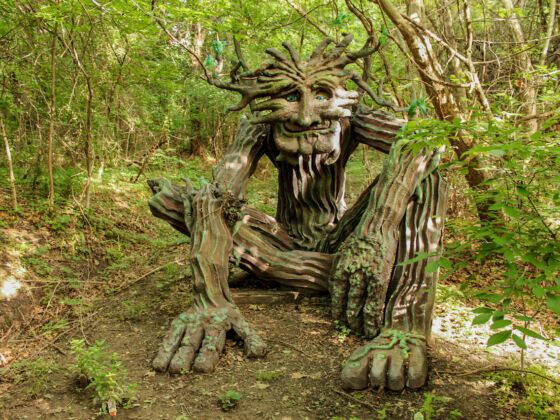
Pagan Traveler: The Mysterious Origins Of The Green Man

11/24/09  Print This Post Print This Post    6 Comments   Popular   Written by Marc Latham
  • Stumble It
The icon of several religions, the Green Man’s history spans from medieval churches to hippies in the 60s.

As a born-again pagan hoping to keep the UK green, the Green Man seemed a perfect place to start.

The forest symbol was, of course, a part of British heritage and a defender of green spaces. When I started my research into the motif, some of the literature supported my original image of the Green Man; these books generally focused on his spirit.

The “Green Man” forest spirit has traveled the world for centuries, and seems to have adapted to local cultures as the centuries have passed.

However, another line of research concentrating on archaeology and history declared the Green Man a well-traveled universal religious icon, brought to the UK by Christianity. I was intrigued by the split personality of the Green Man, and will describe what we know about an archetypal symbol that continues to influence and inspire cultures around the world.

The “Green Man” forest spirit has traveled the world for centuries, and seems to have adapted to local cultures as the centuries have passed. Some of the best evidence of the phenomenon today is interestingly found on medieval churches in France and England. But in ancient times, this pagan God of nature lived not only among Celtic forest tribes in northern Europe, but also among great architectural empires such as Egypt, Greece and Rome.

So how did the Green Man find itself becoming a common church decoration, and what do we now know about its origins? The trail appears to stretch from Eastern Asia across to North America.

The Continental Connection

One theory about the origins of the Green Man in the West is that it is a pagan artifact derived from the ancient Celts’ worship of the head. The Celts regarded the head as the seat of the soul.

Interlaken / Photo: tm-tm’s photostream

An armlet found in a Celtic grave at Rodenbach in Germany, dating from around 400 BC, provides material evidence to support a link between the Celts and later representations of the Green Man, as it has a decoration that culminates in an abstracted male head wearing a crown of yew-berries.

As Christianity later spread across old Celtic territory, pagans who converted to the new religion may have influenced the adoption of the nature symbol by the church.

The first record of such a figure in a Christian setting is on the fourth century tomb of Abre in the Church of Saint-Hilaire-le-Grand in Poitiers, France. Abre was the daughter of Saint Hilaire, who was a high-ranking pagan that converted to Christianity and became a renowned figure in the church.

Christianity may also have become accustomed to the foliate heads through the recycling of pagan ornaments, as many old temples and statues were adopted by churches. For example, in the sixth century, as the Franks took power in North-Eastern Europe, Archbishop Nicetius of Trier maintained several foliate head figures in the cathedral church he rebuilt, despite their origination as a pagan symbol.

A few centuries later, the foliate heads became a common feature on continental medieval churches. They then crossed the channel into Britain with the Normans, but remained largely unnoticed until being named Green Men by Lady Raglan in 1939.

After their naming, a common theory for the origins of the foliate heads was that they had been passed down from ancient British pagan tradition, along with the Jack-in-the-Green May Day figure.

However, an exhaustive historical study by Dr. Roy Judge found no evidence of the Jack-in-the-Green before the eighteenth century, centuries after the Green Man foliate heads crossed the channel into British churches.

An Asian Heritage?

Although the Green Man may be a descendant of old Celtic and European culture, there is another line of thinking that traces its origins to south and east Asia.

Photo: stevecadman

Renowned Green Man researchers such as Mercia MacDermott and Mike Harding argue that the most common representation of the European Green Man, which disgorges vegetation from its mouth, bears a striking similarity to statues of the kirttimukha and makara in India.

Harding also found a similar design in the Apo Kayan region of Borneo, and thinks the motif traveled along the trade routes linking Europe and Asia.

Another motif that links the East and Europe at that time is the Three Rabbits/Hares figure which often appears in churches alongside the Green Man. Harding explains:

“This second motif consists of three rabbits, or hares, chasing each other in a circle, with each animal sharing an ear in much the same way as six foliate heads on the roof boss in Chichester Cathedral each share an eye with their neighbours. The earliest known example of this triple rabbit motif occurs in Buddhist cave paintings, dating from the late 6th/early 7th century, in Dunhuang, on the edge of the Gobi desert in western China.”

As with the Green Man, there is no written record of what the Rabbits/Hares motif symbolizes. Chris Chapman offered the following theory:

The hare is strongly represented in world mythology and from ancient times has had divine associations…in Christian contexts, the three hares may be associated with the Virgin Mary in her role in the redemption of mankind. This might explain why a Three Hares boss is often juxtaposed in western European churches with a boss of the Green Man, perhaps a representation of sinful humanity.

New Homes for the Green Man

Although ecclesiastical Green Man figures peaked in medieval times, they found a new home on secular buildings around the world during the Victorian era.

The Green Man’s resurgence gathered pace in the twentieth century, starting with its naming by Lady Raglan, and then becoming an environmental totem for the counter-culture movement that emerged during the 1960s.

The Green Man now looks very healthy for a 2500 year old global traveler, but whether this is one Green Man archetype that has traveled the world, or many similar designs that have emerged like pyramids in the Jungian collective unconscious, is still unclear.

We may never know the truth.

What do you think about the history of the Green Man and his cultural influence? Share your thoughts below.


  • Stumble It

About the Author

Marc Latham

Marc Latham spent his 20s travelling the world and learning a bit about life, and his 30s learning in university and travelling a bit more. After graduating with a PhD in 2005 Marc has since been freelancing, learning and travelling out of the Greenygrey website, and has had two books published by Chipmunka.

6 Comments... join the discussion!

  • Ian MacKenzie replied on November 24, 2009

    Very interesting article! It made me immediately think of the “Ents” – the giant tree creatures in Lord of the Rings. I’m willing to bet Tolkien was thinking of the Green Man when we created them

    http://en.wikipedia.org/wiki/Ent

    (Report comment)

    ↵ Reply
  • Marc Latham replied on December 1, 2009

    Cheers Ian. Let’s hope the Green men and women win the battle in Copehhagen next week. May the Ents be with them!

    (Report comment)

    ↵ Reply
  • TY replied on December 12, 2009

    The Green Man is also found in the Islamic tradition… he’s called Khidr.

    (Report comment)

    ↵ Reply
  • Marc Latham replied on December 12, 2009

    Thanks Ty. Yes, indeed: http://khidr.org/

    (Report comment)

    ↵ Reply
  • sheila replied on February 14, 2010

    Is The Green Man and Pan one and the same, I wear a Green man pendant and I have had a few people saying Oh I love your Pan pendant, I don’t believe my Green man is Pan, Pan was half goat from what I recall, or am I wrong Please help me out. blessings Sheila ann

    (Report comment)

    ↵ Reply
  • Marc Latham replied on February 15, 2010

    Hi Shiela, Pan was a Greek god, and is one of many green man figures that are associated with the male side of nature and fertility in world mythology.

    You’re right: Pan was half goat, and is thought to have inspired the first imagery of the horned devil created by Middle-Age Christians:
    http://en.wikipedia.org/wiki/Pan_(god)

    In Celtic mythology there is Cernunnos, who was also a horned god, and is thought by some people to be an inspiration for the Green Man tradition in northern Europe: http://www.nlpagan.net/index.php?id=greenman.

    The horned god is a Wicca deity: http://en.wikipedia.org/wiki/Horned_God

    Hope that helps, cheers.

    (Report comment)

    ↵ Reply

Leave a Comment

Get Matador in your inbox and around the web.

Sign up for our FREE weekly newsletter.


View full list of RSS feeds

Jump To Category:


Popular Stories on Matador

Expat Artists: How Living Abroad Facilitates The Creative Life

There's the sense of creative abandon abroad, the liber... 

Calculating the Human Speed Limit

Just how fast could human sprinters go? Matador talks t... 

Unplugged: Breaking Your Television Addiction

Chances are there's some life wasting going on behind y... 

Review: TELL ME MORE® French

Candice Walsh reviews some innovative

The 5 Sports You Should be Watching

Forget baseball. How about Finnish wife carrying instea... 

The Happy Planet Index: Finding Happiness Without Destroying the Earth

Happiness and long life expectancy don't have to cost t... 

The Dharma Shack Chronicles

Notes from Summer 2009 in the Dharma Shack, a lean-to a... 

Essential Cookbooks for the Culinary Traveler

The fastest way into the heart of a culture might very ... 

10 Words and Phrases We Never Want to See in Travel Writing Again

These words and phrases have been used too much in trav... 

Matador Launches Its Flickr Photo Pool

Add your photography to the Matador community's portfol... 


Focus


Editor Blogs

Friends