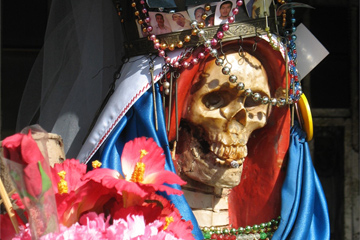
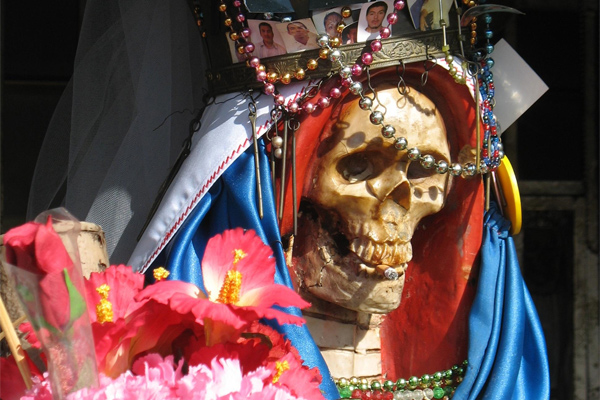
Saint Death Decked Out — Photo: Wikipedia
In this month’s National Geographic, Alma Guillermoprieto wrote an interesting feature story about the growing trend in Mexico (fueled primarily by the drug violence and economic difficulty) of swapping the more traditional Catholic saints with a series of more unusual and macabre spiritual figures (for example, a cheerful little fellow called “Saint Death“).
Now some of you might be thinking, “Hey, doesn’t praying to Death seem a little at odds with… you know… Christianity?” I mean, wouldn’t Jesus get a little pissed?
Then again, some people call Catholicism a polytheistic faith anyway (with the Holy Trinity and hundreds of saints). So maybe Jesus won’t mind saying a little prayer to the Grim Reaper.
I’m kidding, of course. However, the article does raise an interesting question for me: How does a highly religious population react when facing immense and violent hardship?
The Effects of Hardship
Do religious people, when faced with a crisis of faith, look for just about anything else to replace their cracked belief system?
I guess I can see the appeal. You have a highly religious population. Many feel they’ve been let down by the primary figures of their religion (for not answering prayers), but they don’t want to throw the old belief system out completely (because as an individual you might feel you still need something to hold on to, or maybe you fear being ostracized… who knows.)
So many seem to swap out the old theology for something novel, something a little mysterious, but something that still seems to fall within the blurry lines of the old belief system (especially if there are enough other people who buy into it to make you feel like part of a flock).
While I’m using what’s happening in Mexico as an example, an en masse change in beliefs seems to be a common occurrence throughout history when uncontrollable “bad stuff” happens.
Between the Black Plague and the Holocaust, huge changes have taken place in religious make-ups. Some stopped believing, some started believing more fervently, and others abandoned their old systems altogether for something new.
How do you feel hardship affects religious belief on a large scale? Share your thoughts.
About the Author
Related Posts
5 Comments... join the discussion!
-
-
@Reginald – hmm, nice word play. yeah, i guess for a lot of people that’s true.
↵ -
Terrific post, Alex! However, I’d like to suggest another alternative: maybe hardship causes one to examine their core set of beliefs and adjusts them accordingly, without completely abandoning their faith. While I have met individuals who have turned to something new, or abandoned their faith altogether, I have also met individuals who have struggled mightily with the existential question you propose and have been comfortable living with the dissonance between what their faith teaches and their personal experience. These individuals have neither become fanatical believers nor atheistic, but travel a “middle road” of living spiritually yet firmly based in every day reality. Somehow it works for them.
Happy to see you here, Alex! Keep up the great work–
↵ -
@cdkleitch – Thank you for the kind words. Yeah, i think that’s ultimately the point. That people are loathe to drop their old beliefs completely, and so will adapt them to make some sort of sense.
↵ -
Alex – this is a really interesting question…and I would have to agree that while people often question their faith during times of hardship it is more realistic that people adapt and morph their beliefs to the changing world than abandon them altogether.
I’m living in a fairly conservative Mexican city, and the juxtaposition of Christian iconography and death seems very natural here. Everywhere you go from the local market to the taxi-bus, to the neighbourhood church…there is imagery of death (whether it is a crucified Jesus or a Catrina skeleton).
It seems to me, that Santo Muerto is another syncretistic element of Mexico’s Catholic identity appropriating indigenous beliefs. LIke the Virgin of Guadalupe representing the indigenous Mother Goddess or All Saint’s Day reclaiming the Aztec Day of the Dead celebration. It’s really amazing how these beliefs have been maintained through Mexico’s history of colonization and revolution.
My theory would be that Santo Muerto is a new manifestation of a very old spirituality that is resurfacing in response to the rise in violence affecting Mexico today. A manifestation that will no doubt find it’s way into the fabric of Mexico’s colorful and ever-changing take on the Catholic faith.
Thanks so much for this article!
Cheers,
BethThanks again for this art
↵


