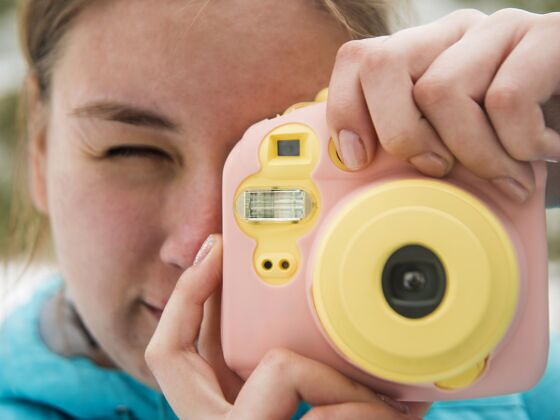
Photo: Brandon Christopher Warren
If so, you might be suffering from Gadget Block – a terrible modern affliction of the geographically minded. You’re so obsessed with recording your experiences that the recording itself is your focus. You’re trying to recapture experiences with the aid of images, notes, tweets and texts – but you can’t recapture something you didn’t have in the first place.
If you think you might be afflicted, that’s not surprising – because we all are. We’re children of the Information Revolution, and there’s never been a generation so buried under “experience-enhancing” technology. We’re so surrounded by shiny things that we can barely see daylight.
There is a cure, but it’s not for the faint-hearted.
Experience First, Record Later
Cameras can’t make memories. A photograph is only a two-dimensional image and even the best photo can’t capture the richness of what our eyes actually see.
Let’s try an experiment. Look out your window for ten seconds, then quickly write down what you saw. Chances are that you’ll jot down a more complicatedly biased story than any camera in the world is capable of telling. You’ll care about some elements more and your gaze will favor them over less ‘interesting’ stuff. Half the view is sky? Who cares – look at that plane!
This explains that special disappointment that comes from looking at a photo you took and marveling at how surprisingly small the subject looks. Seen in person, your mind’s eye inflated it, made it solid and whole. The camera hasn’t – and the result is tiny and flat.
The way around this is to see first and record later. Make a conscious effort to first take in a scene yourself, to forget digital posterity for a minute (or two, or three) and really look, hear, smell, and touch.
Use your non-biological technology as a backup, nothing more. Delay the moment you reach for your gadget as long you feel comfortable – and then just a little bit longer. And keep doing that. Bit by bit, you’ll (re)learn to rely on your own senses first.
Remember: if you’re seeing something for the first time through the lens of your camera, you haven’t truly seen it yet.
Sip The World Through A Straw
But what if those delaying tactics aren’t working? Maybe the problem is overconsumption.
When you get back from trotting the globe and you sift through your mixed media in search of those golden nuggets to treasure, how much do you truly use? How much is wheat and how much chaff?
See if you can work out a daily average: numbers of words used, number of photos taken. Got that? Now double it. That number is your new upper limit. So let’s say you’ve decided your average is 20 usable photos a day. Doubled, that’s 40 photographs, no more, that you’re allowing yourself every day of your next travel adventure. (No, you can’t give yourself extra by deleting unwanted photos on the fly – that’s cheating. It’s 40 clicks of the shutter, period).
What will this painful, maddening exercise do? It’ll make your photos a limited resource. You’ve nullified one of the main reasons to switch to digital – deliberately! Yes, you’re nuts, but you’re also forcing yourself to photograph only the most important things, and to do that, you have to know what they are. You have to see them first.
Deny Yourself
Think the last suggestion sounds like torture? Maybe it’s time for a hardcore intervention. The extreme cure for Gadget Block is simple: you leave everything behind. No camera, no notebook, and no sneakily using your iPhone. Absolutely…nothing.
It’s easy to see why this is an appalling idea. No reminders, no aids, nothing to show the folks at Christmas when everyone’s too full of food to escape your slideshows. But there is a way to keep those memories fresh in your mind – and it’s the oldest one in the book.
Congratulations! You’re about to become an oral historian, following in Homer’s footsteps (the Greek one, of course) – and it’s in the recital of your adventures that you’ll be recording them, lodging them deep into your memory and into the imaginations of others.
See it, remember it, perform it to others – keeping your experiences alive in the telling of them. It’s not just epic poets that advocate such an approach to learning – as part of his 7 Habits of Highly Effective People, Dr Stephen Covey recommends teaching skills to others to truly master them yourself.
For the sake of your memories, would you leave all your gadgets behind?
About the Author
Related Posts
11 Comments... join the discussion!
-
-
I am a writer and a photographer, but when I consider the key moments of my life, no pictures were taken. It’s important to fully live in the moment, rather than always trying to record it for posterity. Nice post!
↵ -
I relate to this as well… in my case, I spend the initial part of the trip just absorbing, and then bring in the camera later on. It’s hard though… I’m tempted to bring the camera with me everywhere.
↵ -
I have the reverse problem. I lug all the camera gear and then get caught up in where ever I am and never take the camera out of the case. If it were not for snapping a few shots with my iPhone i’d have no pictures at all. On My last two trips I did not use my “real” camera or Flip once. I can’t seem to master being there and recording it at the same time. Maybe I need a memory valet. Someone to follow me around and record my experiences for me. Mike are you available? There’s whiskey in it for you…
↵ -
Thanks for the post, Mike. I find myself preaching media moderation less than I practice it. Living in the moment is so easy to say but difficult to do. It’s often an ironic joke that the moments we most want to remember end up as fuzzy memories because we spend all our time taking pictures of it and less time actually involved in it.
↵ -
A good suggestion — a scary suggestion — to limit yourself every day. As it turns out, I usually plumb forget to take pictures before it’s too late. In a way, I suppose that’s a good thing; I’m too absorbed in what’s happening to even think to take out my camera.
↵ -
Thanks, Alex.
That’s a good thing about sunsets – they give you the chance to do that. And there’s no way of truly accurately recording the experience of watching a sun slowly blaze its way under the horizon, turning the sky every color in existence. Even timelapse doesn’t capture that sense of the world turning underneath you…
↵ -
I tend to take photos of everything because my eyesight is bad enough that I like seeing them in retrospect on my computer screen. Of course, I could just wear glasses. But then I’d have no excuse to keep taking all the photos!
In all seriousness: of late, I’ve left behind bulkier cameras in favour of my smaller point&shoot. It’s surreptitious, takes great photos and I can hold up and snap in a quick second. I don’t find it interferes with my memories and/or enjoyment of what I’m doing, and as I’m really bad at note-taking/journal writing, the photos are pictorial proof of where I was and often remind me of what I was feeling too.
↵ -
What a great observation, Mike – definitely something I can relate to on occasion! I really like the idea of relying more on one’s more warm and squishy recording and playback apparatus. It’s a rare picture that’s worth a thousand words from someone who was there with an emotional connection.
I have to confess, I find the prospect of limiting button-presses rather frightening though!
Something that we’ve found is that, when you don’t let it get in the way of other things, the photography aspect actually really enhances the experience. When, in addition to soaking up environments, we’re keeping our eyes peeled for fascinating little details – flaking layered colours of paint on an old rotting door, a particularly amusing-looking gargoyle, a rusty stairwell – the world around us becomes much richer. We force ourselves to notice minutiae as well as the big stuff, and it adds an extra layer of experience.
So I guess, with everything, it’s all about balance!
↵ -
i don’t think i could leave all my gadgets behind for the sake of my memories, but i really appreciate these tips for seeing with more clarity and experiencing the moments we seek to capture.
↵


